 Dimitri
 Europe is facing a critical jet fuel shortage as of April 2026, with the International Energy Agency warning that supplies could run out within six weeks — and the ripple effects are already reaching Canadian fuel markets, airline routes, and auto repair shops from coast to coast.
What's Happening in Europe Right Now
The crisis traces back to the ongoing conflict in the Middle East and the closure of the Strait of Hormuz to commercial shipping. The Strait is a chokepoint through which approximately 20% of the world's seaborne petroleum passes, with roughly two-thirds of that supply historically bound for Europe. When that corridor became impassable for commercial tankers in early 2026, European jet fuel reserves began a sharp decline.
According to the International Energy Agency's April 16, 2026 warning, several European countries face the prospect of jet fuel exhaustion within six weeks if alternative supply routes are not established quickly. The EU responded on April 21, 2026, announcing emergency plans to boost jet fuel imports from the United States — a temporary stopgap that analysts say will not fully close the gap before summer travel season peaks.
Scandinavian carrier SAS cancelled more than 1,000 flights in April 2026 as a direct result of fuel allocation shortfalls. Ryanair CEO Michael O'Leary has signaled potential capacity reductions affecting summer service across multiple European routes.
How This Hits Canadian Drivers and Mechanics
The connection between European aviation fuel and your mechanic's garage might not be immediately obvious — but the links are real and growing.
Refined petroleum supply chains are globally integrated. When jet fuel refining capacity in Europe is diverted or disrupted, the supply of other refined products — including diesel and premium gasoline — faces upward price pressure worldwide. Canadian fuel distributors source refined product through international markets, and price signals from Europe travel quickly to pumps in Toronto, Calgary, and Halifax.
WestJet has already reduced flight capacity by 1% in April, 3% in May, and a projected 6% in June 2026. Air Canada has suspended six routes effective June 1, 2026. Jet fuel prices in Canada have spiked to approximately $1.92 per litre at wholesale — a level that pushes ticket prices up by $135 to $180 per domestic round trip. Fuel surcharges are being passed directly to Canadian consumers.
For mechanics, the practical impact arrives through two channels. First, fleet operators — delivery companies, rideshare platforms, and logistics firms — are scrutinizing vehicle fuel efficiency with unusual urgency. Customers who were already deferring maintenance are now actively asking about fuel economy improvements: tire pressure optimization, air filter replacement, fuel injector cleaning, and engine tuning. Second, diesel-powered vehicles used in commercial transport face tighter operating margins as diesel prices track the global disruption.
What This Means for Your Vehicle
Canadian drivers are already seeing higher pump prices linked to the Iran-Strait of Hormuz supply disruption. The Canada Energy Regulator tracks refined petroleum prices weekly — as of mid-April 2026, gasoline prices in Ottawa are approaching $2.00 per litre, levels that concentrate the mind on vehicle efficiency.
A few maintenance actions that directly affect fuel costs:
Engine air filters: A clogged filter forces the engine to work harder, increasing fuel consumption by up to 10% according to Natural Resources Canada estimates. Most mechanics recommend replacement every 15,000 to 30,000 kilometres.
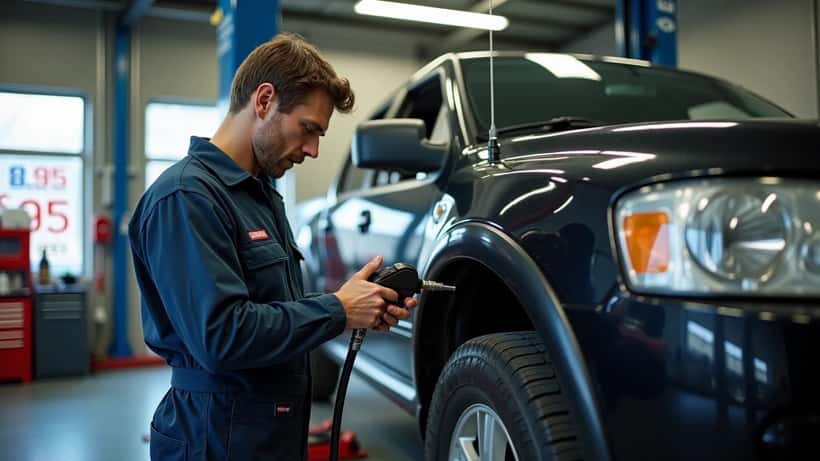
Tire pressure: Under-inflation by 10 PSI increases fuel consumption by approximately 3 to 4%. With fuel at current prices, that translates to real money over a month of driving.
Oxygen sensors: A faulty O2 sensor can reduce fuel economy by up to 40%. It's one of the most cost-effective repairs relative to the fuel savings it delivers.
Engine oil: Running the correct viscosity as specified by your manufacturer — not necessarily the cheapest option — keeps internal friction low and protects fuel efficiency, particularly in cold Canadian climates.
When to Call a Mechanic vs. Wait
Not every fuel economy concern requires an immediate shop visit. A check engine light, however, should never be ignored — it may indicate a sensor fault that is actively degrading your fuel consumption. If your fuel economy has dropped noticeably (track it through your trip computer over two or three fill-ups), that is a signal worth investigating.
For fleet managers and small business owners operating vehicle pools, a scheduled audit of fuel-related maintenance items — filters, sensors, tire condition, and wheel alignment — makes particular financial sense when fuel costs are elevated. A licensed mechanic can assess your vehicle's current fuel efficiency profile in under an hour and prioritize repairs by return on investment.
Similarly, if you are planning a vehicle purchase and fuel costs are a factor, a pre-purchase inspection by a certified mechanic will identify whether a used vehicle's engine has hidden wear that could compromise real-world fuel economy versus the advertised rating.
See also: Ottawa Gas Prices Near $2/L: How to Protect Your Family Budget
What Experts Recommend
Automotive technicians across Canada report an uptick in customers asking specifically about fuel efficiency improvements. The message from most certified mechanics is consistent: the highest-return actions are the basics — tire pressure, air filter, and making sure no check engine codes are active. After those, more advanced diagnostics like fuel injector testing and throttle body cleaning offer incremental gains.
For drivers who have been delaying scheduled maintenance, the current fuel price environment may make that appointment more financially compelling than it was six months ago. A vehicle running at its mechanical best simply uses less fuel — and at $1.90-plus per litre, that difference adds up over a Canadian winter and spring.
If you are unsure where to start, a licensed mechanic can perform a comprehensive vehicle health check and identify which maintenance actions will have the most direct impact on your fuel costs. Expert Zoom connects Canadians with certified automotive professionals who can assess your specific vehicle and driving pattern.
Note: Fuel price projections and supply estimates cited are based on IEA and industry reporting from April 2026. Market conditions are subject to rapid change. Consult a certified mechanic for vehicle-specific advice.
