 Maya MacDonald
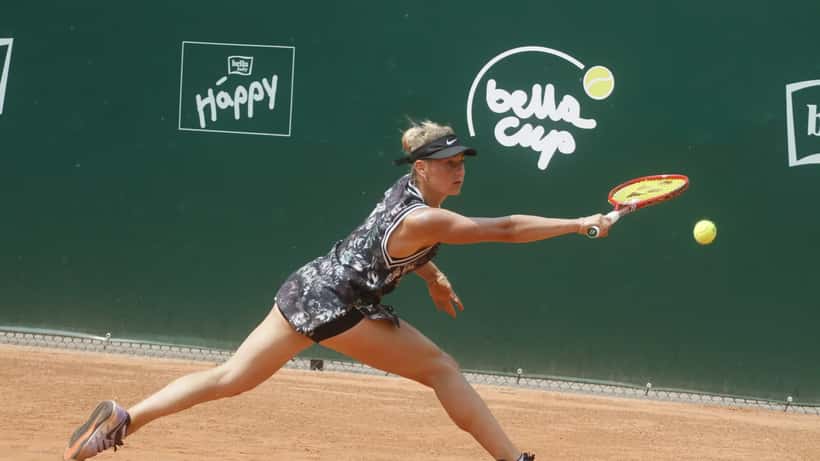
The 2026 tennis season has become an injury chronicle for Marta Kostyuk. Since January, the Ukrainian world No. 12 has logged a confirmed ligament tear in her left ankle at the Australian Open, a hip injury so severe she could not walk after winning the Madrid Open in May, a second ankle withdrawal that forced her out of Queen's Club in June, and now a last-minute exit from the Washington Open — where she arrived as the third seed. Four setbacks. One calendar year. The pattern raises a question every recreational tennis player in Canada should take seriously: at what point does "playing through pain" become a medical mistake?
What Kostyuk's 2026 Season Reveals About Ankle and Hip Injuries
Kostyuk began 2026 in genuine form. She reached the Brisbane International final with three Top 10 victories, then sustained a lateral ankle ligament tear — the most common acute injury in tennis — during the Australian Open in Melbourne. Initial reports suggested she would rest and recover. Instead, she returned weeks later, won the WTA 250 title in Rouen in April, and then claimed the WTA 1000 Madrid trophy in May. After the Madrid final, she disclosed she could barely walk due to hip pain, though imaging ruled out a serious structural problem.
By June, Queen's Club was off the schedule — a right ankle flare-up this time. The Washington Open withdrawal in August followed.
According to the Canadian Academy of Sport and Exercise Medicine (CASEM), the pattern Kostyuk is experiencing — what clinicians call a "kinetic chain cascade" — is well-documented in racquet sports. An unresolved ankle injury forces compensatory loading up the leg, increasing strain on the knee, hip flexors, and lumbar spine. The hip pain Kostyuk described after Madrid is consistent with this cascade: the body redistributes force from a compromised joint onto structures above it, until those structures signal their own distress.
The Expert Angle: Why Elite Athletes Keep Playing Through Injury (And Why You Probably Shouldn't)
Professional tennis players operate in a financial and competitive environment that creates powerful incentives to return too soon. Ranking points expire, wildcards are finite, and sponsorship contracts contain performance clauses. Kostyuk has been transparent about her decision-making — she finished the Madrid final despite significant hip pain because the ranking prize was too valuable to forfeit.
Recreational athletes rarely face those pressures, yet sports medicine specialists across Canada report that their most common patient profile is not the elite competitor but the 35- to 50-year-old club player who re-injured an old ankle or knee because they waited two or three weeks after a sprain and resumed play too quickly.
"The mechanism is almost identical whether you're playing for WTA points or a Saturday morning club ladder," says the standard clinical framing used by CASEM-registered practitioners. Ligament integrity cannot be assessed by swelling alone. Swelling typically subsides within five to seven days — but the structural repair of a partially torn lateral ligament takes six to eight weeks, depending on the grade of injury. The surface appearance of recovery and the biological reality of recovery are two very different timelines.
Concrete Case: What Happens When a Toronto Club Player "Rests for a Week"
Consider the following scenario — composite but clinically representative of what sports medicine clinics in Ontario see regularly.
A 34-year-old recreational player rolls their left ankle during a Saturday match at a Toronto tennis club. The joint swells, they ice it, and they hobble home. By the following Thursday, the swelling has reduced by about 70% and they can walk without significant pain. They return to the court the following Saturday — eight days after the injury.
Here is the if/then logic a sports medicine specialist would apply: if the original injury was a Grade 1 sprain (ligament stretched, no significant tearing), return at eight days is medically reasonable with appropriate bracing. If, however, the injury was a Grade 2 sprain (partial ligament tear, which is far more common than patients assume — accounting for approximately 40% of all ankle sprains in sports medicine literature), then returning at eight days without imaging or physiotherapy assessment more than doubles the risk of developing chronic ankle instability within 12 months.
Chronic ankle instability means recurrent sprains, reduced proprioception, and — critically — the same kinetic chain cascade that Kostyuk is experiencing at the elite level: compensatory hip loading, altered gait, and eventually a secondary injury that sidelines the player for months rather than days.
The numbers matter here. A Grade 2 ankle sprain treated with early physiotherapy (starting in the first week, not after "rest") and a structured return-to-sport protocol has a recurrence rate of roughly 12% at 12 months. The same injury managed with rest-and-wait has a recurrence rate closer to 30%. That difference — 12% versus 30% — translates directly into whether you finish the summer season or spend it in a boot.
Three Red Flags That Mean You Need a Specialist — Not Just Rest
Sports medicine practitioners across Canada consistently identify three presentation features that should trigger a specialist consultation rather than self-managed rest:
1. Pain that persists beyond the "golden window." In a true Grade 1 sprain, pain-free walking should be achievable within four to five days. If you are still limping or compensating your gait at day seven, the injury grade is almost certainly higher than you assumed. An assessment — and almost always an ultrasound or MRI — is warranted.
2. Recurrence within the same season. Kostyuk's trajectory from January (ankle) to June (ankle again) is the elite version of a pattern clinicians see every summer in Canadian recreational sport. A second ankle injury in the same joint, in the same season, is not bad luck — it is a structural instability problem. The 2026 tennis season alone has seen multiple high-profile player withdrawals at the Strasbourg Open and Washington Open for this reason. One sprain is an injury; two in the same joint in the same season is a diagnosis.
3. Pain that migrates upward. If you start the season with a sore ankle and end it with hip tightness or lower back soreness, your body has been compensating for an unresolved problem at the foundation. This is the Kostyuk pattern in miniature. The hip pain she disclosed after Madrid was almost certainly not a new injury — it was the downstream consequence of an incompletely resolved ankle that had been loaded through four months of elite competition.
What a Sports Medicine Consultation Actually Looks Like in Canada
Many Canadians assume that sports medicine visits require a referral or are an out-of-pocket expense. In most provinces, this is only partially true. CASEM-registered sports medicine physicians — who hold specific post-graduate qualifications in sport and exercise medicine beyond a general medical degree — are accessible through provincial health plans in many contexts. An initial consultation for an acute sports injury is typically OHIP-covered in Ontario, for example, when ordered through a GP.
The value of that consultation, particularly for ankle injuries, is twofold. First, clinical assessment (including specific stress tests like the anterior drawer test and talar tilt test) can accurately grade the injury without imaging in most cases. Second, a physiotherapy referral with a specific return-to-sport protocol is far more effective than rest alone — and far less expensive than the downstream costs of chronic instability, which can include bracing, repeat physiotherapy cycles, or in severe cases, surgical stabilization.
Kostyuk's repeated returns-and-reinjuries in 2026 are not a story about poor medical management at the elite level. Elite athletes have access to imaging, team physicians, and rehabilitation staff that recreational players do not. Her story is a story about what happens when the competitive pressures of professional sport collide with the biological timeline of ligament healing — a collision that recreational players can avoid precisely because they do not face those same pressures.
When to Book the Appointment
If you play tennis, padel, squash, or any other racquet sport more than twice a week, the 2026 professional tennis injury wave — Kostyuk, the Strasbourg withdrawals, the Washington Open absentees — is a useful prompt to calibrate your own risk tolerance. The questions to ask yourself are simple: Is this my second ankle issue in twelve months? Am I still compensating my gait more than five days after the injury? Have I developed hip or lower back tightness that followed a lower-limb injury earlier in the season?
If the answer to any of those questions is yes, a sports medicine consultation is not overreaction — it is exactly the kind of early intervention that prevents the multi-month sideline that Kostyuk has been managing since January.
A specialist does not just diagnose the injury. They map the kinetic chain, identify the compensations your body has silently developed, and design a return-to-play protocol calibrated to your specific grade of injury, your age, your activity level, and the demands of your sport. That assessment is what separates a twelve-percent recurrence rate from a thirty-percent one.
For recreational players in Canada, the lesson of Kostyuk's 2026 season is available at a fraction of the cost she has paid to learn it.
This article is for informational purposes only and does not constitute medical advice. If you are experiencing pain or injury, consult a qualified healthcare professional for diagnosis and treatment.
