 Patrick Roy
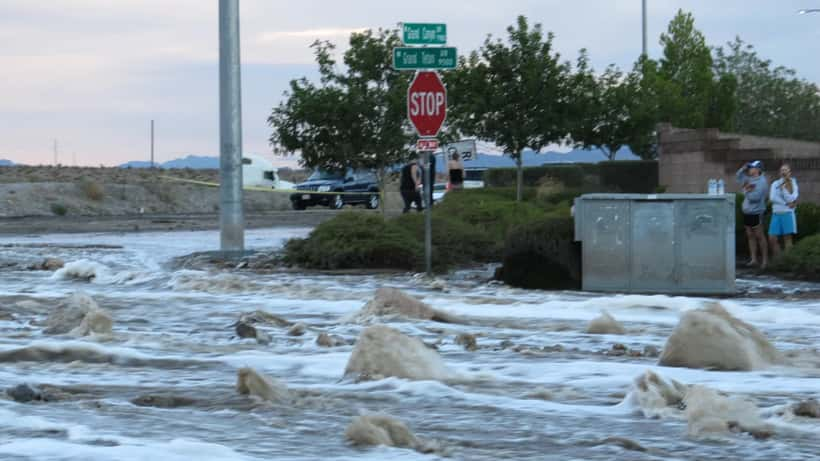
Flash floods struck the Las Vegas Valley on October 12, 2026, inundating residential streets, parking garages, and ground-floor units across the metro area — leaving thousands of homeowners scrambling to assess damage before the desert heat bakes moisture into their walls. The National Weather Service recorded over 2.7 inches of rainfall in under three hours, surpassing the city's average October total in a single storm. For Canadians who own vacation properties, investment condos, or snowbird retreats in Nevada — a surprisingly large group given Las Vegas's draw as a winter escape — the event raises an urgent question: who pays, and what do you do first?
What the Las Vegas Flooding Actually Looked Like
Surveillance footage shared by Clark County Emergency Management showed stormwater surging through the LINQ Promenade, filling underground parking structures along Paradise Road, and breaching the entryways of several residential complexes near Flamingo Boulevard. First responders conducted over 40 water rescues. The flooding was driven by a slow-moving low-pressure system that stalled over the Spring Mountains — unusual for October, when Las Vegas typically sees its driest weather.
Clark County officials declared a local emergency, activating mutual-aid agreements with neighbouring jurisdictions. FEMA representatives confirmed an initial assessment is underway, though federal disaster declarations can take days to weeks. In the meantime, property owners are on their own to document damage and navigate their insurance policies — a process that catches many Canadians flat-footed because U.S. flood insurance rules differ sharply from what most are used to back home.
The Expert Reaction: Why Standard Policies Don't Cover This
The most important thing Canadian snowbird property owners learn too late is that homeowners insurance — whether a U.S. policy or a Canadian policy with a riders clause — almost universally excludes sudden flood damage caused by external surface water. In the United States, flood coverage is administered primarily through the National Flood Insurance Program (NFIP), a separate federal policy that must be purchased independently and has a 30-day waiting period before it takes effect.
According to data published by the Federal Emergency Management Agency (FEMA), fewer than 5% of U.S. homeowners carry NFIP coverage, and the numbers are even lower in desert states where flood risk historically felt remote. Las Vegas's rapid urban development has dramatically reduced the desert's natural absorption capacity — paved surfaces now cover areas that once acted as natural sponges — making flood events both more frequent and more severe than models from two decades ago predicted.
For Canadians holding U.S. real estate, the gap is doubly acute. Most Canadian travel insurance packages and snowbird policies focus on medical emergencies and trip cancellation, not property damage. Your provincial home insurance policy in Ontario or British Columbia almost certainly does not extend to your Nevada condo. If you own the property through a corporation or holding company — a common structure for tax efficiency — the insurer may apply commercial property rules, which carry their own exclusions and sublimits.
A home improvement specialist or public adjuster familiar with cross-border property claims can identify coverage you didn't know you had, including potential claims under a condominium association's master policy, builder's risk riders if the unit was recently renovated, or umbrella liability extensions. But they need to be engaged quickly: most U.S. insurance policies require written notice of loss within 24–72 hours of the event.
A Concrete Scenario: The Snowbird Condo on the Wrong Floor
Consider a retired couple from Calgary who purchased a ground-floor condo in Henderson, Nevada in 2023 as a winter base. They carry standard U.S. homeowners insurance through a Nevada-based carrier but did not purchase an NFIP flood rider — it wasn't offered proactively and they didn't ask. The October 12 flood deposits 14 inches of stormwater through their front door, damaging hardwood flooring (replacement cost: approximately US$8,500), drywall to a height of two feet (US$4,200 in remediation), kitchen cabinetry (US$6,800), and a central HVAC unit located on a ground-floor mechanical pad (US$9,500). Total: approximately US$29,000 in direct losses.
Without flood coverage, their homeowners policy pays: $0 for water intrusion from external surface flooding. Their condominium association's master policy covers common areas (hallways, pool, parking structure) but not individual unit interiors — a distinction written into virtually every HOA master policy in Nevada.
If they had purchased an NFIP dwelling policy at the standard rate for their flood zone (Zone X, lowest risk, approximately US$700/year), they would be entitled to up to US$250,000 in building coverage and up to US$100,000 in contents coverage. Their net out-of-pocket loss would drop to the standard deductible of US$1,000–2,000.
The if/then: if your Las Vegas or Henderson property is ground-floor or below and you do not hold an NFIP policy, you bear 100% of flood remediation costs. Even an inspection by a licensed contractor — required before any drywall is closed up — runs US$400–800 in Las Vegas right now due to demand surge.
For Canadians who discover this gap today, the priority is immediate: document everything with timestamped photos and video before any drying or cleanup begins, contact your U.S. insurer in writing within 24 hours even if coverage seems unlikely, and reach out to your Canadian insurance broker to determine whether any cross-border riders apply. A home improvement consultant with flood remediation experience can also advise on whether mould mitigation — which must begin within 24–48 hours to prevent secondary damage — is worth proceeding with out-of-pocket while the insurance question resolves.
See also: Spring Flooding 2026: What Canadian Homeowners Must Know and Toronto Rain Causes Basement Flooding: Expert Remediation Guide.
What To Do in the Next 72 Hours
Whether you are in Las Vegas managing the property directly or tracking the situation from Canada, the action sequence matters:
Within 24 hours: Notify your U.S. insurer in writing (email with read receipt). Photograph all visible damage from multiple angles before moving anything. If the building is safe to enter, run dehumidifiers — mould colonization begins within 24–48 hours in wet drywall, and remediation costs can triple once mould is present.
Within 48 hours: Contact a licensed Nevada contractor for a documented damage assessment. Request a scope of work in writing — this document is essential for both insurance claims and potential litigation. If your condo association has not yet filed a claim under the master policy, escalate in writing.
Within 72 hours: If your insurer denies coverage, request the denial in writing citing the specific policy exclusion. This denial letter is the foundation for any escalation to a public adjuster or legal challenge. Canadian snowbirds who purchased their property through a real estate lawyer should loop them in now — jurisdiction matters for enforcement of insurance contract obligations.
The good news: FEMA's disaster declaration process, if triggered for Clark County, could open access to low-interest disaster recovery loans through the Small Business Administration (SBA) — available to homeowners, not just businesses — at rates currently around 2.5–4% for primary or secondary residences. These loans can bridge the gap while insurance disputes resolve. Canadian property owners are eligible for SBA disaster loans on U.S. properties they own, regardless of citizenship — a little-known provision that can be lifesaving when a $30,000 remediation bill arrives before an insurance cheque does.
Disclaimer: This article provides general informational guidance only and does not constitute legal, financial, or insurance advice. Property damage claims involve jurisdiction-specific rules. Consult a licensed professional in your province and in Nevada before taking action.
