 Willow Bergeron
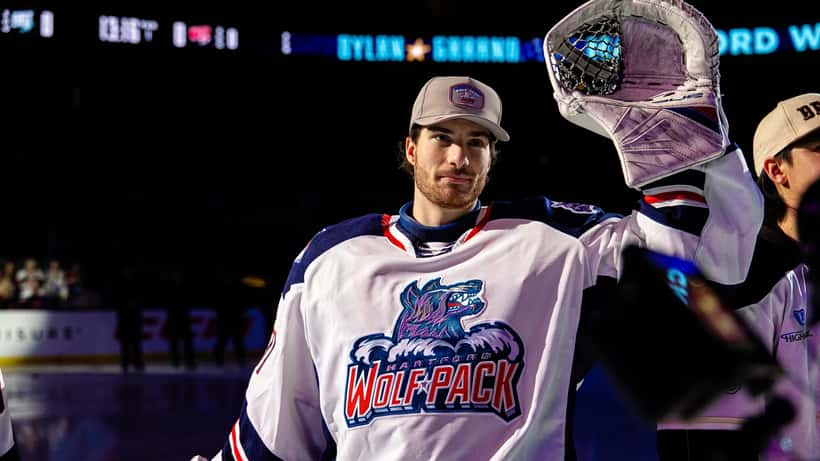
Five days after clearing NHL waivers and reporting to the Hartford Wolf Pack, Dylan Garand was back in Madison Square Garden making history. On October 3, 2026, the 23-year-old Kamloops, B.C. native stopped all 19 shots he faced to deliver a 2-0 shutout victory over the Detroit Red Wings — his first career NHL shutout and a performance that raised an important question for every hockey family watching from coast to coast: what exactly do waivers mean for a young player's career, his earnings, and his rights?
The Week That Defined Garand's 2026-27 Season
When the New York Rangers signed veteran goaltender Joonas Korpisalo from the Boston Bruins on July 1, 2026, it immediately complicated Dylan Garand's path to the NHL roster. Despite entering training camp as a genuine contender for the backup goaltending role — backed by a two-year contract extension signed in June 2026 at an average annual value of $875,000 — Garand found himself on the wrong side of the final roster decision.
The Rangers placed him on waivers. He cleared — meaning no other NHL team put in a claim for his contract — and was assigned to the Hartford Wolf Pack in the American Hockey League. That assignment lasted roughly five days. He was recalled, started, and blanked Detroit in a performance described by beat reporters as capping "the craziest week of his life."
For the average Canadian fan watching his name scroll across the ticker, the sequence raises real questions. What does waiver clearance mean in practice? What does a two-way contract protect? And what should any young hockey player or their family be doing before the first professional deal is signed?
What "Clearing Waivers" Actually Means Under the NHL CBA
The NHL's collective bargaining agreement (CBA), negotiated between the league and the NHL Players' Association, governs every facet of player movement — including the waivers process. When a team places a player on waivers, all 32 other clubs have a 24-hour window to submit a claim. If a claim is made, the claiming team inherits the player's full contract. If no claim comes — as happened with Garand — the player clears waivers and must report to the AHL affiliate.
Waivers eligibility isn't permanent. Players with fewer than a certain number of NHL games on their resume (the threshold varies by age at which a player first signed an entry-level contract) are exempt from waivers altogether. Garand, who made his NHL debut in March 2026 and is now past that initial exempt window, was fully waivers-eligible when the Rangers made their decision.
According to the Employment and Social Development Canada framework on labour standards, employees in federally regulated industries have baseline rights that protect against arbitrary contract termination. In professional hockey, those protections are layered further through the CBA — but only for players who understand what they negotiated in the first place.
How a Two-Way Contract Works — and Why the Structure Matters
A two-way NHL contract pays different amounts depending on whether the player is on the NHL roster or assigned to the AHL. In Garand's case, the Rangers structured his June 2026 extension as a two-way deal in year one and a one-way deal in year two.
Under the two-way structure, Garand earns his full $875,000 AAV when on the NHL roster. In the AHL, he earns a separately negotiated minor-league salary — typically ranging from $85,000 to $130,000 for players at this contract tier, though the specific figure in Garand's deal has not been publicly disclosed. Under the one-way contract in year two, he will earn $875,000 regardless of whether he plays in New York or Hartford.
This two-year progression — two-way in year one, one-way in year two — represents a significant security ladder. It's not automatic. It's the result of deliberate contract architecture, and it's the kind of clause that requires legal expertise to negotiate effectively. Most young Canadian players know their NHL salary; far fewer understand their AHL floor or the waiver-exemption timeline built into their first deal.
Concrete Case: Understanding the Numbers Before Signing
Consider a situation familiar to dozens of hockey families across Ontario, Alberta, and B.C. each spring.
A 22-year-old goaltender drafted in the third round receives two contract offers from his NHL club:
Offer A: Two-way, $900,000 NHL rate / $90,000 AHL rate, two years. Offer B: One-way, $760,000 guaranteed for both years, regardless of roster assignment.
On paper, Offer A appears far superior — a $140,000 gap in nominal NHL value. But consider what happens if the player spends 90 days in the AHL during year one (a routine outcome for young backup goalies fighting for starts):
- 94 NHL days at two-way rate: (94 ÷ 184) × $900,000 ≈ $459,800
- 90 AHL days at two-way rate: (90 ÷ 184) × $90,000 ≈ $43,900
- Year 1 total under Offer A: ≈ $503,700
Under Offer B, even if the player spends every single day of the season in the AHL, he earns $760,000 — a $256,000 advantage.
The if-then rule: if a prospect spends more than roughly 38% of the season in the AHL, a lower nominal one-way contract will outperform a higher nominal two-way deal in actual take-home pay. For a goalie competing for a backup role, 38% AHL time isn't an edge case — it's a realistic baseline scenario. A sports contract lawyer can model these scenarios with projected usage, waiver eligibility dates, and performance bonus structures before any signature is committed.
Garand's deal includes exactly the kind of one-way guarantee in year two that transforms his earnings floor. Not every negotiation produces that outcome, and the players who miss it often don't realize what they left on the table until the waivers wire.
The Waivers Timeline: When Are Players Actually Protected?
Understanding waiver exemption windows is one of the most undervalued pieces of knowledge for young Canadian hockey players and their families. Under the current CBA, a player who signs their first professional contract at age 18 is generally exempt from waivers for their first four professional seasons. A player who signs at 20 or older has a shorter exemption window.
Once that window expires, any AHL assignment — even a one-day conditioning stint — must first pass through waivers. This means a team cannot quietly send a player down to develop; they must first offer him to every other NHL team at no cost.
For a goalie like Garand who has now cleared waivers once, a second clearing could signal to the market that his development has stalled. That perception risk is real, even if the talent picture is more nuanced. Players in this position benefit enormously from legal counsel who understands how waiver placement timing intersects with contract year positioning — specifically, whether a team is incentivized to waive a player before a salary escalation clause kicks in.
What This Means for Garand — and Every Young Canadian Player
Garand's shutout on October 3 likely accelerated his recall timeline and affirmed to the Rangers organization that he remains a viable NHL option. At 23, he now holds NHL experience, a shutout on his resume, and a contract structure that gives him increasing leverage into year two. His outcome this week was positive.
The broader lesson, however, extends well beyond Garand's specific situation. Devon Levi's contract negotiation when moving to Edmonton raised similar questions about RFA rights and how young Canadian goalies can protect their earning power during restricted free agency transitions — as explored in a previous analysis on this platform: Devon Levi's Move to Edmonton and What RFA Rights Mean for Young Goalies. The same legal frameworks apply here, just at the waivers stage rather than the free-agency stage.
When to Consult a Sports Contract Lawyer — Not Just an Agent
Most young hockey players work exclusively with NHLPA-certified agents, who are required to complete agent certification and are prohibited from charging fees that exceed a regulated commission cap. But agents are structurally incentivized by total contract value — which can create subtle pressure toward higher nominal figures over guaranteed floor protections, as the Offer A vs Offer B example above illustrates.
A sports contract lawyer with expertise in collective bargaining agreements brings a different analytical lens: legal risk modeling, waiver timeline analysis, jurisdiction-specific protections, and clause-by-clause review of standard form provisions that are often presented as non-negotiable but frequently are not.
In provinces where many elite prospects develop — Ontario, British Columbia, Quebec, Alberta — there are provincial labour code provisions that can affect grievance processes if disputes arise with the club. The intersection of federal and provincial jurisdiction in professional sports contracts is rarely simple.
Dylan Garand's story ended with a shutout this week. Not every young Canadian player's first waiver experience ends that way — and the quality of legal counsel behind the contract, not just the number on page one, often explains the difference.
Note: This article discusses general principles of professional sports contract law for educational purposes. It is not legal advice. If you are negotiating a professional sports contract, consult a qualified lawyer licensed in your jurisdiction.
