 Eliza Perron
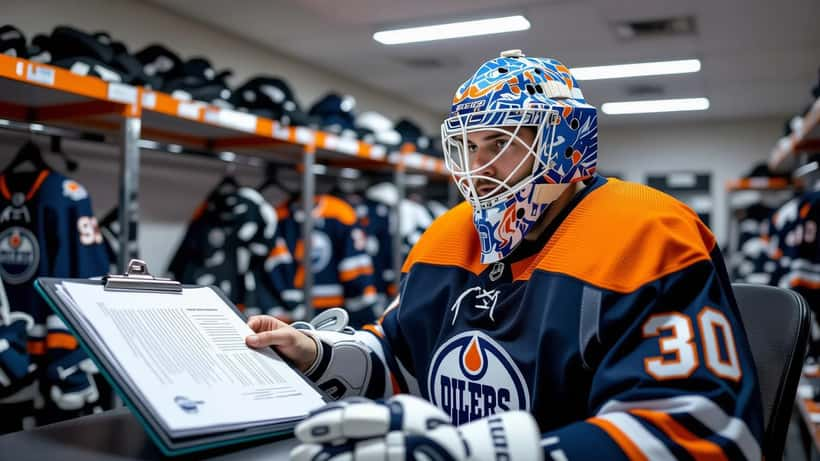
When Devon Levi was traded from the Buffalo Sabres to the Edmonton Oilers on July 1, 2026, the transaction barely registered as a headline in most NHL circles. Edmonton sent a 2028 third-round draft pick. Buffalo received a 2028 seventh-rounder in return. For a goaltender who was a first-round selection four years earlier, the return was stark — a signal that one organization had lost faith in a 24-year-old who had played just 39 career NHL games since being drafted in 2022.
But the trade opened a door. With starter Frederik Andersen sidelined by injury at the start of the 2026-27 season, Levi arrived in Edmonton with a realistic path to meaningful NHL ice time alongside Tristan Jarry. He carries that opportunity on an $850,000 contract in its final year. In the summer of 2027, Devon Levi becomes a restricted free agent — and that contractual milestone, largely invisible in sports coverage, is the hinge point on which his career earnings could swing by millions of dollars.
The Question Anyone Following Devon Levi Should Actually Be Asking
How does a professional athlete who has been traded and undervalued protect their financial interests when it is time to negotiate their next contract?
The question is not unique to hockey. It applies to any skilled professional — in engineering, healthcare, technology, or the trades — who enters a contract negotiation at the end of a fixed-term agreement with an employer who holds significantly more information than they do. In the NHL, this dynamic is formalized through the Collective Bargaining Agreement's restricted free agent system. Understanding how it works, what rights it creates, and where it can be weaponized either for or against a player is the difference between leaving a negotiation with market value and leaving it having accepted the minimum the rules required.
How the NHL's RFA System Works — and What It Actually Says
The NHL Players' Association Collective Bargaining Agreement governs how teams and players negotiate after a contract expires. When a player's deal ends and they have not yet accumulated enough service time to become an unrestricted free agent — typically requiring seven years of professional service — they enter restricted free agency.
For a player like Devon Levi, completing his $850,000 contract in 2026-27, this means the following sequence:
Qualifying offer: Edmonton must issue a qualifying offer before a CBA-defined deadline to retain Levi's RFA rights. Published contract data shows Levi's qualifying offer is set at $935,000 — approximately 110% of his 2026-27 base salary of $850,000. If Edmonton declines to tender this offer, Levi automatically becomes an unrestricted free agent, free to sign with any club.
Salary arbitration: If Edmonton issues the qualifying offer but the two parties cannot agree on a new contract, either side may file for salary arbitration — subject to eligibility based on years of professional service and age. An independent arbitrator reviews a structured presentation of comparable players, contractual circumstances, and performance data, then issues a binding salary decision. The team retains one "walk-away" option per arbitration cycle: they can elect not to sign the award, but doing so renders the player an unrestricted free agent, and the team loses all rights.
Offer sheets: A rival NHL team can sign an RFA to an offer sheet at any time during the negotiating window. The original team — in this case Edmonton — has seven business days to match the contract in full and retain the player. If Edmonton declines to match, they receive draft pick compensation calculated on a tiered scale based on the offer sheet's total value. For contracts in Levi's likely range, compensation typically runs between a first and second-round pick.
Each of these mechanisms creates leverage — or erodes it — depending entirely on how well-prepared the player's representation is going into the negotiation. A player who signs the qualifying offer without engaging legal counsel is, in contractual terms, accepting the statutory minimum while comparable market rates often sit meaningfully higher.
A Concrete Scenario: What Devon Levi's 2027 Off-Season Could Look Like
Levi enters 2026-27 on a $850,000 base salary with a qualifying offer of $935,000 on file. Assume he splits the crease with Jarry, starts between 28 and 35 games, and posts an NHL save percentage of .909-.914 — a realistic range given his .904 mark across 52 AHL starts with Rochester last season.
Those numbers would make him a legitimate NHL backup with starter upside, a profile that the recent market has valued between $1.8 million and $2.6 million annually. Look at the comparable landscape: goalies with one to two years of NHL work, modest but positive save percentage, and age under 26 have consistently received arbitration awards and negotiated deals well above a 110% qualifying offer floor.
Scenario A — No legal representation, accepts qualifying offer: Edmonton tenders the $935,000 qualifying offer. Levi, uncertain of his leverage after years of inconsistent deployment, accepts. He signs a one-year bridge deal at $935,000. In parallel, a comparable young goaltender with similar stats and age secures a two-year deal at $2.1 million annually through a structured arbitration process. The gap over that same two-year window: $2.33 million in foregone earnings ($4.2 million vs. $1.87 million).
Scenario B — Legal counsel engaged before qualifying offer deadline: Levi's legal representatives compile a comparables brief. They identify five goalies in the 23-26 age range with similar save percentages and AHL-to-NHL transitions, filed under the CBA's arbitration comparables framework. The brief also highlights Levi's acquisition cost — Edmonton essentially obtained him for a late third-round pick, suggesting his upside is underpriced at the contractual level. In salary arbitration, the arbitrator awards $2.1 million annually. Over a two-year term, Levi earns $4.2 million — a delta exceeding $2.3 million compared to the unrepresented scenario, against a legal consultation cost typically ranging from $1,500 to $6,000 for a well-scoped sports contract engagement.
The arithmetic is consistent across contract negotiations outside professional sport as well. The qualifying offer is a legal floor that protects the team, not the player. Professionals who treat the qualifying offer or initial employer renewal as the baseline — rather than as a starting point to challenge — routinely leave contractual value on the table that a qualified adviser would have captured.
What Devon Levi's Situation Reveals About Any Specialized Employment Contract
The RFA system in hockey is unusually transparent. Salary databases like PuckPedia publish contract values, qualifying offers, and cap hits in real time. Comparables are publicly documented. The CBA itself runs to hundreds of pages governing precisely how arbitration hearings must be conducted.
Most employment contracts in Canada do not offer this level of transparency. A software developer at a scaling company negotiating a performance bonus structure, a nurse practitioner reviewing a non-compete clause in a new hospital agreement, or a skilled tradesperson with a deferred compensation arrangement are operating with far less visibility into comparable market rates and legal precedent than Devon Levi's agents have access to.
The structural asymmetry is the same: the employer or team drafts the contract according to their interests and precedent, then presents it to a professional who is often reviewing that document for the first time. Without independent legal review — from a professional who negotiates these clauses regularly — the signing party is relying on the other side's documentation to understand their own rights.
For professionals navigating high-stakes contract renewals in Canada — whether in sport, healthcare, technology, financial services, or skilled trades — the question that matters is not whether you can read the contract. It is whether you understand what the contract does not say, what comparables exist, and whether the terms offered reflect actual market conditions or the minimum the drafter was required to offer.
You can read about how RFA status played out for another young NHL professional navigating contract rights in Canada and why the contractual terms on a bridge deal matter far more than their headline salary figure.
What to Do Before Your Next Contract Year
Devon Levi does not need to make a $2.3 million mistake in July 2027 to make the news. But the structural lesson — that professionals negotiating specialized contracts without independent legal review consistently underperform on compensation compared to those who engage counsel before signing — applies to any high-stakes renewal.
ExpertZoom connects Canadians with qualified legal professionals specializing in employment and contract law, including practitioners with direct experience in sports law, executive compensation, and complex employment agreements. An initial consultation of 30 to 60 minutes can identify the specific provisions worth challenging before you sign — and position you to negotiate from the same footing as the party who drafted the document.
Devon Levi gets a second act in Edmonton. Your contract renewal deserves the same level of strategic preparation.
Disclaimer: This article is for informational purposes only and does not constitute legal or financial advice. For guidance specific to your situation, consult a qualified legal professional.
