 Sophie Leblanc
The Draconid meteor shower reaches its annual peak over Canada tonight, October 8, 2026, with astronomers expecting between 5 and 10 meteors per hour visible to the naked eye from a dark backyard. For millions of Canadian pet owners planning an evening of stargazing, the event brings an unexpected consideration: how your dog or cat might respond when you step outside, alter your routine, or inadvertently expose them to the evening's spectacle.
What the Draconid Shower Brings to Canadian Skies
The Draconids, sometimes called the Giacobinids, originate from debris shed by Comet 21P/Giacobini-Zinner. Unlike most meteor showers that peak before dawn, the Draconids are best observed in the evening — making tonight ideal for Canadians across all time zones. Peak activity is predicted around 9 p.m. EDT (6 p.m. PDT), according to EarthSky.
This year's shower arrives under near-perfect conditions. The new moon falls on October 10, 2026, leaving the sky dark and unobscured during peak hours. No outburst is forecast: observers should expect a quiet, modest display of around 5 to 10 streaks per hour under clear, rural skies. The radiant point sits in the constellation Draco, near the stars Eltanin and Rastaban. From most of Canada, Draco is highest in the north just as the sky darkens, so viewers should face northward and allow 20 minutes for their eyes to adjust.
That's enough to send thousands of Canadian families into their backyards tonight with a blanket — and, in many households, with their dogs.
Why Your Pet May Act Strangely This Evening
Here is what many stargazers do not anticipate: your pet's evening is being disrupted too.
Dogs and cats are highly attuned to routine. A household that normally settles into quiet after dinner is suddenly alive with activity: lights off, coats on, family members stepping outside and staring upward in unusual silence. From a dog's perspective, that combination of altered behaviour, changed lighting, and extended outdoor time at an unfamiliar hour is a cluster of ambiguous signals.
Veterinary behaviourists describe this as a disruption in environmental predictability. When an animal cannot read its owner's behaviour clearly — "is this an emergency? should I be alert?" — the stress response activates. Signs that your dog or cat is experiencing anxiety on a stargazing night include: persistent panting or yawning, pacing or inability to settle, excessive lip-licking or drooling, trembling or shaking, hiding or seeking confinement in a small space, vocalizing (barking, whining, meowing), and refusal to eat a normally enjoyed treat.
Cats often show subtler cues: ears flattened or rotated sideways, a tail held low or tucked tightly to the body, dilated pupils while at rest, and sudden freezing in place.
According to data from pet insurer Trupanion, anxiety-related pet claims in Canada rose 98 per cent between 2020 and 2025, reflecting growing recognition that domestic animals experience genuine stress responses to environmental change — not just thunder and fireworks.
The Silent Factor: Routine, Not Noise
Meteor showers are silent events. Unlike fireworks or thunderstorms, there is no percussive trigger — which leads many pet owners to assume their animals will be unaffected. That assumption is worth questioning.
A brief flash of light across the sky, glimpsed through a window or an open door, is not a routine visual stimulus for a house cat. Nor is an owner returning repeatedly from outside carrying the smell of cold air and fresh dew without explanation. Younger dogs, recently adopted cats, and animals with a history of generalized anxiety disorder are particularly sensitive to non-noise-based environmental changes.
The stressor, in these cases, is not the meteor. It is the unexplained disruption to the evening's expected sequence: dinner, calm, bed. When that sequence breaks unpredictably, the animal has no way to anticipate what comes next — and uncertainty, not danger, is the driver of most domestic pet anxiety.
You can find more practical guidance on managing pet stress in Canadian households in this guide from Expert Zoom: Why Your Pet May Be Stressed During Unusual Events — A Vet Explains. And for emergencies that require relocation or rapid adaptation, this Expert Zoom article on protecting pets during Canada's 2026 wildfire season covers the vet-backed protocol for sudden environmental disruption.
Sophie and Beau: What One Overlooked Evening Can Cost
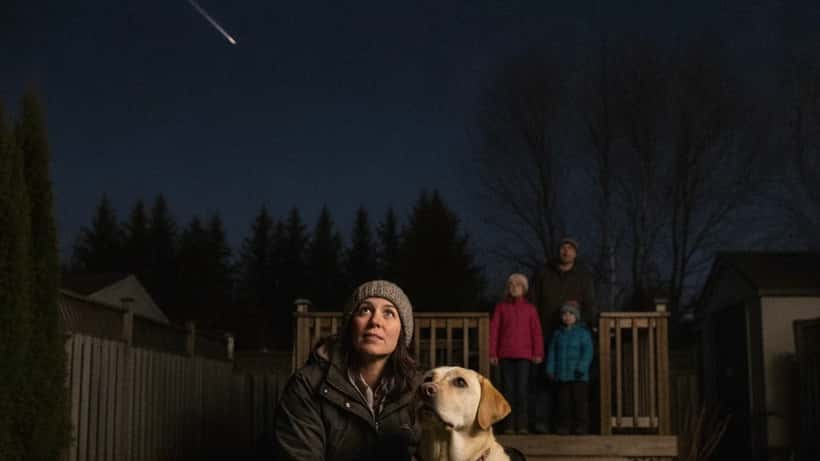
Consider this scenario, drawn from the kind of situation veterinary behaviourists increasingly encounter. Sophie, 38, lives with her husband and two children in a suburb of Ottawa. They plan to watch the Draconids from the backyard on the evening of October 8. They bring their four-year-old Labrador Retriever, Beau, outside with them. Beau has shown mild anxiety in past thunderstorms, but the couple has never consulted a vet about it.
On the lawn, Beau spends 45 minutes pacing, whining at the door, and jumping up on Sophie. The children lose interest in the shower. The following morning, Beau refuses his breakfast. Over the next two weeks, a pattern develops: he barks at the back door each evening and shows a new reluctance to go outside after dark.
This secondary behavioural shift — what veterinary behaviourists call negative association formation — is easy to misread as a personality quirk. If left unaddressed for three months, it will likely require a structured behavioural modification programme costing between $800 and $1,500, plus potential prescription anti-anxiety medication at $80 to $120 per month.
If Sophie had consulted an ExpertZoom veterinarian before the evening — even a 20-minute telehealth session at $60 to $120 — a licensed professional could have screened Beau for pre-existing anxiety markers and provided a concrete protocol: a veterinary-grade calming supplement ($30 to $60 per month), a safe room with familiar bedding, and clear guidance on whether Beau should stay inside while the family watches. The if/then logic is direct: if your dog has ever shown any stress response to an environmental change, a proactive vet check before tonight's meteor shower costs less than one month of medication following an anxiety spiral.
Disclaimer: This article is for informational purposes only and does not constitute veterinary advice. Always consult a licensed veterinarian for your pet's specific health needs.
What the CVMA Says About Pre-Event Preparation
The Canadian Veterinary Medical Association (CVMA) recommends that pet owners proactively assess their animals' stress tolerance ahead of anticipated disruptions to daily routine. The key steps are straightforward:
- Maintain predictable feeding and walk schedules on the day of any unusual household event
- Provide a safe, confined retreat — a crate, a familiar room, or a corner with the pet's bedding and a worn item of clothing
- Avoid forcing the animal to participate in outdoor activities it has not been conditioned to
- Consult a veterinarian if anxiety signs last more than 24 hours after the triggering event, or if the animal refuses food for more than one meal
For cats, a Feliway pheromone diffuser installed several hours before the evening can reduce baseline stress before disruption begins. For dogs with a known anxiety history, a brief veterinary consultation is advisable before any unusual event — not after.
Tonight's Window and What to Do Now
The Draconid peak runs from approximately 9 p.m. to midnight local time across Canada on October 8, 2026. If you are planning to watch from your backyard and your pet has any history of anxiety, noise sensitivity, or unpredictable behaviour, this is a reasonable moment to consult a veterinarian.
Expert Zoom connects Canadian pet owners with licensed veterinarians available for same-day telehealth appointments. A 20-minute session can confirm whether your pet needs a pre-event calming protocol, a safe room setup, or simply a supplement on hand as a precaution. For most households, no intervention will be needed. For those whose pets have a prior history of stress, the cost of a consultation tonight is a fraction of what a reactive treatment programme will cost in November.
The Draconids return every October. A well-managed anxiety response, set up once with professional guidance, protects your pet for every stargazing season ahead.
