 Megan Thériault
Michael Kesselring Contract Extension Talks Heat Up for Buffalo Sabres in 2026
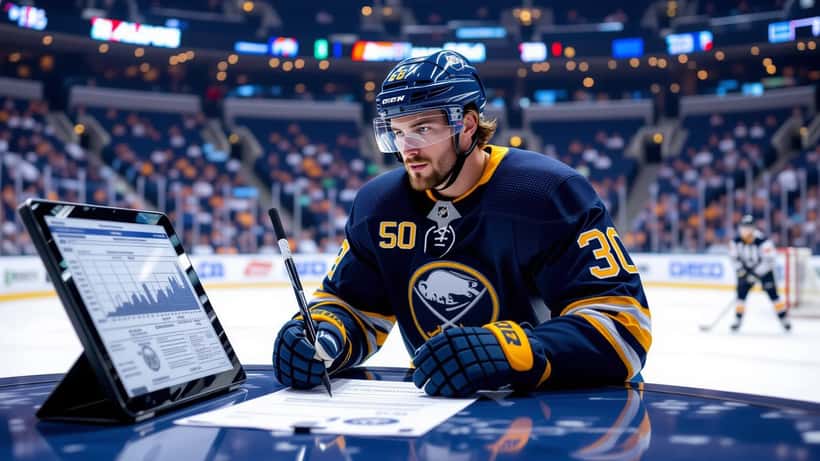
As the 2026 Stanley Cup Playoffs unfold, Buffalo Sabres defenseman Michael Kesselring finds himself at the centre of a quiet but important conversation: what is the 26-year-old worth on his next contract? Once viewed as the headline return in the blockbuster trade that sent JJ Peterka to the Utah Mammoth, Kesselring has battled injuries and lineup competition during his first season in Western New York. Yet the Sabres still face a decision this off-season that could shape their blue line for years.
This article looks beyond the box score. It examines the contract dynamics, salary-cap pressures and professional considerations surrounding Kesselring in 2026—and why athletes, agents and front-office executives increasingly rely on specialised advisors when careers and millions of dollars are on the line.
From Utah to Buffalo: the trade that changed everything
On June 26, 2025, the Sabres acquired Kesselring and forward Josh Doan from Utah in exchange for winger JJ Peterka. At the time, many analysts considered Kesselring the centrepiece of the deal. The 6-foot-5 right-shot defender was coming off a seven-goal, 29-point campaign with the Mammoth and looked ready to solidify Buffalo’s defence for years.
Doan, however, stole the spotlight. The 23-year-old forward enjoyed a breakout season, scored more than 20 goals and signed a seven-year, $48.75 million extension in January 2026. Kesselring, meanwhile, struggled to stay healthy. A nagging knee issue and a recurring high-ankle sprain limited him to sporadic appearances, and by the trade deadline the Sabres added defencemen Luke Schenn and Logan Stanley, pushing Kesselring toward the press box.
The contrast between the two players illustrates how quickly narratives shift in professional sport. A trade that once looked like a defensive coup for Buffalo is now an open question: do the Sabres commit to Kesselring long term, or do they look elsewhere?
The numbers behind the next deal
According to salary-cap projections from AFP Analytics, Kesselring is on track for a three-year extension worth roughly $4.27 million annually. That figure reflects both his potential and his uneven 2025-26 performance. Buffalo’s cap picture is already tight. The Sabres have only limited space under the projected ceiling and must also address Alex Tuch’s next contract, which could exceed $8.5 million per season on a long-term deal.
Those constraints make Kesselring’s negotiation more than a routine re-signing. General manager Jarmo Kekalainen and his staff must weigh the defender’s size, shot and age against his injury history and declining ice time. A bridge deal at a moderate cap hit might protect the team if Kesselring cannot rebound, while a longer-term pact would bet on his return to form.
The situation is a textbook example of the complexity facing modern athletes. Contract talks involve performance data, medical histories, comparable contracts, tax implications and long-term career planning. For players like Kesselring, having the right advisory team can be the difference between a favourable deal and a career misstep.
Why contract negotiations are a team sport
Behind every NHL contract sits a network of specialists. A sports agent negotiates the headline terms and manages relationships with the club. An employment or sports lawyer reviews the collective-bargaining language, escrow rules and bonus structures. A wealth manager helps the player structure signing bonuses, plan for retirement and navigate cross-border tax issues. A certified accountant ensures compliance and optimises cash flow.
The same principle applies in related cases across the league. For instance, the Sabres’ handling of Peyton Krebs’s RFA contract negotiation shows how restricted free agency, arbitration rights and employment law intersect in Canadian markets. Whether a player is an established veteran or a young RFA, the paperwork behind the paycheck can be as important as the on-ice performance.
Injuries add another layer. When a player like Kesselring enters negotiations with a medical file that includes knee and ankle issues, insurers, team doctors and independent physicians all become part of the conversation. A player’s camp may commission its own medical assessments to counter team concerns, while the club may seek protective contract language or shorter term limits.
The Expert Zoom angle: specialised advice when stakes are high
At Expert Zoom, we believe that high-stakes career decisions deserve more than intuition. Our marketplace connects athletes, agents and sports organisations with vetted specialists who understand the nuances of professional sport: contract negotiators, sports lawyers, wealth managers, tax planners and performance consultants.
For a defenceman heading into a pivotal contract summer, the right advice can reshape a career. A sports lawyer can review an offer sheet or arbitration submission. A financial planner can model how a three-year deal in a high-tax state compares with a longer contract elsewhere. A performance consultant can help the player demonstrate durability and value to the front office. These conversations are not luxuries; they are risk-management tools.
The Kesselring case also highlights a broader trend. As salary-cap science becomes more sophisticated, teams and players both rely on external expertise. Analytics departments evaluate every shift. Agents study comparable contracts from every angle. Lawyers monitor regulatory changes. In this environment, athletes who build strong advisory teams gain a measurable edge.
What fans and professionals can watch in 2026
Several signals will determine Kesselring’s future in Buffalo. First, his playoff usage—if he dresses at all—will tell the coaching staff’s confidence level. Second, the Sabres’ performance in the post-season could influence how aggressively management reshapes the roster. Third, the health of other defencemen, particularly Rasmus Dahlin and Mattias Samuelsson, will affect how urgently Buffalo needs right-shot depth.
For business-minded observers, Kesselring’s next contract is also a case study in asset management. The Sabres invested significant trade capital to acquire him. If they re-sign him at a reasonable number, they preserve value. If they let him walk or trade him, they risk recouping less than they gave up. These are the decisions that separate contending franchises from perpetual rebuilders.
Conclusion
Michael Kesselring’s 2025-26 season did not go according to plan, but his story is far from finished. As the Sabres evaluate their off-season priorities, the defenceman’s contract negotiation will test the organisation’s patience and the player’s ability to rebound. For athletes in similar positions, the lesson is clear: success is not only measured in goals and assists, but also in the quality of the professional advice surrounding you.
Whether you are a professional athlete, an agent or a team executive, Expert Zoom can connect you with the specialists who help turn career uncertainty into informed strategy. Because when the spotlight fades and the contract talks begin, expertise is what separates a good deal from a great one.
