 Dimitri
 Calgary drivers are being warned to brace for another punishing hail season after severe thunderstorms arrived early in southern Alberta on June 23, 2026, weeks ahead of the usual peak. The Insurance Bureau of Canada (IBC) has urged Albertans to prepare their vehicles now, noting that the province has recorded a major hailstorm every single year for the past decade — damage that has added up to roughly $8 billion. For anyone parked on a Calgary street when the sky turns green, an auto-repair specialist says the difference between a minor claim and a written-off car often comes down to a few decisions made before and after the storm.
Why Calgary sits in "Hailstorm Alley"
Calgary lies at the heart of a corridor stretching from High River up through Red Deer that meteorologists nickname "Hailstorm Alley," one of the most hail-prone regions in North America. Warm prairie air colliding with cool Rocky Mountain downdrafts builds towering storm cells that can drop hail the size of golf balls — or larger — in a matter of minutes.
The financial toll is staggering. According to the IBC, a single August 2024 hailstorm over Calgary generated more than 130,000 insurance claims and nearly $2.8 billion in insured damage, making it the costliest hailstorm in Canadian history. A more localized storm on July 13, 2025 saw insured losses almost double from an initial $92 million estimate to $164 million within weeks. Crucially, the IBC reported that vehicle damage represented more than half of all claims from that 2025 event.
That last figure is the one repair professionals want drivers to notice: in Calgary, your car — not your roof — is statistically the thing most likely to be dented.
What hail actually does to a vehicle
Hail damage is rarely just cosmetic. A body technician assessing a hail-struck car looks well beyond the obvious roof and hood dimples. Repeated impacts can crack windshields and sunroofs, shatter side mirrors, and split trim and weather seals that let water into the cabin later. Dents on aluminum panels — increasingly common on newer trucks and EVs — behave differently from steel and often cannot be massaged out the same way.
The preferred fix for most hail dents is paintless dent repair (PDR), a technique in which a trained technician works each dent out from behind the panel using specialized rods, preserving the factory paint. PDR is faster and cheaper than conventional bodywork, but it has limits: dents with cracked or chipped paint, or panels stretched by very large stones, may still require repainting or replacement. A reputable shop will tell you honestly which panels can be saved and which cannot.
Before the storm: an expert's checklist
The single most effective step is also the simplest — get the vehicle under cover. A garage, a parkade, or even a carport dramatically reduces exposure. When covered parking is not available, technicians recommend keeping a set of thick moving blankets or a purpose-made hail cover in the trunk during storm season; laid over the roof, hood and windshield, they blunt the impact of smaller stones.
Drivers should also treat severe-thunderstorm alerts seriously rather than waiting to see the hail. Environment Canada issues warnings for the Calgary region through its public weather service, and Alberta storms can escalate from a watch to golf-ball hail in under half an hour. The same vigilance that protects your car applies to your property — our guide to severe-weather home safety covers the rest of the checklist. If you are already driving when hail begins, do not stop under a highway overpass — that blocks traffic and creates rear-end collision risk. Instead, pull fully off the road at the nearest gas station canopy or covered structure and wait it out.
After the storm: protect your claim
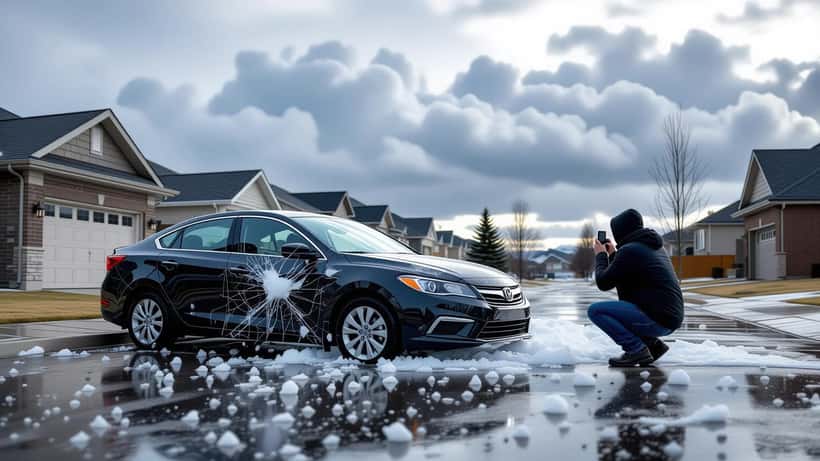
Once it is safe, document everything before you drive to a shop. Photograph the whole vehicle in good light, including the windshield, glass, mirrors and the hail stones themselves if any remain — a coin or ruler beside a stone helps establish size for an adjuster. Note the date and time. This record matters because hail damage from an earlier storm can be hard to distinguish from a new event months down the line.
Whether the repair is covered depends entirely on your policy. Hail falls under comprehensive coverage on an Alberta auto policy — the optional portion that also covers theft, fire and falling objects. Basic liability-only insurance will not pay for a single dent. Drivers who carry comprehensive coverage should also check their deductible; on a lightly damaged car, the repair estimate can sometimes fall close to the deductible, in which case filing a claim may not be worthwhile.
This article is general information, not financial or insurance advice. Coverage terms, deductibles and claim procedures vary between insurers — confirm the specifics with your own broker or policy documents before acting.
Choosing a repair shop — and avoiding chasers
After a major storm, out-of-town "storm chaser" repair operations often flood Calgary, set up temporary lots, and pressure owners into signing over insurance cheques. A qualified auto-body professional advises caution: choose a shop with a permanent local address, verify it is registered to work with your insurer, and get the assessment in writing. Ask specifically whether the shop performs PDR in-house or subcontracts it, and confirm any warranty on the work. A dent repaired badly can trap moisture and lead to rust that surfaces long after the temporary lot has packed up and left.
The bottom line for Calgary drivers
With the 2026 season already underway and a decade-long pattern of billion-dollar storms behind it, Calgary is not a city where hail can be treated as a freak event. Getting your vehicle under cover, keeping comprehensive coverage current, documenting damage carefully, and choosing an established repair specialist are the four moves that consistently separate a manageable inconvenience from a costly, drawn-out ordeal. And because Alberta's weather rarely offers a quiet season, drivers who prepare for hail today should be thinking ahead to winterizing their vehicle once the storms give way to snow.
If you are unsure whether your car has hidden hail damage, or whether a claim is worth filing against your deductible, a qualified mechanic or auto-body expert can inspect the vehicle and give you a clear, written assessment before you commit to anything.
