 Olivia Dubois
Tonight at Al-Awwal Park in Riyadh, Al-Nassr — Cristiano Ronaldo's Saudi club — face Neftchi Fergana of Uzbekistan in Matchday 2 of the AFC Champions League Elite 2026-27. On paper, the result should be straightforward. But the opening round told a very different story: the Saudi giants were hammered 4-0 by Al Ain in their debut, while the Uzbek underdogs claimed a 1-0 win over Air Force courtesy of a last-gasp Zoran Marušić strike. For sports medicine professionals, the gap between those results carries a warning that Canadian recreational athletes know all too well — post-tournament fatigue doesn't announce itself with an injury. It announces itself with a result nobody expected.
Medical disclaimer: The health information in this article is for general informational purposes only and does not constitute medical advice. Consult a qualified health professional before making changes to your training or recovery programme.
From Tashkent to Riyadh: When World Cup Glory Meets Club Duty
Uzbekistan made history at the 2026 FIFA World Cup — the Central Asian nation's first-ever appearance at football's biggest stage, competing under head coach Fabio Cannavaro. Several Neftchi Fergana players were part of that national squad, including goalkeeper Botirali Ergashev and midfielder Jamshid Iskanderov, according to Uzbek football media reports ahead of the tournament. The World Cup ran through the summer of 2026, meaning these athletes returned to domestic league duty and then — within weeks — found themselves in the centre of an AFC Champions League campaign against one of the richest clubs in Asia.
Al-Nassr is no different. Multiple Saudi internationals in the squad carried heavy competitive loads through the World Cup cycle. Factor in Riyadh's October heat, where temperatures still reach 35°C on matchday, and the conditions for a performance collapse become visible before a ball is kicked.
FIFA's medical advisory committees have consistently documented that players competing in major international tournaments face an elevated soft-tissue injury risk of 20-to-40% in the first four to six weeks of post-tournament club play, compared to their baseline season averages. That window — August through October for World Cup participants — is precisely when Group D of the AFC Champions League Elite 2026-27 begins.
Why the Smaller Club May Have the Hidden Advantage
Sports science offers an uncomfortable truth about elite football that applies equally to recreational leagues in Canada: the "weaker" team in a post-tournament fixture can carry a structural physiological advantage.
Neftchi Fergana does not carry the same World Cup representation burden as their opponents. Their squad has fewer internationals, meaning fresher legs in more positions, less accumulated physical mileage, and a lower residual cognitive fatigue load. When Marušić slotted home his winner in the 83rd minute against Air Force, it was partly an expression of physical condition, not just tactical preparation.
Al-Nassr's 4-0 collapse against Al Ain — a result that stunned observers who expected Ronaldo's side to open with a convincing performance — carries a similar signature. Elite athletes competing at high volume without adequate recovery windows don't just underperform. They can fail catastrophically, even against opponents they should handle comfortably.
The British Journal of Sports Medicine has found that mentally fatigued athletes exhibit measurably slower reaction times and significantly poorer decision-making under pressure, independent of their physical condition. Post-tournament squads, competing in continental fixtures against tactically prepared opponents, are exposed on both fronts simultaneously.
The Canadian Parallel: When Summer Tournaments Run Into Fall Seasons
Canada's grassroots sports participation surged dramatically in the summer of 2026, partly driven by the country's historic World Cup hosting role. Statistics Canada estimates that more than 20 million Canadians participate in organized sport — the vast majority recreational and amateur. Many of those athletes competed in summer tournaments, provincial championships, or club finals between June and September 2026. The majority returned to their fall seasons without structured recovery protocols.
According to the Public Health Agency of Canada, maintaining long-term physical health depends not only on sufficient physical activity but on adequate recovery between periods of intense effort — a principle that applies equally to a Saudi Pro League midfielder and a recreational athlete in Mississauga.
For amateur athletes, the post-tournament period is routinely treated as downtime rather than a deliberate recovery window. That misclassification is precisely where preventable injuries are born.
The $2,880 Mistake: A Scenario Canadian Sports Clinics See Every Autumn
Sports medicine clinics across Ontario see a pattern repeat itself each fall season — and the 2026 version arrived earlier and in greater volume than usual.
Consider the situation facing Ryan, a 34-year-old midfielder from Brampton who plays in a local adult recreational soccer league. In late July 2026, his club competed in a five-match Ontario Soccer adult provincial championship over eight days — reaching the final and finishing runners-up. It was the biggest tournament result of his playing career. Two weeks later, he was back on the pitch for his fall league opener.
By week four of the fall season, he noticed persistent tightness in his left hamstring after training. He attributed it to rust and played through it. By week six, he pulled the hamstring during a 40-metre sprint — a grade 2 strain that put him on the sideline for ten weeks.
The if/then logic of his situation is straightforward:
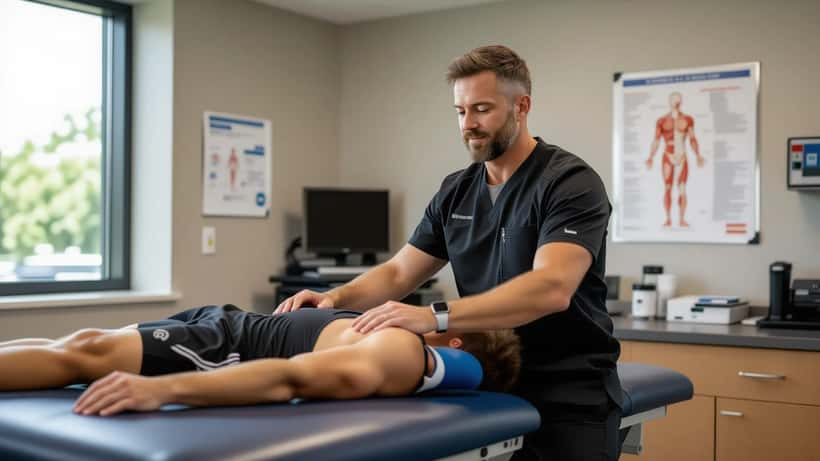
If Ryan had followed a 3-to-4-week active recovery protocol after the provincial tournament, the grade 1 precursor strain would likely have been identified and managed before it progressed to a full tear. That protocol would include reducing training load by 60%, incorporating low-impact cross-training such as swimming or cycling, and scheduling one sports medicine appointment.
Cost of the proactive path: An initial sports medicine assessment in Ontario typically runs $250 to $350, including movement screening, hamstring strength asymmetry testing, and a personalized return-to-sport timeline.
Cost of the reactive path: Three physiotherapy sessions per week over eight weeks at $120 per session comes to $2,880 in fees alone — plus ten weeks of missed play, the psychological cost of a lost season, and a significantly elevated re-injury risk in the following 12 months for athletes who rush back from improperly managed soft-tissue injuries.
The ratio is roughly 1:9 in favour of proactive consultation. No recreational athlete knowingly chooses the expensive option. They simply don't recognize the symptoms as a signal until it's too late.
Five Signs Your Body Is Telling You Something Post-Tournament
Sports medicine practitioners across Canada identify these as post-tournament fatigue indicators that require professional assessment, not a wait-and-see approach:
- Muscle soreness lasting beyond 72 hours of rest. Normal DOMS resolves within 48 to 72 hours. Soreness that persists beyond that window suggests incomplete muscular recovery.
- Unexplained performance drops. If pace, endurance, or strength is measurably lower than your pre-tournament baseline after two full weeks of rest, consult a professional before returning to competitive intensity.
- Elevated resting heart rate. A resting HR that sits 5 to 10 BPM above your typical baseline for more than one week is a physiological signal that your body is still in recovery mode.
- Sleep disruption or persistent irritability. These are well-documented early markers of overtraining syndrome, which develops when competitive load consistently exceeds the body's recovery capacity.
- Localized joint or tendon pain. Sharp or pinching pain around the Achilles, hip flexors, hamstrings, or knee tendons after a competitive period warrants imaging and assessment — not ice and hope.
Any two of these indicators appearing within four to six weeks of a high-intensity competition period is a strong signal that your body has not fully recovered. The appropriate response is a consultation with a sports medicine physician or registered physiotherapist, not an increased training load.
What the AFC Champions League Is Teaching Every Canadian Athlete
The Ecuador vs. Saudi Arabia fatigue story from the 2026 World Cup demonstrated how poor tournament recovery management reshapes competitive outcomes at the elite level. Tonight's fixture in Riyadh adds another chapter: even the most financially powerful clubs in Asian football cannot buy their way out of the biology of recovery.
For Canadian athletes heading into the second half of their 2026 fall season, the lesson from Al-Awwal Park is direct. The weeks after your biggest tournament of the year are not a reward for hard work — they are the foundation on which your next competitive peak is built. Treating them as optional preparation time is the single most predictable cause of the injury that defines your off-season.
A consultation with a sports medicine physician or registered physiotherapist costs a fraction of the physiotherapy bill you'll face if you skip it. If you competed hard this summer and are now feeling the first signs of something not quite right, ExpertZoom connects you with qualified sports health experts across Canada who can assess your specific situation and design a return-to-performance protocol built around your body, your sport, and your goals.
