 Chloe Wilson
Giovanni Reyna has been named in the United States men's national team's 26-man squad for the 2026 FIFA World Cup. For many watching American soccer, that selection felt like the triumphant end of a very long story. Since 2021, the Borussia Mönchengladbach forward has sustained at least eight distinct injuries — soft-tissue tears, muscle strains, a leg fracture — that have repeatedly interrupted what observers believe should have been one of the most dominant attacking careers in American football history.
USMNT coach Mauricio Pochettino described Reyna as a "special situation" when explaining his selection. Reyna had not started a club match for Mönchengladbach since December 2025, recovering from a muscle injury sustained in February 2026, though he featured from the bench in his club's last four matches before being named in the squad.
Here he is. And what his journey reveals about sports injury management matters far beyond professional football.
Eight Injuries in Five Years
Reyna's injury record is striking in both its length and its variety. The majority of his problems have been soft-tissue injuries — hamstring strains, hip flexor tears, and muscle ailments — interspersed with a leg fracture and recurring knee concerns. He spent extended periods at Nottingham Forest on loan as clubs tried to manage his workload, and was used primarily as an impact substitute throughout the 2025–26 season.
The pattern is familiar to sports medicine professionals: a talented athlete with naturally explosive physical qualities whose soft-tissue system has struggled to keep pace with the demands placed on it.
Why Soft-Tissue Injuries Are So Deceptive
The majority of Reyna's setbacks have involved the muscles and connective tissues that enable the explosive movement that defines his game. Soft-tissue injuries are treacherous for one specific reason: they feel better well before they are fully healed.
A hamstring strain that stops hurting after ten days has not yet restored the muscle-fibre architecture that provides full strength and elasticity. Returning to competitive football at that point — particularly at the sprint speeds demanded by elite sport — dramatically increases re-injury risk. According to Sports Medicine Australia, the re-injury rate for inadequately managed hamstring strains is estimated at between 12 and 34 per cent in the first three months of return.
For Reyna, that cycle repeated across five seasons. For everyday Australians who play weekend sport, the lesson is identical: the absence of pain is not the same as readiness to return.
What a Proper Return-to-Play Protocol Involves
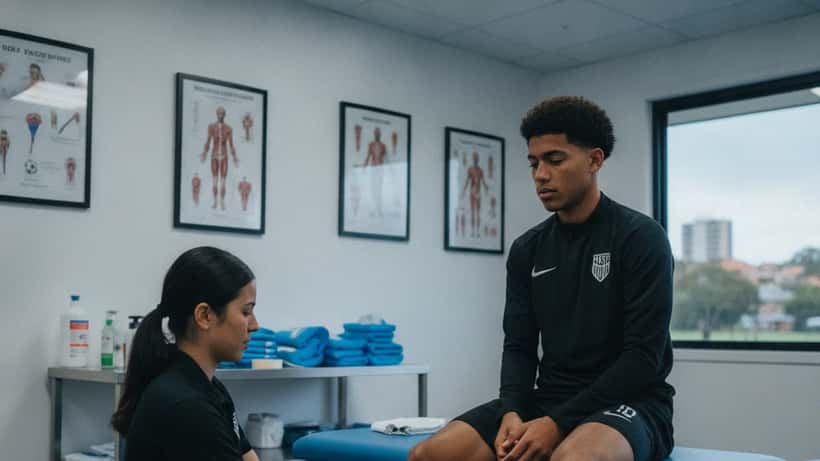
Reyna's World Cup selection is only possible because Pochettino's medical staff are confident he has completed a structured fitness programme. At professional level, return-to-play protocols typically include:
- Acute management — Ice, compression, and rest in the first 48–72 hours following an injury
- Medical imaging — MRI or ultrasound to confirm the extent of tissue damage
- Progressive rehabilitation — Graduated loading under physiotherapy supervision, advancing from walking through jogging, running, sprinting, then full contact
- Functional benchmarks — Tests measuring explosive speed and strength symmetry between the injured and non-injured limb
- Medical clearance — Doctor sign-off before competitive training resumes
The key word is "graduated". The systematic increase in load over weeks — not days — allows repaired tissue to remodel and strengthen under controlled stress. Compressing or skipping stages is what generates the chronic re-injury cycle that has characterised Reyna's career.
The Psychological Dimension of Repeated Injuries
A history like Reyna's carries a psychological weight that receives less attention than the physical. The fear of re-injury can cause athletes to subconsciously reduce their top-end effort, change how they absorb contact, or avoid the explosive bursts of movement that define their game. Sports psychologists refer to this as kinesiophobia — movement-related fear following injury — and it is a clinically recognised barrier to full return to performance.
For amateur and recreational athletes, this dimension is equally real. Anxiety about re-injury after recurring soft-tissue problems is a legitimate concern that a sports psychologist or sports medicine professional can address alongside physical rehabilitation.
When Should Australians Seek Help for a Recurring Sports Injury?
Reyna's story resonates with thousands of Australian athletes who have experienced the cycle of injury, incomplete recovery, and re-injury. Knowing when to step up from self-management to professional assessment is critical.
See a sports medicine specialist if you are experiencing:
- A recurring injury in the same muscle or joint over multiple months
- Pain that returns when you increase training intensity after a period of rest
- Swelling or stiffness around a joint that has not resolved after two weeks
- A reduction in speed or power that persists beyond what the initial injury seems to explain
- Anxiety about returning to sport that is affecting how you train or compete
A physiotherapist or sports medicine doctor can assess load tolerance, identify biomechanical factors contributing to re-injury, and design a programme that returns you to full activity safely.
Gio Reyna reached his second World Cup through elite medical support, structured rehabilitation, and a coaching staff prepared to manage him as a "special situation." For the rest of us, recovery runs through the same principles: accurate diagnosis, proper rehabilitation, and expert advice at the right time. ExpertZoom connects you with qualified sports medicine professionals and physiotherapists across Australia who can guide your return to sport — from the first assessment to full clearance.
For more on injury risks in football, see: Hidden Injury Risks in Competitive Football.
This article is general in nature. If you are managing a recurring sports injury, consult a qualified health professional before returning to physical activity.
