 Emily Turner
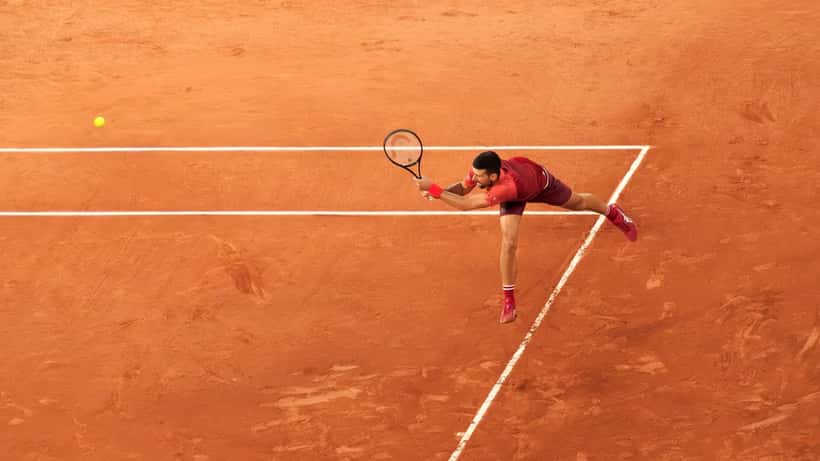
Novak Djokovic walked off Court Philippe-Chatrier just before midnight on Wednesday 27 May 2026 with a 6-3, 6-2, 6-7(9), 6-3 win over French wildcard Valentin Royer, his second-round result at Roland Garros 2026. The Serbian is 39 years and 0 days old. He is the oldest man to reach the third round in Paris since Roger Federer in 2021, and he has now won 91 of his last 100 Grand Slam matches against players he is, on average, more than ten years older than.
For Australian recreational athletes — the 1.4 million Australians aged 40 and over who regularly play tennis, golf, or competitive social sport — Djokovic's late-career form is no longer just a sporting curiosity. It has become one of the most-studied case files in sports medicine: a real-time experiment in what training, recovery, and lifestyle protocols can extend high-level performance into the late 30s, and which ones are evidence-based enough to apply to the rest of us.
What the Roland Garros sports-medicine teams are watching
Djokovic's published recovery protocol, his physiotherapy team's interviews, and his observable movement patterns on court give sports physicians a remarkably complete picture. Three elements appear repeatedly in the analysis being published in the European Journal of Sport Science and the Australian Journal of Science and Medicine in Sport:
Movement preparation, not stretching. Djokovic's pre-match routine is now closer to 45 minutes of dynamic mobility and neural priming than the static-stretching routine that dominated tennis preparation in the 2000s. Australian Institute of Sport guidance now reflects this shift; the AIS has formally moved away from recommending pre-exercise static stretching as a default for any athlete over 35.
Sleep as a performance variable. Djokovic publicly tracks 8–9 hours of sleep per night, with a hard rule against late-night matches affecting his rise time. Australian sleep researchers at the Centre for Sleep Science at UWA have documented that athletes who consistently sleep fewer than seven hours are three to five times more likely to suffer a soft-tissue injury within 12 months — a finding that has reshaped how Tennis Australia coaches its over-40 ranked players.
Strength work that protects joints. At 39, Djokovic still squats and deadlifts at loads well above what most recreational athletes attempt — but with a coaching emphasis on tendon adaptation and connective-tissue resilience rather than peak strength. Sports physiotherapists call this approach "load tolerance training," and it has become standard practice for masters-level Australian tennis players returning from Achilles or knee complaints.
The injury that almost ended his year
Djokovic arrived in Paris four weeks after a hamstring strain forced him to retire mid-match in Rome on 7 May 2026. Returning to a Grand Slam four weeks after a grade-one strain at any age is aggressive; doing so at 39 was, in the words of one Sydney-based sports physician, "a calculated risk that worked only because the rehab progression was textbook."
The protocol — published in fragments by Djokovic's physiotherapist on social media and corroborated by Rome-tournament medical staff — followed the modern Australian sports-medicine playbook closely: 72 hours of relative rest with active calf and glute work to protect the recovering tissue, isometric loading from day four, eccentric loading from day eight, and full sprint reintroduction at day 18. For Australian club tennis players returning from a hamstring strain over 40, this 18–21-day return curve is what local sports-medicine clinics now use as a default benchmark.
What carries over to weekend Australian athletes
Most of Djokovic's regime is not transferable. Few amateur athletes can afford full-time physiotherapists, hyperbaric chambers, or daily monitored recovery sessions. But three principles have been adapted for older Australian athletes and are now recommended through Sport Australia's resources for masters-age participants, available at sportaus.gov.au.
Train for tissue resilience, not personal records. After 40, the goal of strength work shifts from maximal lifts to tendon and ligament durability. Two short, controlled strength sessions per week, focused on slow eccentric loading of calves, hamstrings, and forearms, reduces tennis-specific injury rates by roughly 30%, according to studies cited in the Australian Journal of Science and Medicine in Sport.
Treat sleep like a training session. A 7-hour minimum, with consistent wake times, is the single highest-yield habit in masters athletes. Players who add even 45 minutes per night over a 12-week block show measurable improvements in reaction time and reduced soft-tissue injuries — without changing anything else.
Respect the 48-hour rule. Two consecutive days of high-intensity play after 40 dramatically increases the risk of overuse injuries, particularly Achilles tendinopathy and elbow tendinopathy. Djokovic's match schedule deliberately spaces high-load sessions; club players who replicate this pattern report significantly fewer in-season injuries.
When recreational athletes should consult a sports physician
The line for older Australian athletes is clearer than it used to be. A consultation is warranted when an injury fails to improve within 7–10 days of standard self-care, when the same injury recurs more than twice in 12 months, or when sleep, energy, and recovery are persistently degraded despite no change in training load. The Royal Australian College of General Practitioners recommends a sports-physician referral for any tendon injury in adults over 40 that has not resolved within four weeks.
For Australian tennis players in their 40s, 50s, and 60s — and the rising number of pickleball converts adding load to long-rested joints — Djokovic's run in Paris is less a sporting headline than a data point. The 39-year-old has not beaten time. He has bought himself an extra four to five years of high-level play by treating recovery, sleep, and load management as core training, not luxuries.
He plays Joao Fonseca or Dino Prizmic in the third round on Friday. Whatever the result, the longevity playbook he is publishing in public — match by match, injury by injury — is now the most influential masters-athlete reference document of the decade.
If you are an Australian recreational athlete over 40 managing a persistent injury, a load-tolerance plateau, or a return-to-sport timeline, a single consultation with a sports physician or accredited exercise physiologist can shorten your recovery and reduce your re-injury risk. Expert Zoom connects you with Australian sports-medicine specialists and physiotherapists familiar with masters-age return-to-play protocols.
For broader peak-performance context across the men's tour and the recovery science behind it, see our coverage of Jannik Sinner's Monte-Carlo Masters peak-performance run.
