 Emily Turner
On 23 July 2026, Ashok Sharma ran in to bowl his first over for India at the Harare Sports Club, Zimbabwe, becoming the country's newest T20I cricketer. The 24-year-old Gujarat Titans pacer — raised in a farming village near Jaipur, Rajasthan — had taken 28 wickets in 16 T20 matches to earn this moment. As fans across Australia and India watched his express pace in action, the conversation that rarely follows was missing: what does it cost, physically, to bowl fast? And how many young Australian club cricketers are absorbing the same load without the monitoring systems that protect elite players?
The Biomechanical Reality of Fast Bowling
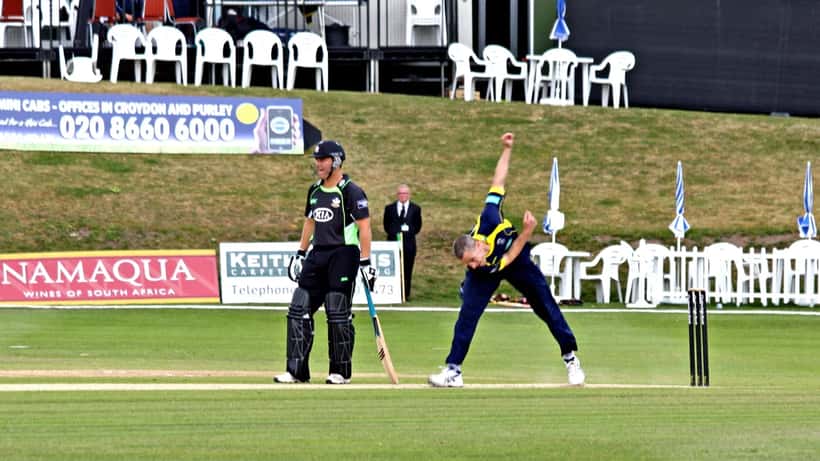
Fast bowling is among sport's most physically demanding skills. Each delivery requires a bowler to generate ground reaction forces equivalent to 8–9 times their body weight through the back foot, according to research cited by the Australian Institute of Sport. The lumbar spine — particularly in bowlers still developing bone density — absorbs that stress over thousands of repetitions each season: club matches, state representative cricket, IPL fixtures, and now international tours.
Ashok Sharma's route to Harare included 16 T20 matches and 28 wickets at IPL level. Even in short-form cricket, that workload accumulates. His selection over rival pacers reflected confidence in his pace, but express pace comes with a structural cost.
The injury that defines fast-bowling careers — at elite and community level alike — is a stress fracture of the pars interarticularis, the small bony section connecting vertebrae in the lower back. Cricket Australia's high-performance network has estimated that 30–40% of young fast bowlers who start bowling regularly from their mid-teens will experience clinically significant lumbar load problems before the age of 25. Most never see a specialist until the fracture is complete.
Australia's Fast Bowling Problem: Not Just an Elite Issue
Australia has produced some of the finest fast bowlers in world cricket — Pat Cummins, Mitchell Starc, Josh Hazlewood — but for every career that survives the system intact, dozens more end early with stress fractures, disc protrusions, or hip pathology. The less-visible version of this problem plays out every weekend on community ovals across New South Wales, Victoria, Queensland, and Western Australia.
When Australian fans watch a 24-year-old debut for India at express pace, that image filters down to club dressing rooms. Young bowlers want to bowl faster. Coaches want aggressive front-foot action. Nobody in a junior or senior grade club has access to a physio monitoring delivery counts.
As documented in the injury patterns tracked across West Indies vs New Zealand 2026: the fast-bowler injuries every week, even professional squads with full medical support cycle through bowling injuries in a single series. Club-level players are absorbing similar loads with none of the protection.
The problem has a secondary dimension that rarely enters the conversation: nutrition. Young fast bowlers who are undereating — common in adolescents managing body image alongside athletic performance — have measurably lower bone density and a disproportionately higher fracture risk. A sports medicine assessment addresses both the mechanical load and the systemic factors that determine how well a body tolerates that load.
What a Sports Medicine Consultation Actually Does
A sports medicine doctor or musculoskeletal physiotherapist trained in cricket injury assessment provides something a general GP rarely delivers in a standard appointment: a structured evaluation of bowling load, action mechanics, and bone stress risk. The tools they use — including MRI and SPECT-CT bone scans when indicated — can detect a pars stress reaction before it becomes a frank fracture.
That distinction is everything. A stress reaction caught early means 6–8 weeks of modified training and a graduated return programme. Caught late, after months of continued bowling load, the same injury can mean 16–20 weeks completely off bowling, surgical assessment in severe cases, and in the worst outcomes, a permanent change of action that sacrifices pace.
Sports Medicine Australia's guidelines recommend that any young bowler under 25 who bowls more than 4–6 overs per session and reports persistent lower back pain should receive a clinical examination within two weeks of symptom onset, with load reduction as the immediate first response. Imaging is indicated if symptoms persist beyond three weeks. A structured return-to-bowl programme supervised by a qualified practitioner is the standard of care.
The window of intervention is short. A 16-year-old playing weekend district cricket and training twice per week can accumulate more bowling deliveries across a season than an adult professional in a managed environment — typically with zero load monitoring, no screening, and no access to the clinical pathways that protect elite cricketers like Ashok Sharma.
As seen in the recovery pathway described for Jofra Archer's return to England's T20I squad, even world-class fast bowlers with full medical teams take 12–18 months to return from serious back injuries. For club players without that infrastructure, prevention is the only viable strategy.
When Back Pain Means More Than Muscle Soreness: A Real Scenario
Consider a scenario familiar to sports clinics across Australia's summer cricket season.
A 19-year-old district cricketer in outer Melbourne — a right-arm medium-fast bowler — plays First XI cricket on Saturdays and trains on Tuesday and Thursday evenings. Over the 2025–26 season he bowls an average of 14 overs per match day and roughly 35–40 deliveries each training session. His total weekly bowling load from October through March runs to approximately 190–220 deliveries per week.
In mid-December he mentions to his coach that his lower back aches after bowling. His coach attributes it to fitness and tells him to stretch more. His parents assume it is growing pains. He takes ibuprofen on match days and continues. By March, the pain has become localised to the right side of his lumbar spine, worse on extension and rotation to the right. An MRI arranged after a GP referral reveals a bilateral L4 pars stress fracture with bone marrow oedema — consistent with a load that has been accumulating since at least October.
The direct rule here: if a fast bowler under 22 is bowling more than 150 deliveries per week and reports lower back pain on the bowling-arm side that persists for more than 10 days, an urgent sports medicine review is the appropriate response — not a wait-and-see approach. Caught at the stress reaction stage (October–November in this scenario), the intervention is 6–8 weeks of modified training at a cost of roughly $300–$600 in specialist and physiotherapy consultations. Caught as a complete bilateral fracture in March, the cost rises to $1,800–$2,500 in imaging, specialist consultation, and a rehabilitation programme extending through the following pre-season.
Tom's outcome — bowled out for a full season at 19 — is not uncommon. What is uncommon is the junior cricketer who receives a proactive assessment before symptoms become structural damage.
What to Do Now
Whether you are a young fast bowler, a parent in the stands, or a club coach managing a junior programme, the steps are consistent:
Count deliveries, not just overs. A simple weekly tally — deliveries per session multiplied by sessions per week — creates visibility. If a junior bowler consistently exceeds 150 deliveries per week, a physiotherapy review is appropriate as a preventive measure, even without symptoms.
Treat persistent back pain as urgent. Lower back pain in a fast bowler that does not resolve within two weeks of modified activity is not standard training soreness. It is a clinical screening indicator that warrants professional assessment.
Book a sports medicine or physiotherapy consultation. You can self-refer to a musculoskeletal physiotherapist with cricket experience, or ask your GP for a referral. ExpertZoom connects you with Australian sports medicine specialists and cricket-experienced physiotherapists who understand how fast-bowling load translates to clinical risk.
Follow age-appropriate load guidelines. Cricket Australia recommends a maximum of four overs per match for under-17 players, scaling progressively with age and development. Many community clubs exceed these limits, often inadvertently.
Ashok Sharma reached his T20I debut at 24 through years of managed progression — Rajasthan cricket, India A cricket, IPL cricket — in systems designed to build load tolerance gradually. For every young Australian pace bowler who wants to follow a similar path, the most important investment is not extra net sessions. It is a healthcare professional who understands cricket and can catch injury risk before it rewrites the story.
This article contains general health information and does not substitute for advice from a qualified sports medicine practitioner or physiotherapist. If you or your child is experiencing symptoms, seek professional assessment promptly.
