 Olivia Miller
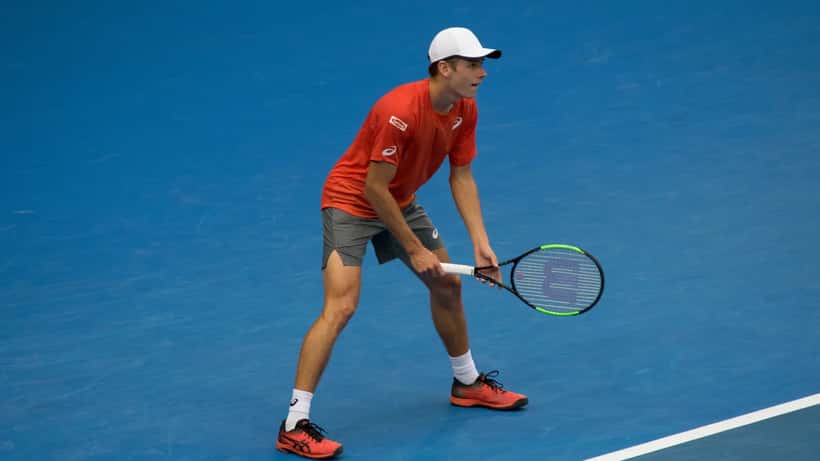
Australia's top-ranked tennis player Alex de Minaur was eliminated from the Madrid Open on Thursday, April 24, 2026, losing 6-3, 6-1 to Rafael Jódar, a 19-year-old Spanish wildcard ranked outside the top 200. The result arrived in just over an hour and left de Minaur — seeded fifth at the tournament — without a win in four consecutive tour events.
The score-line was stark: de Minaur, who won the Rotterdam title in February and reached the Australian Open quarter-finals in January, was unable to match an unranked teenager across two sets on clay in Madrid. It was his second successive first- or second-round exit after a first-round loss in Barcelona the previous week.
A Rapid Decline After a Promising Start
De Minaur entered 2026 in the best form of his career. His Rotterdam win was clinical, and his Australian Open run energised a home crowd. At that point, many observers considered him a genuine Roland Garros contender by May.
The reversal since Rotterdam has been steep. According to ATP Tour match records, de Minaur has won just four of his last nine matches. That converts to a 44 per cent win rate across March and April — a sharp fall from the 78 per cent win rate he maintained across January and February. The deterioration is not subtle. It is measurable, consistent, and carries the hallmarks of what sports medicine specialists describe as compound performance regression.
What Sports Medicine Specialists Recognise
Compound performance regression is a term used by sports physicians and performance scientists to describe a decline that stems from multiple overlapping causes rather than a single identifiable injury or error. The Australian Institute of Sport (AIS), which supports elite Australian athletes including those on the ATP and WTA tours, identifies three primary contributors: accumulated physical fatigue, neurological load from sustained competitive travel, and disrupted recovery cycles.
De Minaur's schedule offers context. He competed across Australia in January, flew to Europe for Rotterdam in February, then transitioned to the clay season in March. Clay demands a fundamentally different physical profile from hard courts: longer rallies, higher lateral load on the hips and knees, greater aerobic output per point. Without a dedicated transition period, athletes accustomed to the hard-court game often reach clay tournaments already depleted.
The AIS recommends a minimum of five to seven days of active rest — light movement, no competitive match play, sleep prioritisation — for athletes transitioning between surface types after a high-output hard-court block. Whether de Minaur's programme incorporated this level of recovery is unclear. His results suggest it may not have.
The Mental Health Dimension: When Excellence Becomes a Weight
Sports psychologists draw a sharp distinction between short-term performance anxiety — a normal, manageable response to competitive pressure — and the deeper mental load that accumulates when an elite athlete begins to carry the expectations of an entire sport.
De Minaur is the first Australian man to reach the top five in the ATP rankings since Lleyton Hewitt. He is frequently described in Australian sports media as the country's most important tennis asset. That kind of cultural weight does not disappear when the player walks onto a clay court in Madrid.
Research published through Sport Australia, the federal government's sport development body, describes a process researchers call evaluative apprehension: the increased self-monitoring that occurs when an athlete performs under perceived scrutiny. In practical terms, it means that fluid, automatic movements — a cross-court backhand, a first-serve placement decision — become subject to conscious analysis in the moment of execution. The result is hesitation, mechanical play, and the breakdown of the instinctive game that characterises top-level performance.
The 6-1 second set against Jódar carries the signature of this pattern. De Minaur holds the technical ability to defeat an unranked teenager on any surface. The absence of a physical injury explanation — he completed the match without retiring — points to a psychological and physiological overload that shut down competitive instinct.
What Australians Who Perform Under Pressure Should Know
De Minaur's situation mirrors patterns that health specialists working outside sport see regularly. Sustained high output — in professional environments, in caregiving, in high-stakes vocations — without adequate recovery creates the same cascade in the general population that it creates in elite athletes. The presenting symptoms are consistent: declining output despite unchanged effort, loss of motivation after previously valued achievements, disrupted sleep, and emotional flatness.
If you recognise these signs in yourself or someone close to you, the appropriate response is not to push through. A general practitioner can assess underlying physical contributors — iron levels, thyroid function, cortisol, sleep quality — that are frequently missed when burnout is labelled purely psychological. A sports medicine physician or occupational health specialist can map workload patterns and design a recovery protocol. A clinical psychologist can address the mental performance component.
If you are already familiar with the physical terrain — clay courts and injury risk explored in depth for Australian tennis fans — the psychological dimension deserves equal attention.
The evidence base for combined physical-psychological intervention is strong. According to the AIS performance health framework, athletes who receive integrated medical and psychological support after acute regression return to competitive performance faster than those managed through training intensity adjustments alone.
What Comes Next for De Minaur
Rome and Roland Garros remain on the 2026 clay calendar before de Minaur transitions to grass at Queen's and Wimbledon. These are not venues where early exits are acceptable if Australian tennis is to maintain its international standing.
The honest assessment of de Minaur's April suggests he needs a period of genuine medical and psychological support before Rome, not simply a tactical debrief. His talent is not in question. The question is whether the people around him have the expertise to correctly diagnose what the body and mind are communicating.
For Australians dealing with performance-related health issues — whether elite athletes or professionals working in high-pressure environments — early consultation with the right specialist shortens recovery timelines significantly. The Australian Institute of Sport provides guidance on evidence-based approaches to athlete health, performance recovery, and mental wellbeing that apply well beyond elite sport.
This article is for informational purposes only and does not constitute medical or psychological advice. If you are experiencing symptoms of burnout, fatigue, or performance-related stress, please consult a qualified health professional.
