
 Isabelle Torres
TL;DR: For the 2025–26 financial year (1 July 2025 – 30 June 2026), eligible Australians can claim work-from-home running costs at 67 cents per hour under the ATO's fixed rate method, or opt for the actual cost method for potentially larger deductions. The ATO's data-matching program automatically cross-references employer income statements, bank records, and share registry data — returns that overclaim or underdisclose are flagged within weeks of lodging. Three categories generate the most claims and the most audits: work-from-home expenses, car and travel, and charitable donations. This guide explains the current rules for each category, how to substantiate them correctly, and which specific behaviours draw ATO compliance scrutiny. Self-preparers must lodge by 31 October 2026; registered tax agents can access extended deadlines into 2027.
The Three Golden Rules the ATO Applies to Every Deduction
The Australian Taxation Office (ATO) applies three non-negotiable tests to every deduction claim. Failing any single test means the deduction is disallowed — regardless of how reasonable the underlying expense seems.
Rule 1 — You spent the money yourself and were not reimbursed. If your employer covered the cost, either directly or through salary sacrifice, you cannot claim it. This applies to equipment, professional memberships, and training courses funded via any employer arrangement.
Rule 2 — The expense is directly related to earning your income. A deduction must connect directly to your current employment or income-producing activity. Costs that are merely convenient or that relate to a future career change do not qualify. A registered nurse completing a primary school teaching degree to change careers cannot deduct those fees — the course leads to a different profession, not an improvement in current nursing skills [ATO, Tax basics for individuals, 2025].
Rule 3 — You have a record to prove it. Receipts, bank statements, logbooks, and invoices are all acceptable forms of evidence. The ATO accepts digital copies provided they are clear and legible. Without documentation, a deduction can be disallowed even when the expense was genuine.
Consider the case of Marcus, a Brisbane-based IT consultant who claimed $4,200 in work-from-home expenses for the 2024–25 year but kept no usage diary. When the ATO requested substantiation, he was unable to recover enough records and the deduction was reduced to $1,400. Logging hours in real time — not reconstructing records at tax time — is the most reliable protection.
À retenir: These three rules apply to every category below. When in doubt, ask: Did I pay it? Does it connect to my current income? Can I prove it?
Work-From-Home Deductions in 2026: Fixed Rate vs Actual Cost Method
Working from home generates running costs that may be partially deductible. The ATO provides two calculation methods for the 2025–26 financial year.
The Fixed Rate Method
The fixed rate method allows a deduction of 67 cents per work-from-home hour [ATO, PCG 2023/1]. This single rate covers electricity and gas used for heating, cooling, and lighting; phone and internet usage; and stationery and computer consumables. You must keep a continuous record of the actual hours worked from home — a diary, timesheet, or roster. A 12-week representative sample is acceptable only when your work-from-home pattern is consistent and stable throughout the year.
What the 67-cent rate does not cover: the decline in value (depreciation) of home office furniture and equipment. A desk, ergonomic chair, or work computer must be claimed separately using the depreciation rules below.
The Actual Cost Method
The actual cost method calculates the true work-related proportion of each expense — electricity, internet, phone, furniture, and equipment depreciation — based on your floor area percentage or documented usage ratios. For Australians with a dedicated home office room, this method typically yields a higher deduction, but it demands precise records: floor area measurements, itemised utility bills, and phone usage logs.
Equipment deductions (both methods): Home office items costing $300 or less — webcams, keyboards, headsets — are fully deductible in the year of purchase. Items costing more than $300 are depreciated over their effective life, as specified in the ATO's Tax Depreciation Guide. A laptop purchased for $1,800 in August 2025, used 80% for work, generates an annual depreciation deduction based on its useful life.
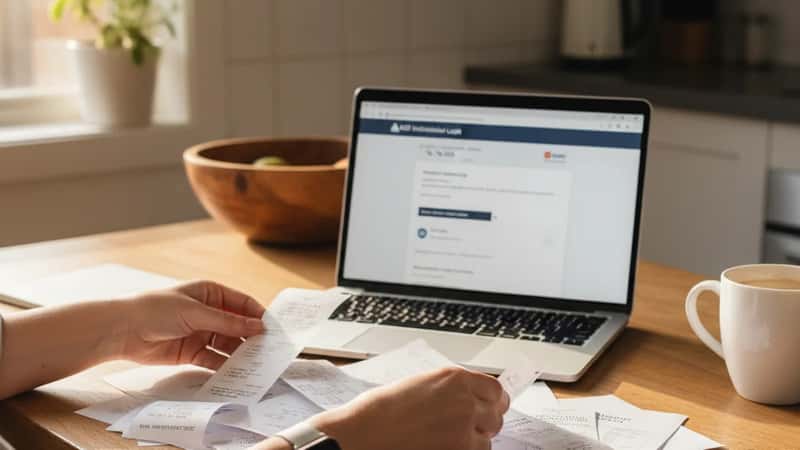
Work-Related Expenses Beyond the Home Office
Work-from-home costs are one segment of a broader set of deductible work-related expenses. The following categories are the most commonly claimed by Australian employees.
Car and Travel Expenses
Work-related travel — visiting clients, attending different worksites, or travelling between jobs in the same day — is deductible. The daily commute from home to your regular workplace is not. Two ATO methods apply:
- Cents-per-kilometre method: A flat rate per kilometre (85 cents/km for 2023–24; the ATO reviews this rate annually for subsequent years) for up to 5,000 km of work-related travel, with no need to keep fuel receipts. You must be able to show how you calculated the kilometres.
- Logbook method: Required when work-related travel exceeds 5,000 km per year, or when you want to claim actual vehicle running costs. A 12-week logbook must record every trip, purpose, and odometer reading.
Self-Education Expenses
Course fees, textbooks, travel to and from study, and internet costs for online study are deductible when the qualification directly maintains or improves the skills required in your current job. The key test — as with all deductions — is that the course relates to your existing role. A pharmacist completing a pharmacy management degree: deductible. The same pharmacist completing a real estate licence: not deductible.
Tools, Uniforms, and Protective Clothing
Tools and equipment you purchase for your own work use follow the same $300 threshold rule. Compulsory uniforms (distinctively identified as the employer's uniform) and protective clothing required by occupational health and safety rules are deductible, along with laundry costs. The ATO allows a laundry claim of up to $150 without receipts, using a per-load rate published on its website [ATO, 2025].
Professional Memberships and Subscriptions
Union fees, professional association membership fees — such as those paid to CPA Australia or Chartered Accountants Australia and New Zealand (CA ANZ) — and subscriptions to professional journals directly relevant to your employment are fully deductible without a threshold limit.
Superannuation, Investments, and Charitable Deductions
Several deduction categories apply outside of direct employment expenses and can have an outsized effect on a taxpayer's final position.
Personal Superannuation Contributions
Australians who make voluntary personal contributions to their superannuation fund can claim a deduction. To do so, they must lodge a Notice of Intent to Claim a Deduction with their fund before the tax return is filed — and before the fund processes the contribution as non-concessional. The concessional (pre-tax) contributions cap for 2025–26 is $30,000 per person, including any employer contributions already made on your behalf [ATO, Super contribution caps, 2025]. Exceeding this cap triggers an excess concessional contributions charge.
This strategy is especially valuable for self-employed individuals, part-time workers with low employer super contributions, and high-income earners looking to manage taxable income before year-end. For context on how recent superannuation rule changes affect retirement planning strategies, see Superannuation Changes April 2026: What Every Australian Needs to Know.
Negative Gearing and Investment Deductions
Interest on loans used to acquire income-producing investments — shares, managed funds, or rental properties — is deductible against that investment's income. Where investment expenses exceed investment income (a net investment loss), the shortfall is deducted from other income, reducing overall taxable income. This is the mechanism behind negative gearing. Australia's 2026 Federal Budget proposed targeted changes to negative gearing for certain property classes; taxpayers with investment properties should confirm the current rules with a registered tax agent before lodging.
Charitable Donations to Deductible Gift Recipients
Donations of $2 or more to organisations registered as Deductible Gift Recipients (DGRs) are fully deductible without a limit. The gift must be purely voluntary — no goods, services, or raffle entries in return. The ATO maintains a public DGR register at ato.gov.au where recipients can be verified before donating.
Cost of Managing Tax Affairs
The fees you pay a registered tax agent, the cost of tax return software, and expenses directly related to preparing or lodging your return are themselves deductible — but only in the income year they are incurred.
ATO Audit Triggers: What Gets You Flagged in 2026
The ATO's data-matching infrastructure is significantly more sophisticated than it was a decade ago. It ingests data from employers (income statements), banks (interest and transaction data), share registries (dividends and capital gains), state revenue offices (property transactions), and services Australia (government payments). Returns that deviate materially from expected benchmarks for your occupation and income level are selected for review.
"Our real-time data-matching now cross-references employer income statements, bank interest, and share dividends automatically. Discrepancies between what is lodged and what we already hold trigger an automated review workflow," — ATO Compliance Program guidance, 2024–25.

The Six Most Common Audit Triggers
1. WFH claims without an hours diary. The ATO has consistently identified the absence of a contemporaneous hours record as the single most common substantiation gap. Reconstructing a diary at tax time — rather than maintaining it throughout the year — is detectable and invites disallowance.
2. Car deductions that exceed occupation benchmarks. The ATO publishes occupation-specific benchmarks for a range of industries. A call-centre agent claiming 4,500 km of work travel, or a desk-based accountant claiming daily client visits, will attract questions. Stay within the range typical for your role.
3. Claiming 100% of phone and internet costs. Few employees have zero private usage. The ATO expects a documented work-use percentage, typically between 25% and 75% depending on employment type. Blanket 100% claims on shared personal devices are routinely challenged.
4. Donation claims well above income-bracket averages. Claims that are statistically implausible relative to your declared income — for example, $5,000 in donations on a $45,000 income — draw attention. Keep DGR receipts for every claim.
5. Undisclosed foreign income or offshore accounts. The ATO participates in the OECD's Common Reporting Standard (CRS) and receives automatic financial account information from over 100 jurisdictions. Unreported offshore interest or rental income is increasingly difficult to conceal.
6. Omitted capital gains. The ATO's data-matching with share registries and cryptocurrency exchange reporting means omitted capital gains events are frequently detected during pre-lodgment checks. Keep full records of acquisition and disposal dates and amounts.
If the ATO contacts you seeking substantiation, respond by the stated deadline, provide all available records, and consider engaging a registered tax agent to manage the correspondence. Genuine errors disclosed proactively are treated more favourably than non-responses under the ATO's Taxpayer's Charter.
Australia's middle-class tax pressures in 2026 make correct deduction claiming more important than ever — a disallowed claim can convert a refund into a tax liability with interest.
Frequently Asked Questions
What is the lodgment deadline for the 2026 Australian tax return?
The standard deadline for individuals lodging their own return is 31 October 2026. If you engage a registered tax agent before that date, their lodgment program typically extends to 15 May 2027 (or later for complex returns). Register with a tax agent early in the financial year to access the full extension.
Can I use both the fixed rate and actual cost methods in the same year?
No. You must choose one method for the entire income year and apply it consistently. You can, however, switch methods between income years. In practice, people with a dedicated home office room — where the floor-area ratio calculation is cleanly documentable — often benefit from switching to the actual cost method.
What records do I need to survive an ATO audit?
You need contemporaneous records: receipts dated at the time of purchase, a WFH hours diary maintained throughout the year (not reconstructed), a logbook for car travel, and bank or credit card statements confirming payment. The ATO accepts digital records in PDF or image format, provided they are legible and include the date, amount, supplier, and nature of the expense.
How does the concessional superannuation cap affect my deduction?
The $30,000 concessional cap includes all contributions made to your super — your employer's Superannuation Guarantee contributions (currently 11.5% of ordinary time earnings for 2025-26) plus any voluntary contributions you make. If your employer already contributes close to or above $30,000 on your behalf, making additional personal contributions and claiming them as a deduction could trigger excess contributions tax. Calculate the headroom before acting.
Disclaimer: The information in this article is provided for general informational purposes only and does not constitute financial or tax advice. Australian tax laws are complex and subject to change. Consult a registered tax agent or financial adviser for advice specific to your circumstances.