 Isabelle Torres
TL;DR: Australia's Small-scale Technology Certificates (STCs) remain the most significant federal solar rebate available to homeowners in 2026, delivering upfront discounts of $2,000 to $4,500 on a standard 6.6 kW system. The deeming period for installations completed in 2026 has dropped to five years — reducing the certificate count compared to earlier years — but the savings are still substantial. Add a Virtual Power Plant (VPP) program and a state-level battery incentive, and the total return on a solar-plus-storage system can cut payback time to under six years.
More than four million rooftop solar systems now operate in Australia [Clean Energy Regulator, 2025], the highest per-capita adoption rate in the world. Yet many homeowners still don't fully understand how STCs are calculated, what a VPP actually pays, or why Clean Energy Council (CEC) installer accreditation isn't optional — it's a legal requirement for your rebate to be valid.
How the STC Scheme Works — and Why It Still Matters in 2026
The STC scheme — administered by the Clean Energy Regulator (CER) under the Renewable Energy (Electricity) Act 2000 — creates tradable certificates for eligible solar photovoltaic (PV) systems rated under 100 kW. Each certificate represents one megawatt-hour of renewable electricity displaced over the deeming period. Homeowners don't trade the certificates themselves: your accredited installer creates the STCs, sells them on the spot market or through the Small-scale Technology Certificate Clearing House, and passes that value directly off your installation invoice.
In practice, this point-of-sale mechanism means the rebate is invisible to the homeowner — your quote already arrives with the discount applied. A 6.6 kW system that would otherwise cost $9,500 might appear on your invoice as $6,400, because the installer has pre-sold your STC entitlement before installation day. The Clean Energy Regulator oversees compliance and maintains a public registry of all created certificates.
Why the Deeming Period Matters More Than Ever
The STC program is legislated to end on 31 December 2030. Each 1 January, the deeming period drops by one year. For any system installed between 1 January and 31 December 2026, the deeming period is five years. This annual step-down means that every year you delay, your STC entitlement — and therefore your upfront discount — shrinks. A homeowner who installs in 2026 captures five years' worth of certificates; one who waits until 2028 captures only three. Acting in 2026 locks in significantly more value than waiting.
Calculating Your STC Discount in 2026
The number of STCs your system generates depends on three variables: system output (measured in kilowatts), the STC zone in which the property sits, and the deeming period (five years for 2026 installations). Australia is divided into four STC zones based on solar irradiance — Zone 1 covers the sunniest regions (far north Queensland, Northern Territory) and yields the most certificates; Zone 4 covers Tasmania and yields the fewest.
The formula: STCs = System Size (kW) × Zone Rating (MWh/kW/year) × Deeming Period (years)
For a standard 6.6 kW system installed in 2026:
- Sydney (Zone 3): 6.6 × 1.382 × 5 = 46 STCs → At $38/STC = $1,748 upfront discount
- Brisbane (Zone 2): 6.6 × 1.536 × 5 = 51 STCs → At $38/STC = $1,938 upfront discount
- Darwin (Zone 1): 6.6 × 1.622 × 5 = 53 STCs → At $38/STC = $2,014 upfront discount
The STC spot price has traded between $35 and $40 in 2024–2025 [Clean Energy Regulator, 2025]. Larger systems — particularly 10 kW+ installations eligible under the scheme cap — proportionally produce more certificates, with total discounts reaching $3,000 to $4,500 for bigger households.
VPP Programs — Earning Ongoing Income From Your Battery
A Virtual Power Plant (VPP) is a network of home battery systems aggregated by a retailer or grid operator. When the grid is under stress — typically on summer afternoons when air-conditioning demand peaks — the VPP operator draws stored energy from enrolled home batteries simultaneously, effectively dispatching them as a single large power station. In exchange, enrolled homeowners receive ongoing financial credits, reduced energy tariffs, or direct payments.
Three major VPP programs are currently active across Australia:
- SA Power Networks VPP (South Australia) — part of the state's world-first grid-scale battery initiative; enrolled households receive network credits and reduced time-of-use tariffs.
- AGL Virtual Power Plant — available nationally to AGL customers with eligible batteries; subscribers earn bill credits of approximately $1–$2 per kWh dispatched during grid events.
- Simply Energy VPP — combines an upfront battery purchase subsidy with ongoing export revenue under a participation contract.
VPP participation is entirely separate from your STC rebate — you can claim both simultaneously. The additional annual benefit from an active VPP participation ranges from $300 to $800 per year, depending on battery capacity and local grid conditions [Australian Energy Market Commission, 2025]. With Australia facing increasing pressure on its electricity grid, joining a VPP positions your home as an active grid asset rather than a passive consumer.
State Rebates That Stack on Top of Your Federal STC Discount

The federal STC scheme is a floor, not a ceiling. Every Australian state and territory operates its own incentive layer, and most programs can be claimed in addition to STCs — meaning savvy homeowners can access two or three separate incentives for a single installation.
| State/Territory | Program | Maximum Benefit |
|---|---|---|
| Victoria | Solar Homes Program | Up to $1,400 (solar) + up to $8,800 (battery) |
| South Australia | Home Battery Scheme | Up to $4,000 (battery, with VPP obligation) |
| Queensland | Battery Booster | $4,000 rebate on battery storage |
| New South Wales | Empowering Homes | Interest-free loan up to $14,000 (solar + battery) |
| ACT | Sustainable Household Scheme | Zero-interest loan up to $15,000 |
| Western Australia | Household Energy Storage Scheme | $400 rebate on battery (limited availability) |
Eligibility thresholds, income limits, and application windows differ significantly between programs. Victoria's Solar Homes Program, for example, applies income and property value caps that exclude higher-earning households; Queensland's Battery Booster requires installation by a Q-Accredited contractor.
The federal government's broader push toward household electrification has also made the policy landscape more generous. As green energy tax policy continues to evolve under Treasurer Chalmers, additional incentives or top-up mechanisms may be introduced mid-year. Always verify current eligibility on your state energy department's website before signing a contract, as program funding caps can be exhausted mid-year.
Installer Accreditation — Why Your Choice of Solar Company Is Non-Negotiable
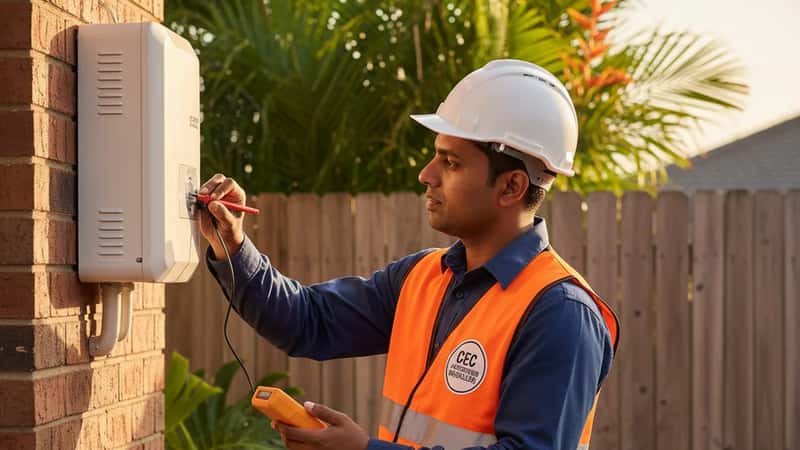
Sarah, a homeowner in a suburban Gold Coast neighbourhood, received three quotes for a 10 kW solar system in early 2025. The cheapest — $2,400 below the next bidder — came from a contractor who promised to "process the STC paperwork after installation." Six months later, no discount had been applied to her account. The inverter had not been commissioned to Australian Standard AS/NZS 4777 (requirements for grid connection of energy systems using inverter technology), and the Clean Energy Regulator had rejected the certificate claim because the contractor held no CEC accreditation.
Under Australian law, STCs can only be created by — or assigned to — a CEC-accredited installer. An unaccredited company may physically mount the panels, but you will receive no federal rebate, your installation may fail to comply with Australian Standards, and your distribution network service provider (DNSP) may refuse to approve your grid connection.
How to Verify CEC Accreditation Before You Sign
Before committing to any installer, confirm all of the following:
- The installer appears on the CEC Accredited Installer Registry at www.cleanenergycouncil.org.au with a current (not expired) accreditation.
- The solar panels and inverter are listed on the CEC Approved Products List.
- The written quote specifies compliance with AS/NZS 5033 (installation and safety requirements for PV arrays) and AS/NZS 4777 (grid connection).
- The STC discount appears as a line item reduction on the installation invoice — not as a separate claim you must make yourself.
A legitimate CEC-accredited installer handles all STC documentation and applies the discount before you pay. If any company asks you to claim the rebate yourself after installation, or cannot produce their CEC accreditation number on request, do not proceed. Australia's growing renewable energy sector has unfortunately attracted a parallel surge in unlicensed operators targeting first-time solar buyers.
How to Claim Your STC Rebate — What Actually Happens After You Sign
From a process standpoint, claiming the STC discount requires nothing from the homeowner beyond choosing a CEC-accredited installer. Here is the sequence from contract to feed-in tariff activation:
- Obtain multiple quotes — from at least three CEC-accredited installers. Confirm each quote includes the STC discount as an applied reduction, with the certificate count and estimated value stated explicitly.
- Sign the contract and schedule — your installer lodges a pre-approval with the local distribution network service provider and books the installation date.
- Installation day — panels are mounted, the inverter is installed and commissioned, and the installer provides a signed installation certificate and compliance declaration.
- STC creation — within 12 months of installation (typically within days to weeks), your installer submits the STC claim to the Clean Energy Regulator's Small-scale Technology Certificate Clearing House.
- Network connection approval — the DNSP inspects the meter configuration and approves export. This typically takes 5–15 business days depending on the state and network operator.
- Feed-in tariff activation — your energy retailer activates your export metering, and you begin earning feed-in credits for electricity your system exports to the grid.
"The biggest mistake homeowners make is assuming the cheapest quote will save them money. An unaccredited installer voids your STC entitlement entirely — you've paid full price for a rebate you'll never receive." — CEC-accredited solar installer, Brisbane, 2025
À retenir: STCs cannot be claimed by homeowners directly. They are created and sold by your accredited installer, with the proceeds applied as an upfront discount on your invoice. The only action required from you is verifying CEC accreditation status before signing any contract.
Frequently Asked Questions on Solar Panel Rebates in Australia 2026
Do STCs reduce the GST on solar panels? No. STCs reduce the pre-GST cost of the system. GST is then calculated on the already-reduced price, so you do save a small additional amount on GST — but the rebate itself is calculated before tax is applied. Your net savings remain substantial either way.
Can I get an STC rebate if I add a battery after the initial solar installation? Batteries are not eligible for federal STCs — only the solar PV panels and inverter generate certificates. State programs cover battery storage separately: Victoria's Solar Homes battery rebate, Queensland's Battery Booster, and South Australia's Home Battery Scheme each provide dedicated storage incentives independent of the STC scheme.
What happens if my installer goes out of business before creating my STCs? The STC entitlement belongs to the system owner once installation is complete. If your installer collapses before submitting the certificate claim, you can apply to the Clean Energy Regulator to have the creation rights reassigned to another accredited party — a process that typically takes six to eight weeks.
Is there an income test for the federal STC scheme? No. The STC scheme has no means testing — all eligible homeowners and small businesses qualify regardless of household income or property value. Some state-level programs do apply income or property value caps (notably Victoria's Solar Homes Program), but the federal rebate is universally available to any property with an eligible solar installation.
Disclaimer: This article provides general information about government incentive programs and is intended for educational purposes only. Solar rebate eligibility, STC values, and state program details change regularly. Consult a CEC-accredited installer and verify current program terms directly with the Clean Energy Regulator and your state energy department before making any financial commitments.