 David Carter
A fast-moving vegetation fire broke out Sunday, April 5, 2026, at approximately 3:05 PM near the 500 block of La Moree Road in San Marcos, California — prompting evacuation orders for two zones including parts of the CSU San Marcos campus. CAL FIRE and the San Marcos Fire Department responded with ground crews and aerial resources as the blaze threatened nearby structures.
The fire is part of a broader pattern of early spring wildfires in Southern California. Concurrent fires in the region burned over 4,100 acres in early April 2026 amid dry conditions and seasonal winds. For homeowners across the United States, events like this raise an urgent question: do you know what to do in the first 72 hours after fire damages your property?
Evacuate First — Assess Later
When fire authorities issue evacuation orders, there is one rule: leave immediately. In San Marcos, two evacuation zones (SDC-0790 and SDC-0793) were activated within minutes of the fire spreading. Residents had little time to gather belongings.
The most common mistake homeowners make after a wildfire is returning too early to assess damage. Structural fire damage is not always visible from the outside. A building can appear intact while compromised beams, weakened foundations, or toxic smoke residue create serious safety hazards inside.
Before re-entering any fire-affected property, confirm with local fire authorities that your zone has been formally cleared. In California, this is coordinated through CAL FIRE and county emergency management agencies.
The Four Types of Fire Damage You Need to Understand
Fire damage falls into four categories that require different types of professional assessment:
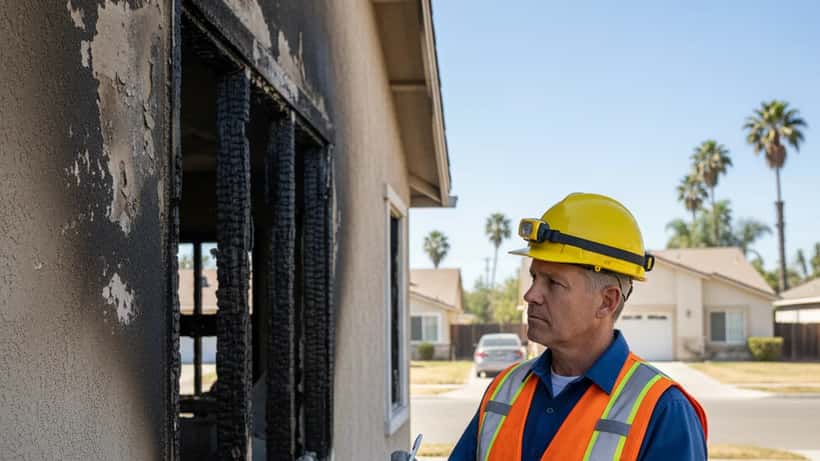
1. Structural damage: Heat can compromise load-bearing walls, roof trusses, and foundation integrity even when visible charring is minimal. A licensed structural engineer or general contractor must evaluate this before you walk through the building.
2. Smoke and soot contamination: Smoke penetrates walls, HVAC systems, insulation, and furniture. Soot contains toxic compounds including carbon monoxide residue, formaldehyde, and benzene. Standard cleaning is not sufficient — professional remediation is required.
3. Water damage from firefighting: The water used to suppress a fire can cause mold growth within 24 to 48 hours. Moisture meters and infrared cameras are used by certified restorers to detect hidden saturation in walls and ceilings.
4. Electrical system compromise: Heat and water can damage wiring insulation, circuit breakers, and electrical panels. Even if the power company restores service, a licensed electrician must inspect the system before it is safe to use.
Document Everything Before Touching Anything
Before any cleanup begins — before calling your insurer, before removing debris — document the damage thoroughly. Use your phone to photograph and video every room, every wall, every damaged item. Do this systematically: room by room, interior and exterior.
This documentation is the foundation of your insurance claim. Under the National Flood Insurance Program and standard homeowner policies in the United States, insurers are required to send an adjuster to assess the damage. According to FEMA's guidance on disaster recovery, policyholders who provide detailed documentation of pre-loss condition and post-loss damage receive faster and more complete settlements.
Keep receipts for any emergency expenses — hotel stays, temporary storage, emergency repairs to prevent further damage. Most standard homeowner policies include "additional living expenses" (ALE) coverage that reimburses these costs while your home is uninhabitable.
When to Call a Public Adjuster or Contractor — and in What Order
The sequence matters:
Step 1: File your claim with your insurer within the required timeframe (usually 30 to 60 days, check your policy).
Step 2: Do not sign any contractor agreement until the insurance adjuster has completed their assessment. Emergency board-up and tarping work can proceed, but hold off on restoration contracts.
Step 3: If the insurer's settlement offer seems low, consider hiring a licensed public adjuster — an independent professional who negotiates on your behalf. Public adjusters typically charge 5% to 15% of the settlement amount, but can increase payouts significantly for complex claims.
Step 4: Once you have your insurance scope of work, hire a licensed general contractor for restoration. In California, all contractors must be licensed through the Contractors State License Board (CSLB). Verify the license before signing any contract.
Avoid door-to-door contractors who show up immediately after a disaster. Post-wildfire scams targeting homeowners are common — the California Department of Consumer Affairs has documented hundreds of cases each year following major fire events.
Wildfire Risk and Your Insurance Coverage
The San Marcos area, like much of Southern California, sits in a fire hazard severity zone. If your home is in a High or Very High Fire Hazard Severity Zone as designated by CAL FIRE, standard homeowner insurers have the right to non-renew your policy. More than 100,000 California homeowners lost their insurance in 2024 and 2025 due to wildfire risk reclassifications.
If you've been dropped by a standard carrier, the California FAIR Plan provides a baseline fire insurance option — but it is not a full homeowner policy and requires supplemental coverage. A licensed insurance professional or public adjuster can help you understand your current exposure and options.
What an Expert Can Do That You Cannot
Home improvement contractors, licensed engineers, and certified fire damage restorers have training and equipment that no homeowner has: moisture meters, structural load calculations, air quality testing, and experience navigating insurance protocols.
The instinct to clean up quickly and move back in is understandable — but acting without professional guidance can void insurance coverage, create health hazards, or leave structural problems that worsen over time. After a fire like the one in San Marcos, the smartest first call is to a professional who specializes in fire damage assessment — before the contractors, before the cleaners, and alongside your insurer.
Note: This article is for informational purposes only. For specific legal or insurance advice regarding your property, consult a licensed professional in your state.
