 Evelyn Carter
Is Kundalini Yoga the most misunderstood form of yoga in the United States? Developed over thousands of years and brought to the West by Yogi Bhajan in 1969, Kundalini Yoga combines breath work, movement, sound, and meditation in a way that differs fundamentally from the fitness-oriented yoga most Americans practice. Yet despite its growing popularity — the Yoga Alliance reports a 37% increase in Kundalini Yoga practitioners in the US between 2019 and 2024 — misconceptions about what it is, what it does, and who it is for remain widespread.
This complete guide covers 11 essential things every beginner needs to know before stepping onto the Kundalini mat — from the science of its breath techniques to what to expect in your first class.
1. Kundalini Yoga Is Not Just Physical Exercise
Most popular yoga styles in the US — Vinyasa, Power Yoga, Hot Yoga — prioritize physical fitness: flexibility, strength, and calorie burn. Kundalini Yoga has a fundamentally different goal: it aims to awaken latent energy (referred to as "kundalini" in Sanskrit, sometimes translated as "coiled serpent") that yogic philosophy locates at the base of the spine, and to channel that energy upward through the body's seven energy centers.
In practical terms, this means a Kundalini class is less about how deep you can go into a pose and more about how the practice affects your nervous system, breathing, and mental state. A session might include holding an arm position for several minutes while using a specific breathing pattern — demanding in a different way from a flow class, but requiring no prior flexibility.
For students coming from athletic backgrounds, this shift in focus is often the biggest surprise. Kundalini Yoga is accessible regardless of body type or physical fitness level, making it genuinely inclusive in a way that performance-oriented yoga styles are not.
2. The Science Behind Pranayama: Why Breathwork Is Central
Pranayama — controlled breathing techniques — is the foundation of Kundalini practice. Techniques like Breath of Fire (Agni Pran), alternate nostril breathing (Nadi Shodhana), and the Long Deep Breath directly affect the autonomic nervous system in ways that modern science is beginning to document systematically.
A 2023 study published in the Journal of Psychiatric Research found that participants who practiced daily pranayama for 8 weeks showed a 31% reduction in cortisol levels and a 28% improvement in self-reported anxiety scores compared to a control group. Breath of Fire — a rapid rhythmic nasal breathing — activates the sympathetic nervous system initially and then stimulates the parasympathetic nervous system, producing a state researchers describe as "active calm."
The physiological mechanism: controlled breathing stimulates the vagus nerve, which regulates heart rate, digestion, and the stress response. Stimulating vagal tone through slow, deep breathing has been shown to improve heart rate variability (HRV) — a biomarker strongly associated with stress resilience and overall health [Stanford Neuroscience Lab, 2024].
Unlike meditation apps that provide passive relaxation, Kundalini breathwork actively trains the nervous system's regulatory capacity.
3. A Typical Kundalini Class: What to Expect
Walking into your first Kundalini class without knowing what to expect can be disorienting. Here is the standard structure:
Tuning in (5-10 minutes): Every Kundalini class begins with a specific mantra — "Ong Namo Guru Dev Namo" — chanted three times. This is not a religious requirement but a traditional signal that the practice is beginning, and it serves to shift mental focus from external concerns to the internal space of the practice.
Warm-up (5-10 minutes): Gentle spinal movements — twisting, cat-cow, spinal flexion — prepare the body and nervous system for the main kriya.
Kriya (20-40 minutes): A kriya is a set of exercises designed to achieve a specific physiological or energetic effect. Common kriyas include the "Nabhi Kriya" (core activation), "Kriya for the Immune System," and "Kriya for Elevation." A kriya might include postures held for 3-11 minutes, breath techniques, hand positions (mudras), and vocal toning simultaneously.
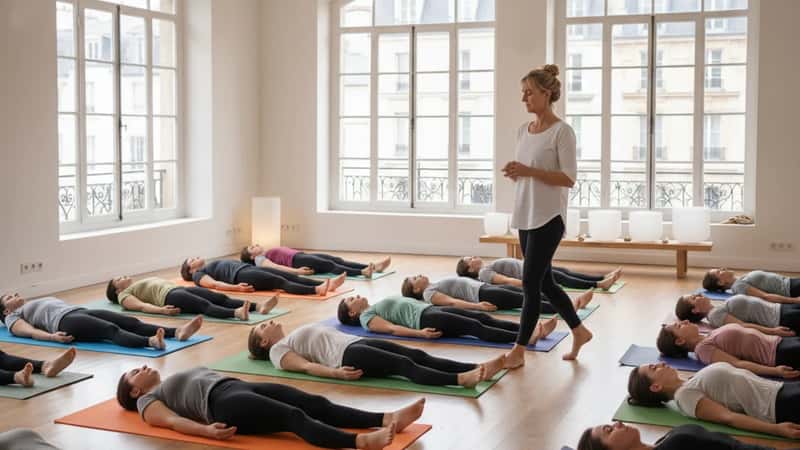
Deep relaxation (5-15 minutes): Participants lie in savasana while the teacher plays sound healing (often gong, crystal bowls, or mantra music). This integration period is not optional — it is physiologically important for consolidating the effects of the kriya.
Meditation (5-15 minutes): A specific meditation technique is introduced — often using a mantra, a visual focal point, or a breath pattern. Kundalini meditations are highly varied; a year of weekly practice may never repeat the same meditation twice.
Closing (5 minutes): The practice ends with a final mantra — "Sat Nam" — and often a blessing song ("Long Time Sun").
4. The Documented Health Benefits of Regular Practice
Research on Kundalini Yoga has accelerated since 2018, with studies published in peer-reviewed journals across mental health, neurology, and integrative medicine. The evidence base is strongest in three areas:
Mental health and stress: A 2023 randomized controlled trial published in JAMA Psychiatry found that adults with generalized anxiety disorder (GAD) who practiced Kundalini Yoga twice weekly showed significantly greater symptom reduction than a control group receiving standard psychoeducation. The researchers attributed the effect to the combination of breathwork and meditative focus — not posture practice alone.
Post-traumatic stress disorder (PTSD): The Veterans Administration has funded research into Kundalini Yoga as a complementary PTSD treatment. The Veterans Yoga Project reports that veteran practitioners show measurable reductions in hypervigilance, sleep disturbance, and emotional reactivity — symptoms that standard pharmaceutical treatments often address less comprehensively.
Cognitive function: Research from the University of California Los Angeles (UCLA) Semel Institute found that older adults who practiced Kundalini Yoga for 12 weeks showed improved performance on memory tasks and processing speed tests compared to those practicing memory-enhancement exercises alone [Neurocase Journal, 2024].
Important disclaimer: Kundalini Yoga is a complementary wellness practice, not a medical treatment. It does not replace professional medical or psychiatric care. Consult a licensed healthcare provider before beginning any new exercise or wellness program, especially if you have existing health conditions.
5. Kundalini Yoga vs. Other Styles: A Practical Comparison
Understanding how Kundalini compares to the styles you may already know helps set realistic expectations:
| Feature | Kundalini Yoga | Hatha Yoga | Vinyasa Yoga | Ashtanga Yoga |
|---|---|---|---|---|
| Physical intensity | Moderate | Low-moderate | Moderate-high | High |
| Spiritual component | Central | Optional | Minimal | Present |
| Flexibility required | None | Moderate | Moderate | High |
| Breathwork emphasis | Very high | Moderate | Low | Moderate |
| Mantras/chanting | Standard | Occasional | Rare | Standard |
| Suitable for beginners | Yes | Yes | Yes | No |
| Meditation integrated | Yes | Sometimes | Rarely | Yes |
| Class length | 60-90 min | 60-75 min | 60-75 min | 90-120 min |
The key differentiator is Kundalini's integrated approach: breath, movement, sound, and meditation are not separate elements but interwoven throughout every class. For people who have tried meditation apps without sustained results, or who find pure meditation too passive, Kundalini's active, multisensory approach is often more engaging.
For students recovering from injury, Kundalini Yoga is particularly accessible: most kriyas can be adapted to chair practice, and the style's emphasis on breath and awareness over physical depth means beginners are not at a disadvantage relative to experienced practitioners.
6. Kriyas: The Building Blocks of Kundalini Practice
A kriya (from Sanskrit: "completed action") is a specific sequence of postures, breathwork, and mental focus designed to produce a defined physiological or psychological effect. Kundalini Yoga contains hundreds of kriyas, each with a documented purpose. Unlike a general yoga class where a teacher selects poses freely, a Kundalini class is typically structured around a single kriya practiced in its entirety.
Kundalini Yoga teachers are trained not to mix kriyas or substitute individual exercises without understanding the energetic intention of the sequence. This is a significant difference from Vinyasa or Hatha teaching, where improvisation and personalization are standard.
Common kriyas and their documented effects:
Nabhi Kriya: Focuses on the navel center and core musculature. Used for building willpower, improving digestive function, and developing physical stamina.
Kriya for the Immune System: A sequence combining arm extensions and specific breathing patterns. Practiced frequently during cold and flu season; preliminary research suggests activation of the lymphatic system.
Kriya for Elevation: A broad-spectrum kriya combining spinal movements, breath of fire, and chanting. One of the most commonly taught kriyas for beginners — its effects include mood elevation, stress reduction, and enhanced mental clarity.
Sat Kriya: A single posture held for extended periods with rhythmic mantra and muscular engagement. Often described as one of the most energetically potent kriyas; not recommended without teacher guidance.
À retenir: No two kriyas are interchangeable. Finding a qualified teacher is essential for learning which kriya is appropriate for your goals and health status.
7. Mantras and Sound: Why Kundalini Yoga Chants
Walking into a room full of people chanting in a language you don't speak can be off-putting for new students. Understanding why Kundalini Yoga uses mantras — and what the science says about sound's effect on the brain — makes the practice more accessible.
Mantras in Kundalini Yoga are drawn primarily from the Gurmukhi language of the Sikh tradition, which Yogi Bhajan was deeply embedded in when he brought the practice to the United States. Common mantras include:
- "Sat Nam" (Truth is my name): Used as a greeting and closing mantra
- "Wahe Guru" (Indescribable wisdom): Used in meditation for emotional processing
- "Ra Ma Da Sa Sa Se So Hung": A healing mantra; the most frequently used in class
- "Gobinday Mukanday": A protective mantra used to clear mental blocks
The mechanism: researchers at the National Brain Research Centre in India have found that repetitive chanting activates specific neural pathways in the prefrontal cortex and limbic system, inducing states associated with reduced anxiety, increased focus, and emotional regulation. The rhythmic quality of chanting synchronizes brainwave activity in ways similar to meditation.
You do not need to understand the literal meaning of mantras to benefit from chanting them. The practice functions through sound vibration, breath control, and focused attention — all of which are accessible regardless of linguistic background or spiritual beliefs.
8. A Real Student's Experience: From Skeptic to Regular Practitioner
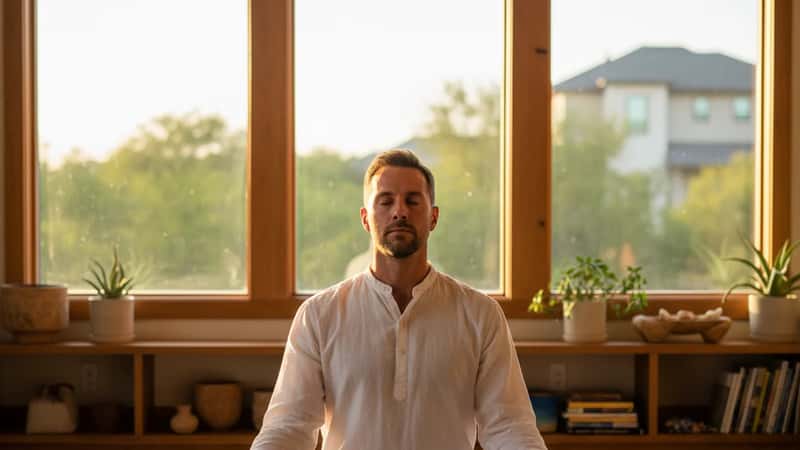
Marcus, a 38-year-old software engineer from Austin, Texas, arrived at his first Kundalini class in 2023 after his therapist suggested he try "something with structured breathwork" for his chronic work-related anxiety. "I walked in wearing gym clothes and immediately felt like I had stumbled into something completely different," he recalls. "There were people in white clothes, someone playing a gong, and the class was starting with chanting. I almost left."
He stayed. By the end of the 90-minute session, his heart rate was slower than when he had arrived, and a restless mental loop about a work deadline had quieted. "I didn't understand what had happened. I just knew I felt different."
Marcus now practices three times per week. "The breathwork rewired something in my nervous system. I still get stressed, but the recovery is faster. I can talk myself down from a 9 to a 3 in about four breaths. That's a skill I didn't have before."
His experience mirrors findings from the Veterans Yoga Project: the most sustained practitioners typically started with a specific symptom they wanted to address — anxiety, insomnia, chronic pain — and stayed because the results were experientially clear, not because they adopted a yogic worldview.
Finding expert guidance from a certified Kundalini Yoga teacher who understands your specific goals can make this transition from skeptic to practitioner significantly smoother.
9. Who Should Be Cautious About Kundalini Yoga
While Kundalini Yoga is broadly accessible, certain conditions require consultation with a healthcare provider before beginning:
Psychosis or severe mental health instability: Kundalini Yoga can produce intense psychological experiences — emotional releases, altered states of awareness, vivid imagery during deep relaxation. For individuals with unmanaged psychosis, bipolar disorder in an active manic phase, or severe dissociative conditions, these effects can be destabilizing. The practice requires the guidance of a teacher who understands mental health considerations.
Pregnancy: Many Kundalini kriyas involve strong core engagement, breath retention, and inversions — all of which require modification or avoidance during pregnancy. Qualified teachers can adapt the practice, but expecting practitioners must disclose their pregnancy and confirm modifications with both their teacher and their obstetric provider.
Hypertension: Breath of Fire and vigorous kriyas temporarily increase heart rate and blood pressure. Individuals with uncontrolled hypertension should practice under medical supervision and inform their teacher.
Recent surgery or physical trauma: Most kriyas require the spine and core to be functional. Post-surgical practitioners should obtain medical clearance before returning to practice.
The general principle: Kundalini Yoga is one of the most accessible yoga styles for beginners, but its intensity is energetic and nervous system-level rather than purely physical. Transparency with your teacher about your health history allows them to guide you appropriately.
10. How to Find a Qualified Kundalini Yoga Teacher in the US
Teacher quality varies significantly in Kundalini Yoga. Knowing how to evaluate credentials protects both your experience and your safety.
The primary credential for Kundalini Yoga teachers in the United States is the KRI (Kundalini Research Institute) Level 1 or Level 2 certification. KRI is the body established by Yogi Bhajan to standardize Kundalini Yoga training. A KRI Level 1 certification requires 200 training hours; Level 2 requires an additional 500 hours with specialization tracks in areas like mental health, prenatal yoga, or teacher training.
When evaluating a teacher, ask:
- Are you KRI-certified? At what level?
- How long have you been teaching Kundalini Yoga specifically?
- Have you had experience working with students managing [your specific condition]?
- Do you have continuing education in areas relevant to your needs?
The Yoga Alliance (yogaalliance.org) registers teachers and schools but does not maintain a Kundalini-specific credential. KRI certification is the relevant benchmark for this style.
Red flags: teachers who claim Kundalini Yoga can cure medical conditions, promise "kundalini awakening" within a fixed timeframe, or discourage students from seeking concurrent medical care. Reputable Kundalini teachers consistently position the practice as complementary — not as a replacement — for professional healthcare.
11. Getting Started: Your First Month of Kundalini Yoga
The first four weeks of Kundalini practice are the most critical for establishing a sustainable routine. Here is a practical framework:
Week 1: Attend two classes with a live teacher (in-person or online). Do not practice kriyas independently until you have learned them with guidance. Focus on learning the foundational breathing techniques: Long Deep Breath, Breath of Fire basics, and three-part breath.
Week 2: Introduce a daily 3-minute meditation. The "Sa Ta Na Ma" meditation — a rhythmic finger-tapping mantra practice — is specifically designed for beginners and has the strongest evidence base for cognitive benefits among Kundalini meditations. Practice it each morning before reaching for your phone.
Week 3: Begin exploring a simple home practice alongside your class attendance. The "Morning Sadhana" (spiritual practice) in the Kundalini tradition typically includes 20 minutes of breathwork, 20 minutes of kriya, and 20 minutes of meditation. Even 10 minutes of daily practice maintains the neurological benefits between classes.
Week 4: Reflect on which aspects of the practice produce the clearest results for your specific goals. Talk to your teacher about deepening in those areas. Kundalini Yoga has specific kriyas for dozens of different outcomes — a skilled teacher will customize your program once they understand what you are working toward.
The research is consistent: practitioners who attend at least twice weekly for the first month are significantly more likely to establish a lasting practice than those who attend sporadically. Consistency in the first 30 days is more important than class frequency after the habit is formed.
Point clé: Start with a qualified teacher, not a YouTube video. Kundalini Yoga is one of the few yoga styles where sequencing and technique significantly affect safety and outcome — solo self-teaching raises the risk of practicing kriyas incorrectly or out of sequence.
Frequently Asked Questions About Kundalini Yoga
Is Kundalini Yoga a religion? Kundalini Yoga as taught by Yogi Bhajan is a technology for consciousness, not a religion. While it draws heavily on Sikh teachings and Tantric traditions, the practice does not require adherents to adopt any specific belief system, and it is practiced by people of all faiths and none. The mantras are used for their vibrational effects, not as religious prayers.
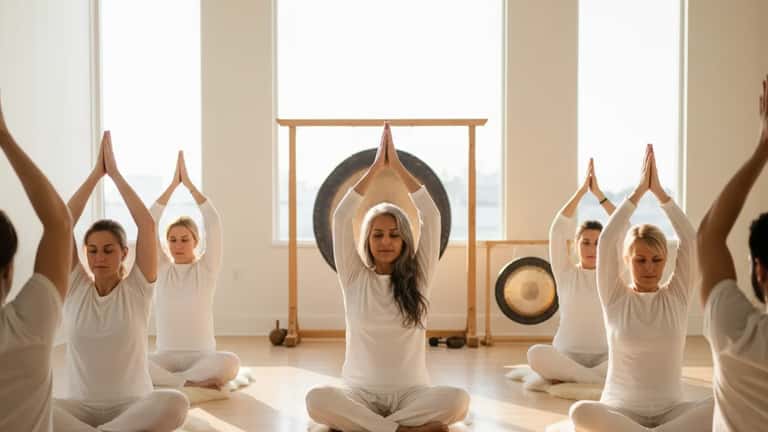
What do I wear to a Kundalini Yoga class? Traditional Kundalini practitioners wear white clothing, as white is believed to expand the auric field and is associated with clarity in the yogic tradition. However, most contemporary studios do not require white clothing for beginners. Comfortable, flexible clothing that allows for floor-based movements is sufficient. You will practice barefoot.
Can I practice Kundalini Yoga at home? Yes, once you have a foundational understanding of the techniques. The KRI's official digital platform (3HO.org) provides guided kriyas and meditations. However, self-teaching without prior class experience is not recommended — Kundalini kriyas involve specific timing, breathing, and sequencing that are difficult to internalize from video alone.
How quickly will I notice results? Many practitioners report noticeable effects — reduced stress reactivity, improved sleep, clearer focus — within the first 4-6 weeks of consistent practice (2-3 times per week). The most significant and sustained benefits are documented after 12+ weeks of regular practice. Instant transformation claims are marketing, not science.
Is Kundalini Yoga safe? When practiced with a qualified teacher and with appropriate health disclosures, Kundalini Yoga is considered safe for the majority of adults. The most common adverse effects are mild and temporary: lightheadedness from breathwork, emotional releases during deep relaxation, or muscle soreness from sustained holds. Serious adverse events are rare and almost universally associated with improper practice or pre-existing undisclosed health conditions.