 Eleanor Stone
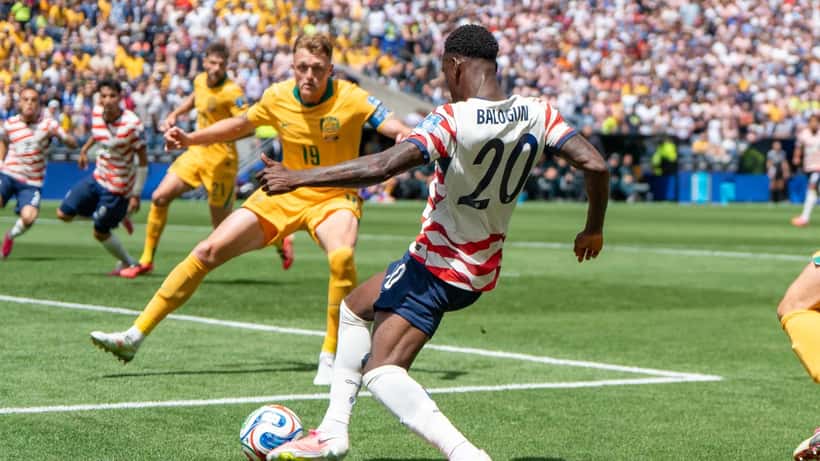
Folarin Balogun's goal against Bosnia and Herzegovina on 1 July had USMNT fans celebrating a historic night — but within minutes of his opener, the Monaco striker's tournament future was in jeopardy. A VAR-reviewed red card in the 64th minute left Balogun facing an automatic one-game suspension, meaning the USA's top scorer could miss the Round of 16 clash against Belgium at Lumen Field, Seattle, on 6 July 2026. The incident has ignited fierce debate over the fairness of FIFA's disciplinary machinery — and it is a timely reminder of why understanding sports law matters far beyond the professional game.
The Incident That Divided Opinion
Balogun was shown a straight red card after a VAR review determined he had dragged his studs down the back of Bosnian defender Tarik Muharemovic's leg. The referee upheld the decision following the review, dismissing Balogun in the 64th minute — just moments after he had put the United States 1-0 up with his third goal of the tournament.
The reaction was swift and polarising. ESPN's post-match technical review concluded that VAR had "misapplied protocols," arguing the challenge fell below the threshold of serious foul play that ordinarily demands a straight red. Despite being reduced to ten men, the USMNT held firm and added a second goal through Malik Tillman's precise free kick, sealing a 2-0 victory — the United States' first World Cup knockout-stage win since 2002.
Balogun becomes only the fifth American ever to receive a red card at a World Cup, following Eric Wynalda in 1990, Fernando Clavijo in 1994, and both Pablo Mastroeni and Eddie Pope in 2006.
How FIFA's Disciplinary Process Actually Works
Every red card at the FIFA World Cup triggers an automatic one-match suspension, applied immediately to the player's next competitive fixture in the same tournament. That rule is straightforward. What is less well understood is the process that follows — and the genuine legal options available to the affected team.
Under FIFA's Disciplinary Code, the full sequence runs as follows:
1. Automatic suspension. Confirmed the moment match officials report the red card. No formal hearing is required for this step.
2. Disciplinary Committee review. FIFA's Disciplinary Committee, chaired for the 2026 World Cup by Emirati legal advisor Mohammed Al Kamali, examines the incident within 24 hours. The committee can maintain the one-match ban, extend it — for example, in cases of violent conduct or deliberate biting — or, in rare circumstances, reduce it if mitigating factors are identified.
3. Right of appeal. Once the Disciplinary Committee's formal decision is notified to the relevant football association, that federation has exactly 24 hours to lodge an appeal with FIFA's separate Appeal Committee. During a live tournament, this timeline is strictly enforced because upcoming fixtures allow no margin for delay.
4. Appeal outcome. Full overturn of a red card suspension is rare. FIFA's test is whether the referee or VAR made a clear and obvious error — a deliberately high threshold that prevents the system from being flooded with opportunistic challenges. Partial outcomes do occur: a two-match or three-match extension, for instance, can sometimes be reduced to one if the appeal demonstrates mitigating factors. For Balogun specifically, the argument would rest on the misapplication of VAR review protocols — a legitimate procedural ground, but one that FIFA committees have historically been slow to accept.
Where Sports Lawyers Come In
Professional clubs and national football associations do not navigate these proceedings alone. Specialist sports law solicitors handle the preparation of appeal submissions, the gathering of video and expert-witness evidence, and the strict management of procedural deadlines. A single missed filing window — in this case, 24 hours — eliminates the right to appeal entirely.
The core legal arguments a sports law solicitor would typically build in a case like Balogun's include:
- Correct application of the Laws of the Game. Specifically, whether the act constituted "serious foul play" under Law 12 — which requires endangerment of an opponent's safety using excessive force — or merely reckless play warranting a yellow card.
- VAR protocol compliance. The video review system has its own procedural rules governing which incidents can be reviewed and how the on-field decision must be framed. A procedural breach by VAR is a distinct ground of appeal, separate from arguing the tackle itself was harmless.
- Precedent and comparative evidence. Sports lawyers track disciplinary outcomes across competitions to identify comparable incidents where committees reduced or overturned bans, building a pattern of reasoning that committees recognise and respond to.
This is not purely the domain of elite football. English amateur and grassroots players are subject to the FA's Judicial Panel and County FA disciplinary processes, which operate on similar principles. A Sunday league player wrongly dismissed, a youth coach banned from the touchline without proper hearing, or a club facing a points deduction all have formal appeal rights — and legal representation at those hearings can be decisive. If you are facing a sporting disciplinary matter in the UK, a qualified sports law solicitor can assess whether viable grounds exist and represent your case before the relevant body.
For wider context on how FIFA's legal framework governs player eligibility and nationality disputes, ExpertZoom's reporting on FIFA dual-nationality eligibility at World Cup 2026 shows how the same regulatory architecture shapes decisions at every level of the game.
What This Means for Team USA Against Belgium
If the appeal fails — and recent history suggests the odds are not in USMNT's favour — Balogun will be absent from arguably the most important match in US Soccer's recent history. The Arsenal academy graduate, who has been the tournament's most decisive American finisher with three goals, is irreplaceable in the current USMNT system.
Belgium, who fought back from 2-0 down against Senegal before winning 3-2 after extra time, will be acutely aware that a weakened US attack improves their own path to the quarterfinals. The match at Lumen Field in Seattle kicks off on 6 July 2026, meaning US Soccer has fewer than five days from the Bosnia win to have an appeal filed, considered, and resolved.
The Wider Lesson from a Controversial Red Card
The Balogun dismissal is more than a talking point for pub debates. It illustrates that even at the summit of world sport, formal legal processes — disciplinary codes, appeal timelines, committee procedures — determine outcomes that millions of people care about deeply.
The same framework that governs Balogun's World Cup fate governs the grassroots footballer wrongly accused of violent conduct at a Saturday morning match. Whether at FIFA level or in your local county FA, knowing your rights, understanding the appeal process, and seeking expert legal advice in time makes the difference between a just outcome and an avoidable injustice.
This article is for informational purposes only and does not constitute legal advice. If you are involved in a sporting disciplinary matter, consult a qualified sports law solicitor.
