 Grace Davies
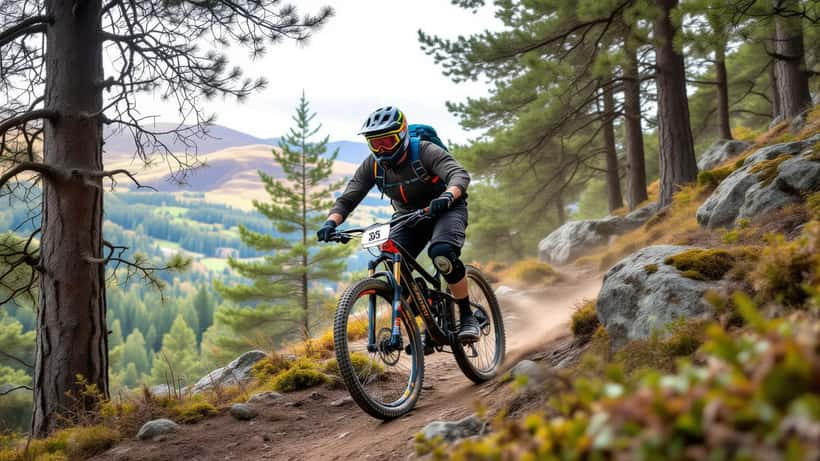
The first Trans Caledonia Enduro wrapped up on 13 September 2026, and the numbers are extraordinary. Eighty riders from nineteen nations tackled 35 timed stages over six days, covering 250 kilometres of Scotland's most demanding mountain terrain — with a cumulative 11,000 metres of descending from Aberdeenshire's granite pine forests to the Tweed Valley's legendary trail networks. What the highlight reels don't show: the sports injuries that accumulate quietly across six consecutive days of elite effort, and what they mean for the thousands of UK recreational riders who watched and plan to push their own limits this autumn.
Six Days, Nineteen Nations, and the Numbers That Matter
The Trans Caledonia Enduro took riders from the Royal Deeside in Aberdeenshire through the Scottish Highlands, across Perthshire, and finally to the Tweed Valley in the Scottish Borders. Six timed stages per day, seven nights of accommodation, approximately 1,833 metres of descending on each riding day. The route — kept secret until the event itself — has already been described by riders and commentators as one of the most ambitious debut enduro events ever held in the UK.
Research consistently shows that downhill mountain biking produces approximately one injury for every 59.5 hours of riding. A Trans Caledonia participant logging six days of five to six hours each day would accumulate between 30 and 36 hours of high-intensity descending — approaching that statistical threshold within the event itself. According to data compiled across multiple UK and European studies, 75% of mountain biking injuries are classified as minor wounds, but 10% require hospitalisation, and the upper extremity — wrists, hands, clavicles, shoulders — is the most commonly affected anatomical region. Mountain bikers also face a 6.9% annual prevalence of diagnosed concussion, a figure notably higher than in most team sports.
When you compress months of riding volume into six consecutive days, the risk profile changes substantially.
What Happens to Your Body Across Six Days of Enduro
Sports medicine specialists distinguish between two categories of post-event pain: adaptive discomfort, which is the expected result of muscular stress, and structural injury, which requires professional assessment. The clinical difficulty is that during multi-day events, adrenaline, competitive drive, and cumulative fatigue create conditions where riders routinely misclassify the second as the first.
The most commonly undertreated injuries following enduro-style events fall into three groups. First, wrist and forearm injuries from sustained braking loads over hours of technical descending — these can mask hairline fractures as "soreness" for 48 to 72 hours after the event ends. Second, knee ligament stress from repeated high-load impact landings, particularly the medial collateral ligament, which can appear stable immediately post-event but deteriorate significantly within a week if left unassessed. Third, shoulder impingement and rotator cuff strain from multiple low-speed crashes that riders absorb and continue riding through.
The NHS guidance on sport injuries is clear that any joint swelling, persistent numbness, or pain that worsens 24 to 48 hours after exercise — rather than improving — is a signal requiring professional evaluation, not continued rest at home.
What a Real Injury Looks Like: A Post-Event Scenario
Consider a 35-year-old recreational rider who joined a satellite charity event running alongside the Trans Caledonia the same week in Perthshire — or, more commonly, a club rider who pushed hard over a two-day weekend in the Tweed Valley inspired by the buzz around the event.
On day one they fall on a technical stage, catching themselves with an outstretched right hand. The wrist aches through the afternoon but they complete the day. On day two, the wrist is stiffer, manageable with a brace. By day three post-event, the swelling has not reduced and gripping the handlebars produces sharp, localised pain on the radial side of the wrist.
Here is the critical if/then: if wrist swelling has not decreased within 72 hours of injury, the probability of a scaphoid fracture — a small but consequential carpal bone that is routinely missed on initial X-ray — rises to a level that requires urgent clinical imaging rather than continued home management. Untreated scaphoid fractures carry a non-union rate of 12–23% depending on the fracture site, and can result in avascular necrosis requiring surgical intervention if left undetected for six to eight weeks.
The clinical threshold is measurable: tenderness in the anatomical snuffbox (the small depression at the base of the thumb, visible when the thumb is extended) combined with swelling beyond 72 hours is a positive clinical sign that mandates CT imaging, not a standard X-ray. Standard X-ray misses up to 20% of acute scaphoid fractures in the first week.
This is exactly the scenario where an online consultation with a sports medicine specialist or orthopaedic expert can compress weeks of GP referral queues into a focused 30-minute assessment — with a clear recommendation on whether imaging is urgent, what immobilisation is appropriate, and how to document the injury mechanism for any subsequent treatment.
Why This Matters Beyond Trans Caledonia
The 80 riders who completed the inaugural Trans Caledonia Enduro are elite-level athletes. They train specifically for multi-day events, wear full-face helmets and body armour, and most have access to physiotherapists and sports medicine support. The recreational riders they inspire typically have none of these.
Research on recreational mountain bikers reveals a consistent pattern: injury rates for recreational riders on technical descents are substantially higher than for competitive riders on the same terrain, primarily because protective equipment use is lower and riding technique is less refined. The Trans Caledonia's 11,000-metre descending total, combined with Pinkbike's widely-shared event highlights, will directly drive increased autumn riding activity at trail centres from Glentress to Cannock Chase — much of it by riders without the training base the Trans Caledonia's 35-stage structure demanded.
For endurance-event inspiration cycles and their effect on amateur athletes, the pattern is consistent across disciplines. The fundamental question — when does inspiration become overexertion — has the same clinical answer in mountain biking as it does in running. This analysis of how amateur athletes manage event-related injuries identifies the same 72-hour assessment window as the critical decision point, regardless of the sport involved.
The RICE Rule, and When It Is No Longer Enough
The standard immediate management of soft tissue sports injuries — Rest, Ice, Compression, Elevation — is appropriate for the first 24 to 48 hours and well understood. The problem is that RICE is frequently extended beyond its clinical utility, substituting for professional assessment when professional assessment is what the injury actually requires.
The threshold at which home management becomes insufficient is clearer than most recreational athletes assume. Any of the following five signs warrants professional evaluation rather than additional rest: joint swelling that has not reduced after 48 hours; pain that is worsening rather than improving at the 72-hour mark; neurological symptoms including tingling, numbness, or altered sensation in the hand or foot; loss of normal range of motion greater than 50% in the affected joint; and visible deformity or acute bruising directly around a joint surface.
These criteria are not exclusive to Trans Caledonia competitors. They apply to any rider who pushes their limits on Scottish trails this autumn — or at any trail centre, club event, or demanding day ride across the UK.
What to Do After Any High-Intensity Ride
The practical protocol after any demanding mountain biking session — whether six stages in Scotland or a single challenging day at your local trail centre — follows three steps. First, document any impacts or falls at the time they happen, including the mechanism and anatomical location, even when the pain appears minor. This record matters significantly if an injury is later confirmed and a timeline of events becomes relevant.
Second, monitor the 72-hour window actively. Improving symptoms across that period are reassuring. Symptoms that plateau or worsen after 24 hours are not a signal to continue resting at home — they are a signal to seek professional input.
Third, do not wait for a GP appointment to assess a joint injury that has not improved. Sports medicine specialists and orthopaedic experts available online can evaluate injury descriptions, review the reported mechanism, and provide a triage recommendation — including whether imaging is urgent and what type — within a single consultation. This avoids both the undertreatment of assuming time alone will resolve a structural problem, and the overcorrection of attending an emergency department for injuries that are appropriately handled in community settings.
The Trans Caledonia Enduro has put Scotland firmly on the international mountain biking map, and rightly so. But the figure that matters most in the days following the event is not 11,000 metres or 35 stages. It is 72 hours — the window in which the difference between a manageable bruise and a fracture requiring treatment becomes clinically clear, and in which a brief expert consultation can make the call that rest and ice simply cannot.
This article provides general health information only and is not a substitute for professional medical advice. If you have concerns about a sports injury, consult a qualified healthcare professional.
