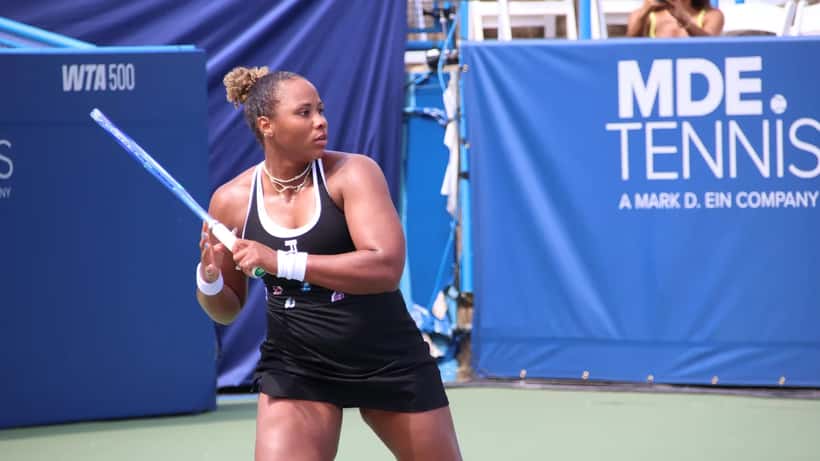
 Grace Davies
On Centre Court at Wimbledon 2026, Taylor Townsend did something the bookmakers gave her only a 19% chance of doing: she pushed Iga Swiatek, the world's top-ranked player and defending champion, to a third and deciding set. But the tennis is only the beginning of the story. Behind Townsend's aggressive serve-and-volley game is a six-year journey through blocked fallopian tubes, an emergency C-section, and 18 months away from professional sport — a comeback that health specialists say holds vital lessons for post-partum recovery far beyond the tennis court.
The Draw That Shocked SW19
Nobody envied Townsend her Round 1 fate when the Wimbledon 2026 draw was announced. The world No. 3 Swiatek, a three-time Wimbledon finalist between 2023 and 2025, took the opening set 6-1 in just 31 minutes. But Townsend, ranked No. 79 in the world, refused to fold. She broke Swiatek twice in the second set and took it 6-2, setting up a deciding third set in front of a packed Centre Court crowd on 30 June 2026.
The giant-killing attempt arrives at the end of Townsend's most decorated stretch of career. In May 2026 she won the Roland Garros doubles title with Kateřina Siniaková — her third Grand Slam doubles crown, following Wimbledon 2024 and the Australian Open 2025. In July 2025, she became the first mother in WTA history to reach the world No. 1 doubles ranking, according to the WTA's official records. That last achievement carries more weight than the ranking number alone suggests.
Six Years of Fertility Struggles — and a Birth That Changed Everything
Townsend, now 30, spent much of her mid-twenties quietly battling fertility problems. Medical tests revealed her fallopian tubes were blocked — a condition that significantly reduces the chance of natural conception. She fell pregnant in 2020.
Her son, Adyn Aubrey Allen, was born on 14 March 2021 — but not without crisis. An emergency C-section, the opposite of her planned birth, left Townsend describing the experience as "traumatic." In public interviews she has spoken candidly about the lingering physical effects of the procedure. "I didn't know how my body was going to react," she said when discussing her return to competition, acknowledging that the surgery's aftermath shaped every step of her rehabilitation.
That honesty has made her one of the most compelling voices in professional sport on the subject of post-partum recovery.
What a C-Section Actually Does to an Athlete's Body
A Caesarean section is major abdominal surgery. It involves incisions through multiple layers of tissue — skin, subcutaneous fat, fascia, the rectus sheath, peritoneum, and the uterine wall — requiring substantial healing time before the body can safely tolerate high-impact exercise. The NHS advises that women avoid strenuous activity for at least six to eight weeks after a Caesarean birth, and notes that full recovery — particularly rehabilitation of the abdominal muscles and pelvic floor — typically takes considerably longer.
For a tennis player, the implications are significant. Every serve Townsend hits relies on rotational core power generated through the same abdominal tissue that was surgically cut. Every sprint to a drop shot loads the hip flexors and pelvic girdle disrupted by the procedure. Scar tissue, if left untreated through targeted physiotherapy, can restrict movement, reduce power transfer through the kinetic chain, and cause compensatory injuries in the knees and lower back.
Townsend's decision to take 18 months away from professional tennis is, from a sports medicine perspective, clinically reasonable — and arguably the reason she is still competing at elite level five years after giving birth.
A Comeback Built on Patience and Expert Guidance
When Townsend returned to the tour in 2022, her approach was deliberate. She did not immediately prioritise singles competition. Instead, she rebuilt match fitness through doubles — a format that offers physically demanding competition with shorter court coverage patterns and a shared workload. The strategy is consistent with graduated return-to-sport protocols used in clinical rehabilitation for post-surgical patients.
The results validated the approach. She reached the US Open doubles final in 2022, broke into the WTA doubles top five in 2023, and claimed the world No. 1 doubles ranking in July 2025. In 2026 alone she has won four combined doubles titles — Roland Garros, Miami, Madrid, and Indian Wells, all alongside Siniaková.
As specialist health guidance has shown in similar elite recovery cases — including recovery from post-viral illness in other professional tennis players — athletes who follow expert-supervised rehabilitation protocols consistently achieve better long-term outcomes than those who return to competition prematurely.
What Townsend's Journey Means for Women Beyond Sport
The Taylor Townsend story resonates far beyond professional tennis because most post-partum recovery journeys happen quietly, without a Centre Court to mark the achievement.
Around one in three births in England is now by Caesarean section, according to NHS statistics — representing hundreds of thousands of women each year. Many return to physically demanding work, daily life, and exercise routines without structured post-surgical rehabilitation. The consequences — pelvic floor dysfunction, abdominal separation known as diastasis recti, chronic lower back pain, and reduced core stability — are common but frequently underreported and undertreated.
Townsend's trajectory is a powerful argument for what specialist-guided recovery makes possible. Health experts recommend that any woman following a Caesarean birth seek an assessment that covers:
- Pelvic floor function, assessed by a women's health physiotherapist
- Core stability screening, including specific evaluation for diastasis recti
- Scar tissue mobilisation, to restore full range of movement and reduce adhesion-related restrictions
- A graduated return-to-activity plan, tailored to individual healing progress rather than generic timelines
These recommendations are not exclusive to professional athletes preparing to compete at Wimbledon. They are clinically appropriate for anyone who wants to return to full physical function safely, whether that means running a parkrun, returning to a physically active job, or simply carrying a toddler without lower back pain.
Back on Centre Court
The third set is being played as this article goes to press. What started with a fertility diagnosis, moved through a traumatic emergency delivery, and required 18 months of disciplined rehabilitation is today a serve-and-volley challenge to the defending Wimbledon champion on sport's most famous grass court.
Townsend's result today will be recorded in the draws and statistics. What will not be recorded as easily is what her journey demonstrates: that post-C-section recovery, taken seriously and supported by the right specialists, makes extraordinary outcomes possible.
For the estimated 200,000 women who have a Caesarean section in England every year, the first step toward that kind of recovery is the same one Townsend took — seeking expert support before returning to full activity.
If you have had a Caesarean section and want guidance on post-partum rehabilitation, a qualified health specialist can help you build a personalised recovery plan suited to your goals and your body.
This article covers general health information. Please consult a qualified healthcare professional for advice specific to your circumstances.
