 Alice Howard
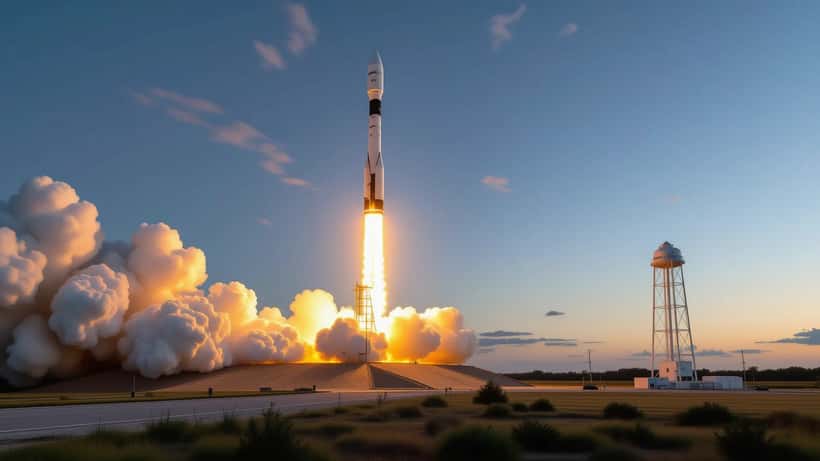
SpaceX is preparing to launch Starship, the largest rocket ever built, on its critical Flight 13 test from Starbase, Texas, on Thursday 23 July 2026 at 6:45 p.m. EDT — days after an automatic abort halted the previous attempt at the last second. According to SpaceX, the earlier launch on 16 July was aborted at T−0 when four Raptor engines failed to reach acceptable starting parameters, and engineers removed and replaced two engines before rescheduling. For British students sitting GCSE and A-level physics, that dramatic countdown is not just a news headline — it is a live, working example of nearly every mechanics topic on the exam syllabus.
Why a scrubbed launch is a physics lesson
The reason Flight 13 was aborted comes straight from the specification. A rocket only leaves the pad when its thrust exceeds its weight — the thrust-to-weight ratio must be greater than one. Super Heavy, the booster stage, relies on 33 Raptor engines firing together. When four of them did not ignite correctly, the flight software calculated that the safety margin was gone and shut the sequence down.
That is Newton's second and third laws in a single moment. The engines push hot gas downward, and by Newton's third law the gas pushes the rocket upward with an equal and opposite force. If too few engines fire, the upward force cannot overcome the rocket's enormous weight, and it stays put. Students who can explain that reasoning in an exam are demonstrating exactly the "force, mass and acceleration" understanding examiners reward.
The numbers behind reaching orbit
To understand why rockets are so hard to fly, look at the speeds involved. To stay in low Earth orbit, a spacecraft must travel at roughly 7.8 kilometres per second — about 28,000 km/h. That is the orbital velocity every A-level student meets in the circular motion and gravitational fields modules, where the gravitational force provides the centripetal force that keeps a satellite in orbit.
Flight 13 is designed to be suborbital, meaning Starship will not complete a full lap of the planet. Instead, according to reporting from Space.com, it aims to deploy 20 next-generation Starlink V3 satellites, relight a single Raptor engine while in space, then perform a controlled re-entry and splashdown in the Indian Ocean. The difference between "suborbital" and "orbital" is a classic exam trap: it depends entirely on whether the vehicle reaches that critical sideways speed, not simply how high it flies.
For older students, the launch also illustrates the Tsiolkovsky rocket equation, which links a rocket's change in velocity to how much of its mass is fuel. It explains why rockets are almost entirely propellant and why staging — dropping the heavy booster once its fuel is spent — is essential. These ideas stretch beyond the core syllabus, but they are the kind of real-world context that turns an abstract equation into something a student can picture.
What parents and students can take from it
A televised launch is a rare chance to make revision feel relevant. Instead of memorising that "thrust equals rate of change of momentum," a student can watch 33 engines burning thousands of tonnes of propellant and see momentum change in real time. The mechanics topics that many pupils find the hardest — resolving forces, conservation of momentum, circular motion, energy transfer — are all on display in a single event.
The physics content British pupils are expected to master is set out in the Department for Education's national curriculum science programmes of study, which covers forces, motion and energy from Key Stage 3 upward. Parents worried about whether their child is keeping pace can use that document as a checklist against what is being taught in class.
When a tutor makes the difference
Physics is consistently one of the subjects where students most often seek extra help, precisely because it combines abstract mathematics with problem-solving under time pressure. A single misunderstanding — confusing mass with weight, or forgetting that velocity is a vector — can cascade through an entire exam paper.
This is where a private tutor earns their value. A good homework-help specialist can take a topical event like the Starship launch and use it to unlock a concept a student has been stuck on for weeks. Rather than working through yet another textbook question, a tutor might ask why the launch was aborted, walk through the thrust-to-weight calculation, and let the pupil arrive at the answer themselves. That kind of tailored, one-to-one explanation is difficult to replicate in a classroom of thirty.
Tutors also help with something exams increasingly demand: applying familiar equations to unfamiliar scenarios. Examiners rarely ask a question in the same way twice, so students who have only memorised methods often freeze when the context changes. Practising with real events builds the flexibility to recognise that a rocket launch, a fairground ride and a satellite are all governed by the same handful of principles.
A launch worth watching
Whether Flight 13 succeeds on 23 July or faces another delay, it offers a genuine teaching moment. SpaceX's very public failures and retries also carry a quieter lesson for students: that progress in science comes from testing, failing and adjusting — much like working through past papers until the method finally clicks.
For any student preparing for GCSE or A-level physics in 2026, the advice is simple: watch the launch, then talk through the science behind it. If the concepts feel out of reach, a qualified tutor can turn that curiosity into exam marks. Connecting with a homework-help expert who can explain forces, motion and orbits in plain language may be the most practical way to make one of the year's biggest engineering spectacles count towards a better grade.
