
 Alice Howard
Private tutoring in the UK is booming — but the market is unregulated, and any adult can advertise as a tutor with no mandatory licensing or qualification check. With approximately 1.8 million children receiving private tutoring each week in England [The Sutton Trust, 2024], parents face a genuine challenge: how do you distinguish a safe, qualified tutor from someone who has simply printed a business card?
This guide answers the questions that matter in 2026: which level of DBS check is appropriate, when it is legally required, how to verify a certificate in real time, what qualifications signal genuine subject expertise, and the practical red flags that should stop a hiring decision before it goes further.
What Is a DBS Check and Why Does It Matter for Private Tutoring?
The Disclosure and Barring Service (DBS) was created under the Protection of Freedoms Act 2012, merging the Criminal Records Bureau (CRB) and the Independent Safeguarding Authority (ISA) into a single agency. It maintains two key barred lists — one for individuals prohibited from working with children, one for those prohibited from working with vulnerable adults — and processes background disclosures that reveal criminal records to registered employers.
For private tutoring, the relevance is immediate. A tutor may spend hours alone with a child — in a family home, at a library, or in an online session. Without a DBS check, parents have no independent confirmation that this person has not been convicted of offences that would disqualify them from working in child-facing roles.
A DBS check is not a guarantee of competence, nor a complete safeguarding solution. It reveals what the criminal record system has formally recorded at the point of issue. Treating it as the necessary baseline — the floor, not the ceiling — of any safeguarding assessment is the right approach for any parent or guardian making this decision.
À retenir: A DBS check is the starting point for safeguarding, not the endpoint. It must be combined with reference checks, qualification verification, and ongoing parental awareness.
Three Levels of DBS Check: Which Applies to Private Tutors?
DBS checks come in three tiers, each revealing a different depth of information. A common and dangerous mistake is accepting a Basic DBS check for a role that requires an Enhanced one.
| Level | What it discloses | Who can apply | Approx. cost |
|---|---|---|---|
| Basic | Unspent convictions and conditional cautions only | Anyone — direct self-application | £23 |
| Standard | Spent and unspent convictions, cautions, reprimands, warnings | Must apply via registered organisation | £23 |
| Enhanced | All Standard content + local police intelligence + Children's Barred List check | Must apply via registered organisation | £38 |
Source: Disclosure and Barring Service, gov.uk, 2024. Costs subject to change — verify current fees at gov.uk/dbs-check-applicant-guidance.
For the vast majority of private tutoring arrangements — any situation where a tutor works regularly and unsupervised with a child — an Enhanced DBS check including a barred list check is the appropriate level. This is not optional if you are serious about safeguarding.
A Basic DBS check, which any individual can obtain directly, misses the very information that matters most: spent convictions, local intelligence held by police forces, and critically, whether the individual appears on the Children's Barred List.
When Is an Enhanced DBS Check Legally Required?
The legal threshold is "regulated activity" — a concept defined under the Safeguarding Vulnerable Groups Act 2006, as amended by the Protection of Freedoms Act 2012. For private tutoring, regulated activity is typically engaged when all three of the following apply:
- The tutor works directly with children on a frequent basis — defined as once a week or more, or on four or more days within any 30-day period.
- The sessions are unsupervised — no parent, carer, or other responsible adult is present throughout.
- The role involves teaching, instructing, or training children.
A standard weekly private tutor — visiting a family home on Tuesday evenings while parents are in another room — almost certainly meets all three criteria and falls within regulated activity. The Enhanced DBS check, including the Children's Barred List, is therefore the legally appropriate level.
A critical practical point for self-employed tutors: Independent tutors cannot apply for an Enhanced DBS check directly through the government portal. That route is restricted to organisations registered with the DBS. An independent tutor who holds an Enhanced certificate obtained it through a tutoring agency or a DBS-registered umbrella body. When a tutor presents an Enhanced certificate, ask for the name of the issuing organisation — this is a simple and legitimate request that any professional tutor should answer without hesitation.
Tutor Qualifications: What to Look For in 2026

A DBS check confirms that someone has not been barred from working with children. It says nothing about whether they can teach. The private tutoring market in the UK is entirely unregulated — there is no mandatory licensing body and no minimum qualification requirement. This places the verification burden on families.
The following credentials carry meaningful weight:
- Qualified Teacher Status (QTS): Awarded by the Teaching Regulation Agency (TRA), QTS confirms that a tutor has met the professional standards required to teach in state schools in England. Parents can verify a tutor's QTS status independently at check.education.gov.uk — the government's free teacher status checker. QTS is the closest benchmark to a formal teaching qualification in the private tutoring context.
- Subject-specific degree: Particularly important for secondary and A-level tutoring. A 2:1 or higher in the subject being taught — mathematics, sciences, English, modern languages — adds credibility that generic "teaching experience" does not.
- Examination board familiarity: For GCSE and A-level preparation, a tutor who understands the mark schemes and assessment objectives of AQA, Edexcel, or OCR is far better positioned to improve a pupil's exam performance. With GCSE examinations already underway in 2026, the right tutor knows exactly which skills examiners are rewarding.
- Verifiable teaching history: Schools worked at, year groups taught, and any specialist areas (special educational needs, gifted and talented pupils) should be specific and checkable by reference.
There is no requirement to hire a tutor with QTS. Many excellent tutors are subject specialists without formal teaching qualifications. The point is to be clear about what you are actually assessing and to verify credentials rather than take them at face value.
How to Verify a Tutor's DBS Status in 2026
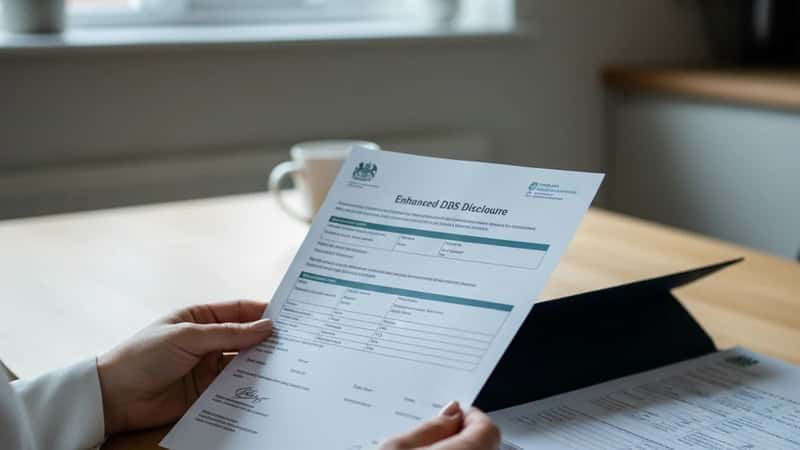
Asking a tutor to "show you their DBS certificate" is not a reliable safeguarding measure on its own. A certificate is a point-in-time snapshot — it reflects the tutor's record on the day it was issued, which may have been several years ago. The DBS Update Service eliminates this limitation.
How to run a parent verification via the DBS Update Service:
- Ask the tutor for their DBS certificate number, date of issue, and confirmation that they have subscribed to the Update Service.
- Visit the DBS status check page at gov.uk/dbs-update-service.
- Enter the certificate number and the tutor's surname, confirm that you have the tutor's consent to search, and submit.
- Review the result: "no change" means the certificate remains current; "changes recorded" means a new disclosure is required before any sessions proceed.
The check is instant and free for the person verifying. If a tutor declines to provide their certificate number or states they are not subscribed to the Update Service, request a new certificate before the first session.
Red Flags and Green Flags: A Parent's Safeguarding Checklist
Knowing what to look for — and what to walk away from — transforms a parent from a passive recipient of a tutor's self-presentation into an active safeguarding participant. The Channel 5 drama The Teacher [Series 3] depicted safeguarding failures in an educational setting that prompted widespread public discussion about professional boundaries between educators and pupils. The issues it raised are not fictional edge cases.
Green flags — positive indicators of a safe, professional tutor:
- Enhanced DBS check with a named issuing organisation, or enrollment in the DBS Update Service with an active and verifiable certificate
- QTS status independently confirmed via the Teaching Regulation Agency checker
- First session proposed in a visible space — family kitchen, a public library, or with a parent present in the room
- Clear, written safeguarding policy for online sessions: platform used, recording consent, session time limits
- Professional references from at least two previous families or a tutoring agency
- Membership of The Tutors' Association (TTA) or a comparable professional body with its own safeguarding standards
Red flags — indicators that should pause or stop the hiring process:
- Reluctance to name the body that issued their DBS check, or refusal to consent to an Update Service check
- Only holds a Basic DBS check for what is clearly a regular, unsupervised child-facing role
- Pushes for communication through personal messaging apps before the first formal meeting
- Insists on conducting sessions in spaces where no parental observation is possible
- No verifiable professional references and a history consisting solely of unverifiable private clients
- Pricing significantly below the market rate in a way that suggests desperation rather than competitiveness
Online Tutoring Safety: Additional Steps for Remote Sessions
Online tutoring introduces safeguarding considerations that a DBS check cannot fully address. As remote learning has become routine for UK families, the risk profile has shifted: the absence of physical co-presence does not eliminate safeguarding concerns — it changes their form.
Practical safeguarding steps for online tutoring in 2026:
- Use established platforms only. Tutoring platforms such as Tutorful, MyTutor, and Superprof require Enhanced DBS verification before listing any tutor. Hiring independently via social media, classified ads, or neighbourhood forums introduces significantly more uncertainty.
- Maintain parental visibility for younger pupils. For children under 13, a parent or guardian should be within the same room, or at minimum monitoring the session. The child's device screen should remain visible to an adult.
- Agree on session recording in advance. Some families request that video sessions be recorded. This must be agreed with the tutor before the first lesson — ideally in writing. Any refusal without a clear explanation is a red flag.
- Use professional video platforms, not personal channels. A legitimate online tutor uses Zoom, Google Meet, or a platform's built-in video tool — not personal FaceTime, WhatsApp video, or direct messaging calls, which create no verifiable record.
For families whose children are eligible for additional educational support, the 2026 SEND reforms announced by Education Secretary Bridget Phillipson are expanding access to funded tutoring pathways. If your child's support plan includes a tutor appointed through a local authority scheme, verify that the appointed tutor holds an Enhanced DBS check — this is a requirement, not an optional extra, for state-funded roles involving children.
For children with SEND needs accessing tutoring through a local authority plan, parents should request written confirmation of the tutor's DBS status before any sessions begin. This is both appropriate and expected [Department for Education SEND Code of Practice, 2015 — under review 2026]. Check updated SEND policy at gov.uk/children-with-special-educational-needs.
Frequently Asked Questions
Do all private tutors legally need an Enhanced DBS check?
Not universally — but any tutor engaged in what the law defines as "regulated activity" (regular, unsupervised, direct work with children) is eligible for, and should hold, an Enhanced DBS including a Children's Barred List check. In practice, a weekly private tutor visiting a home without parental presence throughout the session meets this threshold. Even where the legal obligation is ambiguous, parents are entitled to require an Enhanced DBS check as a condition of engagement, and no reputable professional tutor should object.
Can an independent tutor get an Enhanced DBS check without working through an agency?
Not through the government's direct-application route, which is restricted to Enhanced checks only via registered organisations. An independent tutor must apply through a DBS-registered umbrella body — third-party organisations that process applications on behalf of individuals for a fee (typically £10–£30 on top of the DBS fee). The resulting certificate is fully legitimate. Ask the tutor to name the umbrella body and provide the certificate number so you can run an Update Service check.
How long is a DBS certificate valid?
A DBS certificate has no legal expiry date. However, it is a point-in-time record that does not update automatically. The practical standard is to treat any certificate older than three years as requiring renewal, unless the tutor is enrolled in the DBS Update Service — in which case the certificate is effectively live and verifiable in real time at no cost to the parent.
Is a Basic DBS check adequate for a private tutor?
No. A Basic check reveals only unspent convictions and conditional cautions. It excludes spent convictions, local police intelligence, and — critically — the Children's Barred List. For any tutor working unsupervised with children, an Enhanced check including the barred list is the only disclosure that provides meaningful safeguarding assurance. Accepting a Basic check for an unsupervised child-facing role is not an informed safeguarding decision.
What is the DBS Update Service and how does a parent use it?
The DBS Update Service (£13 per year, subscribed to by the tutor) keeps an Enhanced certificate live and searchable online. Parents can check a tutor's status by visiting gov.uk/dbs-update-service, entering the certificate number and the tutor's surname, and confirming consent to search. The result — "no change" or "changes recorded" — is returned instantly and is free for the person checking.
Disclaimer: The information on this page is provided for general guidance only and does not constitute legal advice. Safeguarding requirements and DBS legislation are subject to change. Always consult official government sources at gov.uk or seek professional advice for your specific circumstances.