 Isobel Fraser
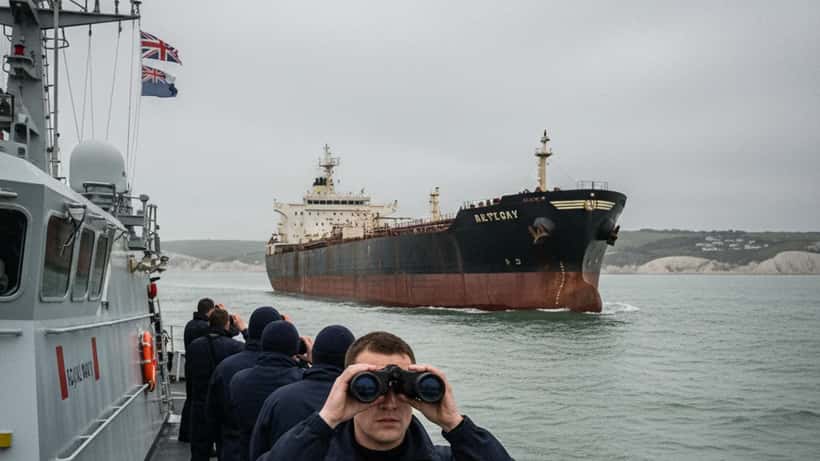
On 25 March 2026, the UK Prime Minister announced that British armed forces and law enforcement now have the authority to intercept and seize sanctioned Russian shadow fleet vessels transiting UK waters. The announcement — described by the government as "the latest blow to Putin's shadow fleet operation" — marks a significant escalation in sanctions enforcement that carries direct implications for UK businesses.
The UK has imposed sanctions on 544 Russian shadow fleet vessels. These ships transport approximately 75% of Russia's crude oil exports, helping fund the war in Ukraine. For British companies, the question is no longer just political: it's whether your supply chain, investment portfolio, or financial counterparties are exposed.
What Is the Shadow Fleet and Why Does It Matter to Businesses?
Russia's shadow fleet consists of ageing oil tankers operating under obscure ownership structures, often registered in jurisdictions with limited transparency. They are designed to move sanctioned Russian crude to buyers in Asia and elsewhere, circumventing Western restrictions.
The UK's Office of Financial Sanctions Implementation (OFSI) has been steadily expanding the sanctions list since 2022. Breaching these sanctions — even unknowingly — carries civil penalties of up to £1 million or 50% of the breach value, whichever is higher.
The Royal Navy has been tracking shadow fleet movements for years. Intelligence suggests these vessels have also loitered near UK subsea infrastructure — a fact that has accelerated the political decision to authorise interception.
What Does This Mean for UK Businesses?
For most companies, direct contact with sanctioned vessels is unlikely. But the risk surfaces in several less obvious ways:
Insurance and maritime exposure: Shipping companies, freight forwarders, and marine insurers face the most direct risk. Any involvement in facilitating the transport of sanctioned cargo — including providing insurance, port services, or ship maintenance — can constitute a sanctions breach.
Investment portfolios: Fund managers and wealth advisers must ensure their portfolios do not contain exposure to entities connected to shadow fleet operations. The complexity of beneficial ownership structures means this requires active due diligence.
Commodity trading: UK-based commodity traders dealing in oil, gas, or refined products must have robust procedures to verify that supply chains do not intersect with sanctioned Russian entities.
Correspondent banking: Banks providing transaction services to customers in shipping, commodities, or Eastern European markets face elevated exposure. Compliance teams need to screen against the latest OFSI consolidated list.
The Compliance Gap: What Most Companies Are Getting Wrong
Sanctions compliance is frequently treated as a tick-box exercise. The problem is that the shadow fleet is specifically designed to obscure beneficial ownership. A vessel may carry four different flags in a year, change its name, and be owned through a chain of shell companies in Liberia, the UAE, and Cyprus.
The EU and UK have coordinated their enforcement approaches, meaning cross-border businesses face a dual compliance burden.
Key mistakes companies make include:
- Relying solely on vessel name or flag rather than IMO number for screening
- Not updating sanctions screening tools when new designations are published
- Failing to conduct beneficial ownership checks on counterparties in high-risk jurisdictions
When to Seek Professional Advice
Sanctions law sits at the intersection of financial regulation, international trade law, and criminal liability. This is not an area to navigate without expert guidance.
A wealth manager or financial adviser can:
- Audit your portfolio for shadow fleet exposure
- Advise on divestment strategies if exposure is found
- Structure investments to avoid future sanctions risk
A legal specialist in sanctions and international trade can:
- Conduct due diligence on counterparties in the shipping, commodities, or energy sectors
- Assess whether a past transaction may have inadvertently breached sanctions
- Prepare a self-disclosure to OFSI if a potential breach is identified — proactive disclosure typically results in significantly reduced penalties
If your business operates in maritime, energy, commodity, or financial services sectors and you have not recently reviewed your sanctions compliance procedures, now is the time.
What Happens If a Vessel Is Seized?
The Royal Navy's authorisation to board vessels opens a new operational phase in UK sanctions enforcement. For businesses with indirect exposure, the practical implications include:
Insurance invalidation: P&I clubs and marine insurers are unlikely to cover claims arising from transactions that involve sanctioned vessels. If cargo is seized, the financial loss may fall entirely on the cargo owner.
Reputational damage: Being named in an OFSI investigation — even if no civil penalty is ultimately imposed — is now a public event. The OFSI publishes enforcement cases, and the threshold for publication of decisions was lowered in 2022.
Supply chain disruption: Businesses that rely on commodity flows through routes used by the shadow fleet — particularly in the Baltic Sea, English Channel, and around the Cape of Good Hope — should model alternative sourcing in case enforcement escalates further.
The Bigger Picture: Why Sanctions Are Getting Harder to Ignore
The UK's move is part of a coordinated allied strategy. The Joint Expeditionary Force — comprising Finland, Sweden, Estonia, Latvia, Lithuania, Denmark, the Netherlands and Norway — has been actively boarding suspected shadow fleet vessels in the Baltic. The UK's new powers align it with this coalition.
Alongside allies, the UK has targeted the infrastructure that supports shadow fleet operations: ship registrars, maritime service providers, and the financial intermediaries that facilitate transactions.
This signals that sanctions are evolving from a list-based compliance exercise into an active enforcement regime. Businesses that treat sanctions as a passive background check — rather than an ongoing risk management function — are increasingly exposed.
A wealth manager or financial adviser who understands the evolving sanctions landscape can help you protect your portfolio. An expert in international trade law can ensure your contracts include appropriate sanctions warranties and termination clauses. Both are now essential partners for any business operating in affected sectors.
Disclaimer: This article provides general information only and does not constitute legal or financial advice. For specific guidance, consult a qualified solicitor specialising in sanctions law or a regulated financial adviser.
