 Ben Davies
BBC Radio 5 Live's AM signal is going dark across parts of England from 30 September 2026, as the corporation shuts down its Exeter and Brighton medium wave transmitters. For millions of listeners who have relied on the 693 kHz or 909 kHz AM frequency to catch live sport and breaking news on an old portable radio, the switch-off is a practical problem with a straightforward solution — if you know which device to buy.
Why the BBC Is Switching Off Its AM Transmitters
The BBC confirmed in May 2022 that Radio 5 Live's AM network would close "no later than December 2027." The financial logic is hard to argue with: maintaining a national network of ageing analogue medium wave transmitters costs tens of millions of pounds per year, while the audience choosing to listen via AM has fallen sharply. According to RAJAR Q1 2026 figures, 77% of UK radio listening now happens via digitally enabled platforms — DAB, smart speakers, streaming apps, and digital television — leaving traditional analogue at just 23% of total listening hours.
The BBC is closing transmitters in phases rather than all at once. Redruth in Cornwall and Folkestone in Kent went dark on 31 July 2026. Exeter (South West) and Brighton (East Sussex) follow on 30 September 2026. Further regional shutdowns are expected throughout 2026 and into 2027, ahead of the full AM closure by December of that year. Radio 5 Live will remain fully available on national DAB digital radio, online via the BBC Sounds app, on smart speakers, and through digital television.
Five and a Half Million Listeners, and Some Still on AM
Radio 5 Live's weekly audience stands at 5.5 million adults. The vast majority already listen digitally — via a DAB car radio on the commute, the BBC Sounds app on a smartphone, or an Amazon Echo in the kitchen. But a significant share of loyal listeners, disproportionately older adults and those in rural or semi-rural areas, still rely on an AM transistor set: a device that runs on batteries, needs no broadband connection, and has sat on the same shelf for a decade or more.
Data from WorldDAB, the global industry body for digital radio, shows that 67% of UK households now own at least one digital radio, with cumulative sales having passed 61.9 million sets. Yet that still leaves a substantial minority of UK homes where the family radio — in the kitchen, the workshop, or by the bedside — is an analogue-only device. For those listeners, the AM closures are not an abstract infrastructure change. They are a morning of silence.
When the Signal Goes: An Exeter Listener's Reality
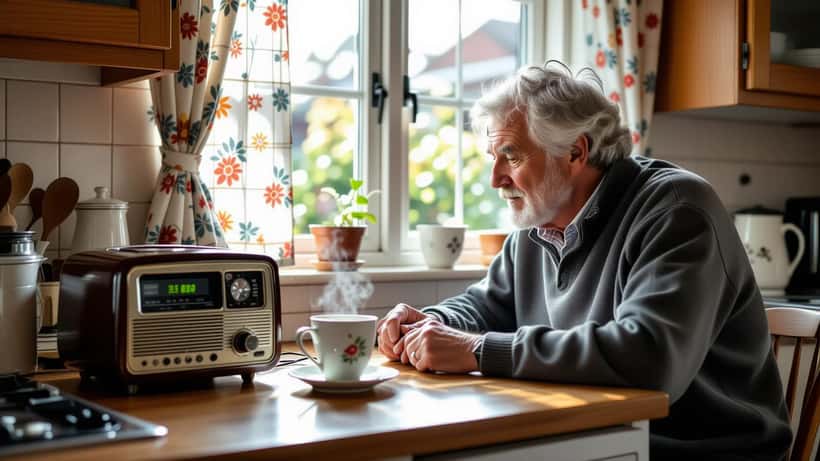
Consider Dave, 63, a retired teacher living in Exeter. A small analogue portable radio has sat on his kitchen worktop since the 1990s. He tunes to 693 AM every morning for the sports headlines and every Saturday afternoon for live football commentary. The radio cost him £8 at a car boot sale and has never once let him down.
On the morning of 1 October 2026, Dave switches it on. There is static where Radio 5 Live used to be. The Exeter transmitter closed the night before.
Here is what his upgrade choices look like, and what each costs:
- Entry-level DAB portable radio: £25–£45. The simplest like-for-like replacement. No Wi-Fi needed, no account required, no setup beyond a quick autoscan. Battery-powered options are available. Roberts and Pure both produce reliable sets at this price point. Dave buys one, presses autoscan, and is listening to Radio 5 Live again within ten minutes.
- Smart speaker (Amazon Echo Dot, Google Nest Mini): £30–£55. Dave says "Alexa, play BBC Radio 5 Live" and the station streams over his home broadband at CD-quality audio. Running cost is zero beyond his existing internet bill. The limitation: requires mains power and a working Wi-Fi connection at all times.
- BBC Sounds app: free. Streams Radio 5 Live on any smartphone or tablet, with a 30-second delay behind the live DAB broadcast. Podcasts, sport clips, and catch-up content included. If Dave already owns a smartphone, this costs him nothing.
- Car DAB adapter: £20–£50. For Dave's 2014 Ford Focus, which has a standard FM-only car radio, a plug-in DAB adapter connects via the existing aerial socket or aux cable. The BBC projects that 81% of the total UK vehicle fleet will have DAB capability by end of 2026 — but older cars like Dave's are in the remaining 19%.
The critical if/then is simple: if Dave keeps an analogue-only radio and does not replace it before 30 September 2026, Radio 5 Live disappears from that device permanently. A DAB portable at £25–£35 is the minimum-effort, minimum-cost fix, with no internet dependency and no new accounts. If Dave also wants coverage in his car, a £25 DAB car adapter brings his total spend to under £60 — considerably less than a full car stereo replacement.
A consumer electronics specialist can assess which combination of devices best fits a household's layout, existing broadband setup, and budget — particularly when multiple rooms are involved or when the listener already has a smart speaker ecosystem that could be extended.
Comparing Your Digital Options
Not every replacement works equally well for every listening habit. Here is a practical breakdown of the main routes:
DAB portable radio (£25–£150): Best for listeners who want a direct analogue-to-digital swap with no internet dependency. BBC national DAB coverage reaches 98% of the UK population, making this reliable everywhere except the most remote rural locations. Battery operation available. Purchase once, no ongoing costs.
Smart speaker (£30–£200): Best for kitchen or bedroom listening where broadband is always available. Audio quality is consistently high. Voice control is convenient for hands-free use. Cannot be taken outdoors or used during a power cut without a battery backup.
BBC Sounds app (free): Best for smartphone users who already carry a device with them throughout the day. Includes a full archive of Radio 5 Live sport and podcasts beyond the live stream. Requires mobile data when away from home Wi-Fi.
Digital television (free via Freeview channel 722): Good for living-room listening. No additional cost if you have an existing Freeview, Sky, or Virgin subscription. Not portable.
Car DAB adapter (£20–£50): Aftermarket plug-in adapters are widely available for vehicles without factory DAB. They connect via FM transmitter or aux cable. A viable solution for the estimated 4.5 million UK cars still without native DAB capability.
For households with more complex setups — multi-room audio systems, legacy hi-fi equipment, or a mix of older and newer devices — getting advice from a consumer electronics professional before purchasing can prevent buying hardware that does not integrate properly with what you already own. You can explore streaming and home audio guides on Expert Zoom for more background on how UK households are approaching the shift away from traditional broadcast.
What to Do Before 30 September 2026
Start with a simple check. Many kitchen radios, clock radios, and portable sets purchased in the last decade include DAB but may never have been activated. If you see "DAB" on the radio's casing or display, press the autoscan or autotune button and let it search — Radio 5 Live should appear in the results.
If your radio has no DAB capability, the replacement decision comes down to three factors: whether you need portability, whether you have reliable broadband, and how much you want to spend.
For portability with no internet: choose a DAB portable. For home listening with broadband: a smart speaker or Sounds app is more versatile. For the car: a DAB adapter is far cheaper than a new head unit.
The timeline also has a broader implication. With the BBC committed to closing all AM transmitters by December 2027, any investment now in a new AM-only device is money spent on a technology heading for extinction. Every new car sold in the UK includes DAB as standard. Every smart speaker streams digital radio natively. The direction of travel is clear.
For listeners who find the upgrade options confusing — particularly those managing audio across multiple rooms or integrating radio with existing home tech — a one-to-one session with a consumer electronics specialist can clarify the best path and prevent a costly misstep before the switch-off date arrives.
