 Amelia Ward
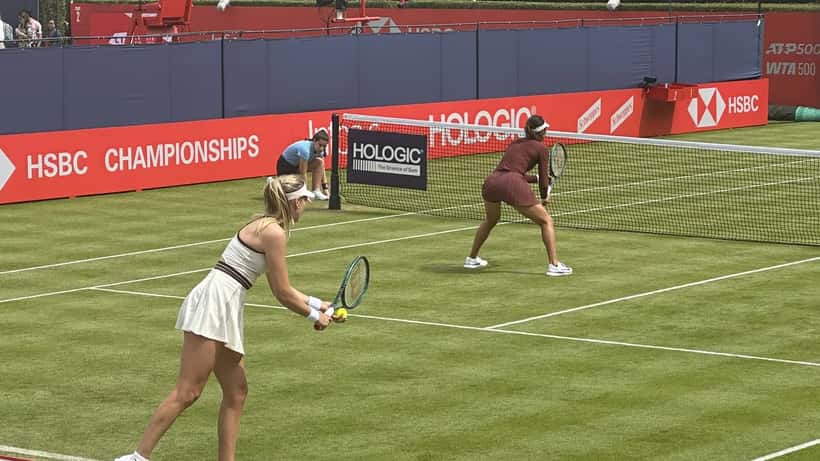
On Sunday 21 June 2026, Francisco Cerundolo and Tommy Paul meet in the men's singles final of the HSBC Championships at Queen's Club in London — the iconic grass-court ATP 500 event that serves as the last major tune-up before Wimbledon. Cerundolo survived a dramatic semi-final against Brandon Nakashima 6-7(5), 6-3, 6-4, while defending champion Paul dispatched Ugo Humbert with clinical precision 6-3, 6-3. But while the world watches two elite players contest a £600,000 winner's cheque on the immaculate turf of West Kensington, millions of recreational players across Britain are heading to their local courts — often unaware of the unique physical demands grass imposes on the body.
Sports medicine specialists consistently flag the clay-to-grass transition in June as one of the highest-risk periods in the tennis calendar. The surface demands shorter, sharper movement, a lower centre of gravity, and unfamiliar load patterns across every major joint. Professional players have weeks of specialist support to navigate this shift; recreational players typically have none. Here are five warning signs that your grass-court season needs expert medical attention rather than just rest and hope.
1. Ankle Pain That Persists More Than 48 Hours After Play
Grass courts demand constant unpredictable changes of direction, placing acute stress on the lateral ankle ligaments. A mild twinge that fades after a warm-down is common and usually harmless. Pain that persists beyond 48 hours — particularly with swelling, bruising, or instability when walking — may indicate a lateral ligament sprain requiring professional assessment.
According to NHS guidance on sports injuries, sprains that go untreated frequently cause chronic ankle instability, a condition that compounds over successive seasons and significantly shortens active playing careers. A physiotherapist can assess ligament integrity through specific provocation tests and design a targeted rehabilitation programme rather than leaving recovery to chance.
2. Knee Discomfort Specifically During Lateral Movement
Grass requires a lower, wider stance to maintain traction on the slippery surface — a position the knee rarely encounters on clay or hard courts. This dramatically increases the load on the medial collateral ligament, the meniscus, and the patellar tendon. The warning sign to watch for is pain that appears specifically during side-to-side movement rather than when running straight forward.
Cerundolo's well-documented period away from the ATP Tour earlier in his career is a reminder of how quickly a structural knee issue can escalate when not caught in time. Even minor meniscal irritation, ignored through the grass season and into Wimbledon fortnight, can require surgical intervention by autumn. If you notice consistent lateral knee pain during your club play this June, consult a sports medicine specialist before the next match rather than after.
3. Wrist or Elbow Pain After Serving
The low, skidding bounce characteristic of grass encourages a more aggressive, flatter service motion — increased ball speed, greater racket head acceleration, and more aggressive pronation through the point of contact. Recreational players who shift instinctively toward this style without adequate physical preparation place disproportionate stress on the wrist extensor tendons and the lateral epicondyle of the elbow.
Lateral epicondylitis — tennis elbow — develops from exactly this pattern. Symptoms include pain on the outer aspect of the elbow, grip weakness, and aching that lingers for hours after play. These are not signs to train through. Early physiotherapy intervention using tendon load management and eccentric strengthening has a strong evidence base for resolving the condition before it becomes a six-to-twelve-month problem.
4. Calf Tightness or Achilles Soreness After Matches
Grass demands continuous micro-adjustments from the calf complex. The soft, variable footing means every stride involves the Achilles tendon absorbing forces it has not encountered on clay since early spring. Mild calf fatigue in the first week of the grass season is expected. What warrants urgent attention is localised pain at the base of the Achilles, particularly if it feels sharp rather than diffuse or appears when rising on tiptoe.
Achilles tendon ruptures peak during the clay-to-grass transition. The tendon is being asked to adapt structurally faster than it can remodel, and the failure mode can be catastrophic. A physiotherapist can perform load-testing protocols to assess whether your tendon is coping with the surface change or approaching a threshold, and can guide you through a calf-strengthening programme calibrated to the grass season.
5. Recurring Lower-Back Stiffness on the Morning After a Match
The serve-and-volley patterns that grass encourages — even for baseline specialists like Paul and Cerundolo — require rapid lumbar extension and rotation at ball toss. Players who rarely practice net approaches suddenly increase spinal extension load dramatically during the six weeks of grass-court tennis. Lower-back stiffness that you consistently wake up with after a match, and that takes more than 30 to 60 minutes to fully resolve, is a meaningful signal rather than ordinary soreness.
Facet joint irritation and early disc involvement both present in this way at first. A sports medicine consultant can perform a movement assessment to distinguish mechanical stiffness from structural involvement, and recommend the targeted core stability work that protects the lumbar spine through the Wimbledon fortnight and beyond.
When to See a Specialist: Now, Not After Wimbledon
Health notice: This article is for general information only and does not constitute medical advice. If you are experiencing pain or injury, consult a qualified healthcare professional before continuing physical activity.
The Queen's Club men's final on 21 June 2026 is a reminder that Wimbledon fortnight begins in just two weeks. For recreational players across Britain, the temptation to maximise court time as the Grand Slam approaches is entirely natural. But playing through any of the five warning signs above during the highest-demand weeks of the grass season is how a correctable issue becomes a season-ending one.
A sports physiotherapist or sports medicine doctor can assess your biomechanics on grass specifically, identify individual risk factors before they escalate, and create a personalised plan that keeps you playing through July. As the dedicated match-fitness preparation seen in players like Harriet Dart at this week's Queen's Club demonstrates, professional health support makes a measurable difference when the pressure is highest. The same principle applies at every level of the game. ExpertZoom connects you with qualified sports medicine and physiotherapy specialists across the UK — take the first step before the warning sign becomes an injury.
