 Abigail Clarke
Celtic make the trip to Fir Park on 11 October 2026 for Gameweek 8 of the Scottish Premiership — and they do so missing at least 11 first-team players through injury. Motherwell are little healthier, with eight confirmed absentees and six more rated doubtful ahead of kick-off, including a serious concern over one of their key players. For the millions of amateur footballers who pull on their boots across Scotland and the rest of the UK every weekend, these headline numbers raise a far more personal question: when you pull up on a Sunday morning with a swollen knee or a popped hamstring, how do you know whether rest is enough, or whether a professional needs to see you that week?
The Injury Toll Shaping Today's Fixture at Fir Park
The scale of absentees heading into today's match underlines just how physically punishing the modern game has become — even at Scottish Premiership level, where squads are smaller and fixture schedules less forgiving than in the English top flight. Celtic's situation is the starkest. Portuguese winger Jota has been absent since suffering an anterior cruciate ligament rupture against Dundee United in April 2025. As of early 2026, manager Martin O'Neill confirmed that the 27-year-old had encountered an unexpected setback and would not return before the end of the 2025/26 season. A full ACL recovery, when properly managed, takes a minimum of nine to twelve months, according to the Chartered Society of Physiotherapy.
That timeline matters because it reflects the reality of genuine rehabilitation — not the shortest conceivable path back to the pitch. The sports medicine literature is consistent: athletes who return to football too early after an ACL injury face a re-injury rate of approximately 25%, meaning one in four who compresses the rehabilitation timeline will damage the same joint again within two seasons. Professional clubs invest substantial sums in physiotherapy staff and medical infrastructure precisely to prevent this cycle. Amateur players have no such safety net — and often no clear framework for knowing what they're dealing with.
What a Sports Physiotherapist Sees That You Cannot
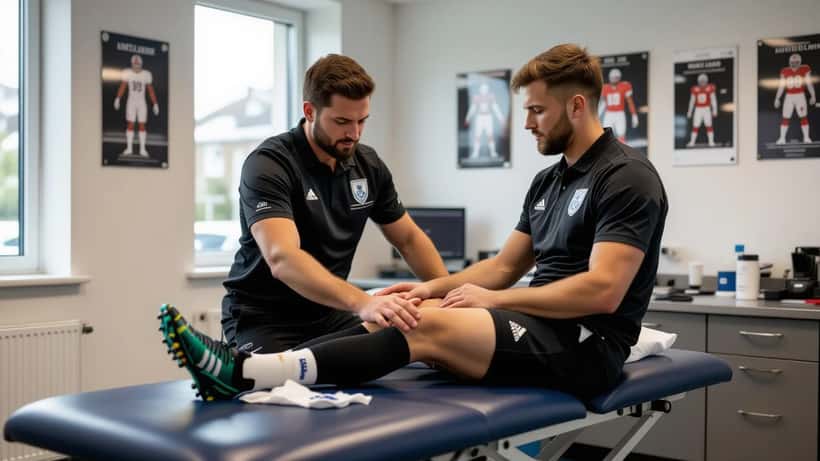
The gap between professional and amateur injury care is not purely financial. It is informational. A qualified sports physiotherapist brings clinical assessment tools that no amount of internet symptom research can replicate: manual testing of ligament integrity, assessment of joint stability across multiple planes of movement, and the clinical experience to distinguish between injuries that look similar on the surface but require completely different management.
Consider the most common football injury: the hamstring strain. To the untrained eye, a Grade I strain (fibres overstretched but structurally intact) and a Grade II partial tear look almost identical in the first 48 hours — both cause posterior thigh pain, both may involve bruising, both make sprinting impossible. The management, however, is radically different. A Grade I strain typically allows return to training in ten to fourteen days with minimal intervention. A Grade II tear requires six to eight weeks of progressive loading, and returning to full training before that threshold dramatically increases the risk of a more severe re-tear.
A sports physiotherapist makes that distinction in a single assessment. Without that assessment, amateur players are guessing.
There are five clinical indicators that sports physiotherapists consistently identify as non-negotiable triggers for seeking professional evaluation within 48 to 72 hours of an injury:
Swelling that does not reduce within 48 hours. Post-match muscle soreness is a normal response to exertion. Persistent joint swelling — particularly in the knee or ankle — indicates intra-articular damage: fluid or blood inside the joint itself, not just in the surrounding soft tissue.
Inability to bear full weight more than 24 hours after the injury. Weight-bearing pain that persists beyond one day warrants imaging to rule out bone stress or complete ligament rupture.
A "pop" or crack audible at the moment of injury. This presentation is strongly associated with ACL involvement and demands professional review rather than a wait-and-see approach, however mild the subsequent pain.
Instability or a joint that "gives way" during normal walking. Loading an unstable joint risks escalating a partial ligament tear to a complete rupture — turning an eight-week injury into a nine-month one.
Pain that worsens after day two rather than improving. Most muscular injuries peak in soreness at 24 to 48 hours and then improve steadily. Pain that intensifies after day two usually signals structural damage that will not resolve without professional management.
The Real Cost of Waiting: A Concrete Case
A scenario that plays out every weekend across Scottish amateur football illustrates exactly what is at stake. A 34-year-old central defender — call him Stuart — is playing Sunday league in Lanarkshire. In the 68th minute, he twists his right knee while challenging for a header. He hears a clear click, feels sharp lateral pain, but walks off the pitch unaided. He assumes it is a minor sprain. He ices it that evening, takes ibuprofen for three days, and — noting that the visible swelling has reduced slightly — returns to five-a-side training on day seven.
By day twelve, the knee is still swollen and buckles once when Stuart descends a flight of stairs. He books his first physiotherapy assessment. The verdict: a Grade II medial collateral ligament sprain with a possible partial ACL component — significant enough to require an MRI scan to rule out complete tears.
The physiotherapist's prognosis is blunt. Had Stuart rested correctly from the outset and begun a structured rehabilitation protocol in the first week — including graduated strengthening exercises, no rotational loading for at least six weeks, and no return to competitive football before clinical reassessment — his estimated recovery window would have been eight to ten weeks. Because he loaded the joint rotationally at day seven, he re-stressed a partially healed ligament at its most vulnerable point. His revised conservative recovery estimate is now 20 to 24 weeks.
The arithmetic is painful. A single initial assessment at a private sports physiotherapy clinic costs between £50 and £90 at most UK practices. An NHS self-referral in Scotland — available without a GP appointment in most health boards — is free. Stuart's decision to skip assessment in week one has now cost him five to six additional months off football, a likely requirement for surgical consultation, and multiple follow-up sessions rather than two or three well-timed appointments. The £60 he saved in week one will cost him multiples of that in the medium term, and far more in lost playing time.
Managing Recovery: What the NHS Recommends
For players dealing with an acute injury, current NHS guidance moves away from the traditional RICE method (Rest, Ice, Compression, Elevation) in favour of the updated PEACE & LOVE framework. The first 72 hours are focused on Protection (avoiding movements that cause significant pain), Elevation (reducing swelling), Avoiding excessive anti-inflammatory medication in the acute phase — since inflammation is part of the body's repair process — Compression, and Education about the injury's nature.
From day three onward, the approach shifts: progressive Load (gentle, graduated movement), Optimism (the psychological dimension of recovery, which research shows directly affects healing timelines), Vascularisation (low-intensity cardiovascular activity that doesn't stress the injured structure), and Exercise (sport-specific rehabilitation to restore movement patterns).
In Scotland, self-referral to NHS physiotherapy is available without a GP appointment in most health boards — a practical advantage that many injured players are unaware of. In England, access to direct NHS physiotherapy varies by integrated care system and region, but remains a realistic option for non-emergency sports injuries. Waiting times for both systems can stretch to several months, which is why a single private assessment early in the recovery window — even if subsequent care continues through the NHS — is often the most cost-effective single decision an injured footballer can make.
For faster access to qualified sports health professionals who can advise on injury severity and rehabilitation approach, you can explore ExpertZoom's network of health specialists. Reviews like Angus Gunn's goalkeeper injury case illustrate how professional-grade insight on sports injuries is increasingly accessible to amateur players, not just the elite.
Celtic's depleted squad heading to Fir Park today makes the abstract concrete: even with the best medical infrastructure in Scottish football, injuries accumulate quickly when the game is played at full intensity. For every first-team absentee on a Celtic teamsheet, there are thousands of amateur players dealing with the same types of injuries — hamstrings, ligaments, impact knocks — with far less guidance available to them. The match at Fir Park will be resolved on the pitch. But for the Sunday league player who turns on the highlights later that evening and recognises something familiar in the injury news, the more important question is simpler: have you had yours looked at?
This article provides general health information and is not a substitute for professional medical or physiotherapy assessment. If you are in pain or uncertain about the severity of an injury, consult a qualified healthcare professional.
