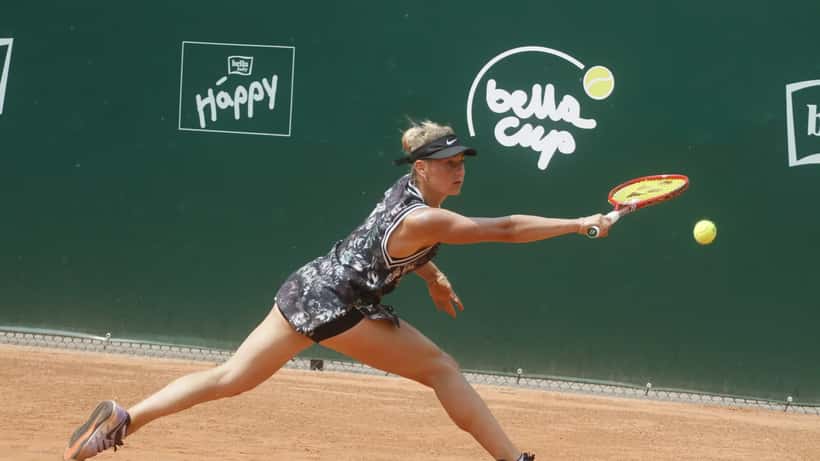
 Harriet Price
On 4 July 2026, as Wimbledon's third round begins at the All England Club in London, Ukrainian tennis player Marta Kostyuk steps onto the grass carrying far more than a racket. The world No. 13 — who came back from a set down to defeat Anna Blinkova in the second round — is once again at the centre of a debate that goes well beyond sport: what are an athlete's legal rights when it comes to political protest on court?
Since February 2022, Kostyuk has refused to shake hands with players from Russia and Belarus, making a deliberate, public stand against the war in Ukraine. This year alone, her protest has continued without pause. At the Brisbane International in January 2026, the WTA arranged separate photo sessions to avoid any confrontation. At the Madrid Open final in May 2026, both Kostyuk and Russian player Mirra Andreeva skipped the net handshake entirely, each walking directly to the umpire's chair. Today, the All England Club forms the latest chapter in a case that raises serious questions about the intersection of sport, freedom of expression, and employment law.
What the WTA Rules Actually Say
The Women's Tennis Association publishes a Code of Conduct that governs player behaviour during matches. While the Code requires players to maintain a baseline standard of sportsmanship, it does not — as of 2026 — explicitly mandate a post-match handshake. The WTA has repeatedly adapted its procedures to accommodate Kostyuk's stance, acknowledging that compelling a handshake could force a political statement from an athlete in circumstances far beyond a sporting disagreement.
This pragmatic approach reflects a broader recognition in professional sport: conduct rules must be balanced against the rights of athletes to hold — and express — political views. No fine or suspension has been issued against Kostyuk since she began her protest, which itself signals where the organisation believes the legal line falls.
Freedom of Expression in Sport: The UK Legal Framework
In England and Wales, the Human Rights Act 1998 incorporates Article 10 of the European Convention on Human Rights, which protects freedom of expression. This applies directly to public bodies and indirectly shapes how private sporting organisations draft their own regulations — particularly organisations hosting events on British soil, as Wimbledon does every July.
Article 10 is not absolute. The right to express a political view can be limited where it causes disorder, breaches specific contractual obligations, or materially harms the rights of others. For Kostyuk, the critical question is whether her refusal constitutes protected expression or a breach of her contract with the WTA tour.
Legal experts in sports law generally view her actions as protected. The refusal is silent, non-disruptive, and linked to a defined political context rather than a personal grievance. British courts have consistently found that political expression — even when controversial — attracts strong legal protection, particularly when it is peaceful and does not compel others to act.
For a broader look at the legal questions facing players competing in the UK, see our earlier analysis: Wimbledon 2026: 5 Legal Questions Every Tennis Player Should Ask.
Can a Sports Body Force an Athlete to Shake Hands?
This question sits at the intersection of contract law and human rights. When a player enters a professional tour, they sign agreements committing to the tour's Code of Conduct. If that Code includes sportsmanship obligations, a governing body could — in theory — impose sanctions for non-compliance.
In practice, enforcing a mandatory handshake rule against a Ukrainian athlete protesting an active military invasion would expose the WTA and Wimbledon to significant reputational and legal risk. A fine or suspension issued on those grounds could be challenged before the Court of Arbitration for Sport in Lausanne, the ultimate arbiter of disputes in professional tennis.
Under CAS jurisprudence, sanctions against athletes for political expression must be proportionate and consistent. Penalising Kostyuk for a silent, private refusal while continuing to allow Russian and Belarusian players to compete under neutral flags would be extremely difficult to defend before any independent tribunal — and would almost certainly fail a proportionality review.
Employment Law Parallels: What This Means Off the Court
Kostyuk's situation has direct parallels for anyone facing workplace conflict over politically or morally motivated decisions. Under the Human Rights Act 1998, employees and contractors in the UK retain the right to hold and express political views even within a professional context — provided this does not cause substantive harm or breach clearly defined conduct requirements.
Employers and sporting bodies can set reasonable conduct standards. What they cannot do is compel workers to perform symbolic acts — whether a handshake, a gesture, or any other expression — that contradict sincerely held political beliefs, without risking claims for constructive dismissal, unlawful deduction, or breach of contract. The principle holds whether the arena is a Wimbledon grass court or a corporate office in London.
This is precisely where professional legal advice matters. Understanding the boundary between conduct rules and protected expression is not straightforward, and the consequences of getting it wrong — for both the individual and the organisation — can be severe.
What Happens at Wimbledon Today?
As of 4 July 2026, Kostyuk faces Emma Navarro — the No. 12 seed from the United States — in the third round. Navarro leads their head-to-head record 4–0, and the American is known for her precise baseline game on grass. Whatever the result, if Kostyuk advances to meet a Russian or Belarusian opponent in a later round, the handshake question will resurface immediately.
The WTA's consistent response — accommodation rather than sanction — signals that the organisation has chosen pragmatism over enforcement. Whether that policy holds through future rounds, and at future Grand Slams, remains an open legal and political question.
When You Need a Legal Expert
Kostyuk's case is a reminder that sport and law are inseparable — from employment contracts and conduct codes to freedom of expression and human rights standards. If you are involved in a dispute involving workplace conduct, political expression, or the limits of contractual obligations in the UK, a qualified solicitor can provide advice tailored to your specific situation.
ExpertZoom connects you with verified legal experts across the UK, available for consultation online or in person. Whether your question involves employment law, sports contracts, or civil liberties, our platform helps you find the right professional quickly and without the usual barriers.
