 Harriet Price
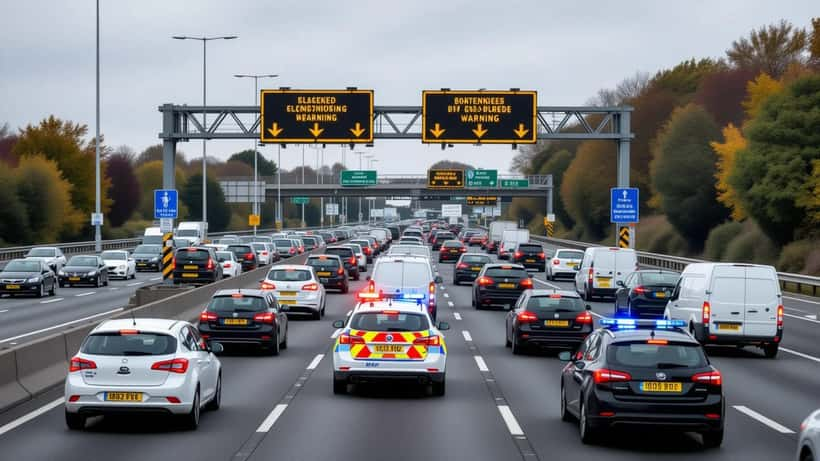
The M60 was closed around Junction 17 at Prestwich in Greater Manchester on the morning of 15 October 2026 after what reports described as a major police incident, leaving traffic gridlocked on the approach and drivers urged to avoid the area. Greater Manchester Police said they were dealing with an incident, and no reopening time had been given at the time of writing.
For the people sitting in the queue, the practical question is rarely about the incident itself. It is what happens next: the missed shift, the late school pickup, the hearing at 10am, the flight from Manchester Airport. This explainer sets out the rules that usually apply when a closure you did not cause makes you late, and when it is worth speaking to a professional.
What is actually known about the closure
According to reports published on the morning of 15 October, including Brit Brief, the closure affected the stretch around Junction 17 (Prestwich) and Junction 18 (Simister), with congestion stretching back on the approach. Live traffic feeds showed delays building back along the ring road.
Police-led closures behave differently from roadworks. There is no advance notice, no published diversion plan, and the reopening time depends on how long officers need the scene. National Highways has previously said in similar cases that it cannot give an estimated reopening time because of the nature of an incident. That uncertainty is exactly what causes disputes afterwards, because nobody can say in advance how late you will be.
This article does not speculate about what happened. The legal points below apply to any unplanned motorway closure, whatever the cause.
Can your employer dock your pay for arriving late?
Most employment contracts in England and Wales do not guarantee payment for hours you did not work, so an employer can often decide not to pay for time missed. What they cannot normally do is make a deduction from wages that is not authorised by your contract, by law, or by your written agreement beforehand. Under Part II of the Employment Rights Act 1996, unauthorised deductions can be challenged.
The distinction matters. Not paying for hours not worked is different from fining you extra for lateness. A "lateness penalty" that takes more than the time actually missed is a far weaker position for an employer unless the contract clearly provides for it.
Disciplinary action is a separate question. A reasonable employer is expected to look at the cause of lateness, and a verified motorway closure outside your control is a very different case from habitual lateness. Keep evidence: a screenshot of the National Highways status page, a traffic alert, or your satnav log showing the stationary time.
The government's Pay and Work Rights Helpline gives free guidance on pay disputes at gov.uk. It is a sensible first call before a dispute becomes formal.
A closure that traps you: the case of the missed shift
Take a composite example. Sam lives in Bury and drives the M60 clockwise each morning to a warehouse job that starts at 8am. Sam is paid £14.50 an hour. On the morning of a police closure, Sam reaches the back of the queue at 7.20am and does not get past the closure until 9.55am, arriving at 10.30am.
Here is how the if/then logic usually works.
If the contract says pay is for hours worked and there is no guaranteed minimum, then the employer can generally treat the 2.5 hours between 8am and 10.30am as unpaid, a reduction of £36.25.
If the employer instead removes a full 4 hours' pay (£58) as a "penalty", then the extra £21.75 above the time actually lost is the sort of amount Sam can challenge as an unauthorised deduction, starting with a written request and, if that fails, early conciliation through Acas.
If Sam's contract is for salaried hours with flexible-time provisions, then the employer may allow the time to be made up later in the week, and Sam should ask for that in writing the same day.
If Sam is dismissed for the lateness after less than two years' service, ordinary unfair dismissal protection is limited, but the dismissal may still be challengeable if it relates to a protected reason, so Sam should seek advice quickly because tribunal time limits are short, generally three months less one day.
None of this is an argument that employers are acting unreasonably. It simply shows that the numbers are small, the rules are specific, and a wrong assumption either way can cost real money.
Other deadlines a closure can break
Court and tribunal hearings. If you are stuck, contact the court or tribunal immediately by phone, explain the closure and ask what to do. Courts see traffic incidents regularly and can sometimes adjourn, but a failure to attend without contact can lead to a decision being made in your absence.
Flights and trains. If you miss a flight because of a motorway closure, the airline is generally not obliged to compensate you, because the delay was caused by something outside its control. Travel insurance may cover missed departures, but many policies exclude traffic and require a minimum buffer, so check the wording before you rely on it. Rail tickets bought for a specific train are often tied to that service, although operators sometimes allow flexibility when a major incident is declared.
Appointments with a fee. Medical, dental and professional appointments often charge for late cancellation. A documented closure is a good reason to ask for a waiver, and many providers will agree.
Delivery and service deadlines. Self-employed drivers and small firms face contract claims if a delivery slot is missed. Whether a closure counts as a force majeure event depends on the exact wording of the contract, and a standard clause covering "events beyond reasonable control" may or may not extend to traffic.
Can you claim compensation from anyone?
For ordinary delays, almost certainly not. There is no general scheme that pays motorists for time lost in a closure caused by an emergency response. National Highways and the police are managing a public-safety situation, and delay costs from a justified closure are not normally recoverable.
Compensation arises mainly where someone was at fault in a way that caused you loss. That could be a crash caused by another driver, in which case your insurer and the other driver's insurer are the relevant parties. It could also be a business that agreed to a fixed deadline and blames you unfairly. If a lorry fire or collision caused the closure, our earlier explainer on who bears legal liability when a road is closed after a lorry fire sets out how liability is worked out. Passengers on a coach caught in a motorway incident have different rights, covered in our piece on passenger rights after a coach fire on the M6.
What to do now if the closure made you late
- Record the evidence today. Take screenshots of the closure notice and traffic maps, and note the times you joined and left the queue.
- Tell the other side early. Send your employer, client or appointment provider a short message, then a written summary later.
- Do not accept a deduction in silence. Ask in writing what contractual provision allows it and how it was calculated.
- Check insurance wording for travel, motor breakdown and business interruption cover.
- Keep an eye on time limits. Employment tribunal claims normally require Acas early conciliation first and must be brought within three months less one day of the act complained of.
When an expert is worth consulting
Most closures end with an annoying morning and nothing more. A conversation with a legal expert becomes worthwhile if a deduction is larger than the time you lost, if you face disciplinary action for a documented closure, if a missed deadline has triggered a contract claim, or if you were injured in a collision connected with the incident.
An employment or consumer law specialist on ExpertZoom can review your contract and your evidence and tell you whether the deduction or the claim against you holds up before you decide how to respond.
This article is general information, not legal advice. Your rights depend on your contract and circumstances, and you should take advice on your own situation.
