 Charlotte Hughes
The A31 ground to a halt on the morning of 9 August 2026, when a lorry carrying household waste caught fire near Ringwood, Hampshire, forcing closure of the route in both directions from the A338 Salisbury Road junction to the M27 Junction 1 at Cadnam. For businesses relying on one of southern England's busiest east–west corridors, the question rising with that smoke is not simply about traffic. It is about money — and about legal accountability.
What Happened on the A31 on 9 August 2026
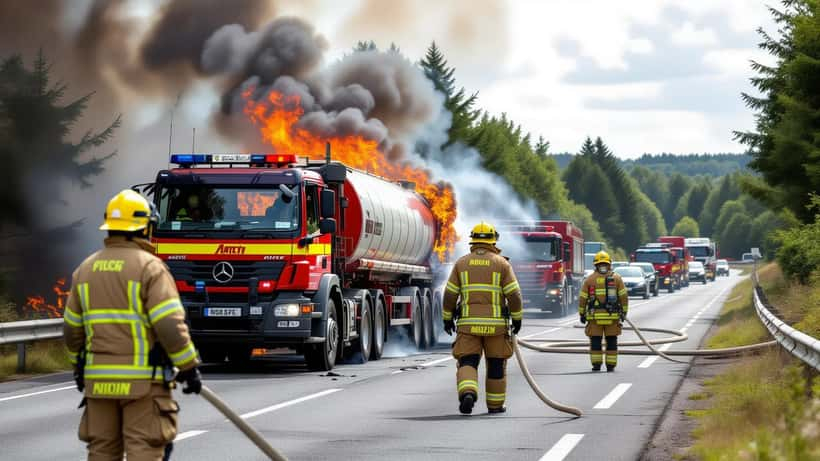
The fire broke out on the eastbound carriageway at approximately 09:09 BST, when the trailer unit of a lorry transporting household waste ignited. Hampshire Fire and Rescue Service responded rapidly, but the blaze spread into the central reservation before it could be brought under control. National Highways closed the A31 in both directions across a 12-mile stretch from Ringwood to the M27 Junction 1 at Cadnam. This corridor links the New Forest to Southampton and carries heavy commuter, tourist, and freight traffic throughout the summer months.
Drivers were diverted onto the A35 via Lyndhurst, but dense New Forest tourist traffic extended journey times by up to 45 minutes in both directions. Lorry fires are not isolated events on British roads. Essex Fire and Rescue alone attended multiple HGV blazes on the M25 and M11 in the twelve months prior. But their legal aftermath remains poorly understood by most businesses caught in the fallout.
The Legal Question at the Heart of Every Road Closure
Under Section 161A of the Highways Act 1980, if a person causes a fire on a highway that injures, interrupts, or endangers other road users, that person is guilty of a criminal offence and liable to a fine not exceeding level 5 on the standard scale — currently £2,500 for individuals, and unlimited for companies. However, criminal liability and civil compensation operate on entirely separate tracks.
For civil compensation, the relevant framework is the Road Traffic Act 1988, which requires that every motor vehicle used on a public road must carry valid third-party insurance. That policy covers injury and property damage caused to third parties. What it does not automatically cover — and what catches most affected businesses by surprise — are consequential economic losses, such as a missed delivery window, a voided service level agreement, or a client-imposed penalty clause.
That distinction between physical damage and financial consequence is where most businesses discover they have far less automatic legal recourse than they assumed.
What the Updated RHA Conditions Mean in 2026
As of 1 January 2026, the Road Haulage Association significantly updated its Standard Conditions of Carriage — the default contractual terms governing the majority of UK freight movements where no bespoke bilateral contract exists. The revised conditions address several aspects directly relevant to incidents like today's A31 fire:
- Cargo liability remains capped at £1,300 per tonne for cargo loss or damage in transit
- Force majeure clauses were rewritten to cover modern logistics scenarios, including automated loading failures and emergencies arising mid-route
- Carrier responsibility during multi-drop deliveries was clarified, but emergency incidents — including vehicle fires — still trigger the force majeure defence, releasing the haulier from contractual delivery obligations
What this means practically: if your goods were on the burning lorry, or on a vehicle directly affected by the closure, your claim against the haulier is capped at £1,300 per tonne unless your own contract specified a higher liability ceiling or you purchased specialist transit insurance. Most standard commercial business insurance policies do not automatically bridge that gap — it must be explicitly written in.
A Concrete Scenario: The Courier's Missed Window
Consider a Southampton-based courier firm that had a time-critical commercial delivery booked for a Bournemouth manufacturing client on the morning of 9 August 2026. The service level agreement specifies a hard delivery window of 09:30 to 11:30 BST, with a £750 failed-delivery penalty clause triggered automatically if the window is missed.
The driver joins the A31 near Ringwood at 09:15, unaware of the developing fire. By 09:40, the road is fully closed. Diversion via the A35 through New Forest summer traffic means the driver does not reach the Bournemouth site until 12:50. The client refuses the delivery and invokes the penalty clause in full.
If the lorry fire resulted from a defect the haulier's maintenance schedule should have identified — say, a brake drum overheating on the A338 that DVSA inspection records show was flagged but left unrepaired — a civil negligence claim against the haulier becomes viable. The courier firm would need to establish three elements:
- The haulier owed a duty of care to other road users (well established in law)
- The fire resulted from a breach of that duty — requiring DVSA maintenance records, expert mechanical testimony, and possibly dashcam evidence
- That breach directly caused the financial loss: closed road → missed window → £750 penalty
If the fire had no preventable cause — a sudden electrical short, an unforeseen defect — the haulier invokes force majeure and the courier firm's £750 loss falls back on their own business interruption insurance, assuming their policy is drafted broadly enough to cover consequential losses arising from third-party highway incidents.
The practical financial difference is stark: a successful negligence claim recovers the full £750 penalty plus any additional consequential losses. Business interruption insurance, by contrast, typically carries an excess of £250 to £500 and may reduce recovery to between £0 and £500 — or exclude the loss entirely if the policy restricts coverage to incidents on the policyholder's own premises or vehicles.
For the courier firm, the first 72 hours are critical. Every hour of delay in obtaining the haulier's DVSA maintenance file — obtainable via a Subject Access Request or pre-action disclosure — narrows the evidentiary window before records may be amended, archived, or lost.
National Highways and the "Green Claims" Process
There is a further dimension to incidents like the A31 fire that most private businesses overlook: National Highways also seeks cost recovery from hauliers responsible for damaging the strategic road network. Through what the agency calls Green Claims, it recovers costs for scorched road markings, damaged central reservation barriers, hazardous material clearance, and specialist resurfacing required after vehicle fires.
Depending on severity, such costs run from £15,000 to £80,000 or more — a significant call on the haulier's public liability insurance. This matters to affected businesses for an indirect but important reason: if the haulier's insurer is simultaneously managing a large National Highways Green Claim and multiple third-party injury claims, its policy limits face substantial pressure. Businesses with complex or high-value consequential loss claims should engage legal advice promptly — before any settlement is agreed between the insurer and National Highways, which could exhaust available cover.
Steps to Take If Your Business Was Affected
If the A31 closure on 9 August 2026 caused your business a measurable financial loss, a solicitor specialising in commercial road traffic claims can advise on whether a formal claim is viable. In the first 48 to 72 hours, the most important steps are:
1. Document the timeline with timestamps. Screenshot National Highways traffic alerts, traffic-update.co.uk reports, and any internal communications acknowledging the delay. Establish a clear chronology from the moment your driver or goods were affected.
2. Preserve your contractual exposure. Retain every delivery record, SLA document, penalty notice, and client correspondence. Courts examining consequential loss claims need to see the precise financial mechanism — not just "we lost money."
3. Request DVSA vehicle records. Under the Freedom of Information Act and GDPR access rights, DVSA maintenance and inspection records for a specific vehicle registration are obtainable. If the lorry had a prior defect notice, this becomes your central piece of evidence.
4. Notify your own insurer immediately. Even if you intend to pursue the haulier, late notification to your own business interruption insurer can invalidate your claim entirely — most policies require notification within 48 to 72 hours of the incident.
5. Review penalty clause enforceability. Not every penalty clause in a commercial contract survives legal scrutiny. Under the Supreme Court's Cavendish Square Holding BV v Makdessi [2015] test, penalty clauses must represent a legitimate interest proportionate to the breach. If a client is invoking a clause that exceeds their genuine loss, it may be challengeable — and a solicitor can advise before you simply pay.
The three-year limitation period for road traffic claims under the Limitation Act 1980 means businesses are not under immediate pressure to file proceedings. They are, however, under immediate pressure to gather evidence — dashcam footage is typically overwritten within 30 to 72 hours, and incident witnesses disperse fast.
YMYL disclaimer: This article provides general legal information only and does not constitute legal advice. Circumstances vary significantly; always consult a qualified solicitor for advice specific to your situation.
For the official legislative text governing fire offences on public highways, see Section 161A of the Highways Act 1980 on legislation.gov.uk.
