 Amelia Davies
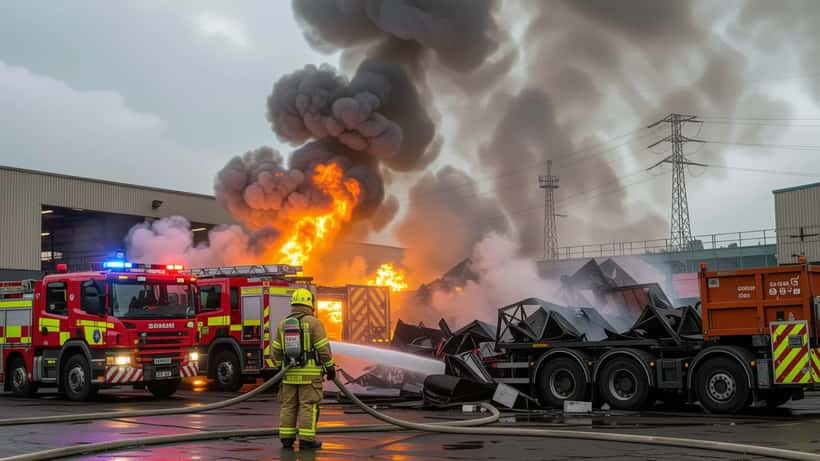
At approximately 11pm on Friday 9 October 2026, a major blaze erupted at a scrapyard on South Street in Glasgow's Govan district. Nine Scottish Fire and Rescue Service appliances responded, with crews battling the fire through the night as nearby residents reported explosions and thick smoke drifting across surrounding streets. Emergency services advised the public to keep windows and doors closed, switch off air conditioning, and close vehicle vents. By Saturday morning, the fire was still being managed — and the legal questions for affected residents were only just beginning.
The Hook: What Glasgow Residents Are Facing the Morning After
When a major industrial fire sends smoke, fumes and potentially hazardous particles into residential properties, the immediate focus is safety. But once the immediate danger passes and residents assess the damage — soot-filmed windowsills, chemical odours embedded in soft furnishings, irritated airways, contaminated cars — the legal picture becomes far more complex than a standard homeowner's insurance claim.
The South Street fire is not a one-off. Glasgow's south side has experienced several significant scrapyard and industrial blazes over the years, particularly along the stretch of Govan and Tradeston near the River Clyde. What makes incidents like this legally significant is that scrapyards routinely store vehicles, gas cylinders, batteries, oils, and other substances that — when they combust near residential areas — trigger specific legal protections that most affected residents do not know they have.
The core message from property and environmental solicitors in Scotland is consistent: the operator of an industrial site that causes harm to neighbours may bear liability, and the clock on some of those claims starts ticking within days of the incident.
What UK and Scots Law Says About Industrial Fire Liability
Legal specialists identify three overlapping frameworks that apply when industrial smoke or fumes reach private homes in Scotland.
Statutory nuisance under the Environmental Protection Act 1990 is the most accessible route. Under section 79 of the Environmental Protection Act 1990, smoke, fumes or effluvia that are "prejudicial to health or a nuisance" constitute a statutory nuisance. Critically, residents do not need to prove that the operator was negligent — only that the nuisance occurred and that it affected them. Glasgow City Council has a legal duty under section 80 to investigate statutory nuisance complaints and can serve an abatement notice on the responsible party. Residents can also take independent action under section 82, applying directly to the sheriff court and serving 21 days' notice on the person responsible.
Private law nuisance under Scots common law requires demonstrating that a neighbour or industrial operator has unreasonably interfered with the use and enjoyment of land. Courts assess factors including the locality (industrial versus residential), the duration of the interference, and whether the party causing the nuisance took reasonable precautions. If evidence emerges that the scrapyard operator failed to maintain adequate fire prevention systems or store hazardous materials in compliance with Scottish Environment Protection Agency (SEPA) guidance, a private nuisance claim becomes substantially stronger.
The rule in Rylands v Fletcher — confirmed in English law in Cambridge Water Co v Eastern Counties Leather plc [1994] and applied in Scots law through equivalent principles of culpa — imposes strict liability when someone brings onto their land something "likely to do mischief" that subsequently escapes and causes damage. Gas cylinders, oils, battery acid and chemical solvents stored in a scrapyard fall squarely within this category. If analysis or SEPA investigation shows that hazardous materials or contaminated firewater spread from the South Street site into residential properties or nearby drains, affected residents may have a strict liability claim regardless of how the fire started or who caused it.
For incidents involving older sites, there is also the possibility of asbestos or other legacy materials — an issue that has arisen in similar fire incidents at industrial sites across the UK. It is worth checking whether any premises in the immediate vicinity pre-date the 1990s, which increases the likelihood that insulation and structural materials could contain hazardous fibres.
Evidence collection is therefore critical in the 48-72 hours after an incident of this kind. Solicitors advise documenting everything before cleaning: photographs of soot deposits and residue, timestamps on all images, any written communications from the council or emergency services, and records of medical consultations.
What Happens to Sarah's £800 Smoke Damage Bill: A Concrete Scenario
Consider this situation, representative of residents within 300 metres of a large scrapyard blaze.
Sarah, 42, lives in a tenement flat on Admiral Street, approximately 250 metres from the South Street site. She followed the emergency services' guidance and kept her windows shut from 11pm Friday until 9am Saturday — ten hours. Despite this, on Saturday morning she finds a soot film on windowsills and kitchen surfaces, a persistent chemical smell embedded in curtains and upholstery, and her car's paintwork dusted with grey particles. By Sunday, she has a sore throat and books a GP appointment.
She collects quotes: professional smoke-odour treatment for the flat costs £420; dry-cleaning curtains and washing all soft furnishings costs £185; a vehicle detail to remove combustion particles costs £120. Total quantifiable loss in the first seven days: £725, plus GP fees and any follow-up medication.
Scenario A — No professional advice: Sarah calls her contents insurer. She discovers that smoke damage caused by an external industrial fire is often excluded under standard policies, or subject to a £250 excess, meaning she recovers at best £475. She is unaware of her statutory nuisance rights or the Rylands v Fletcher doctrine. She absorbs £250 from her own pocket, her medical costs are unrecovered, and there is no record of the harm for any future incident.
Scenario B — Legal consultation within 48 hours: Sarah books a 45-minute initial consultation with a solicitor experienced in environmental and property law (typical fees in Glasgow: £150–£280). The solicitor identifies three parallel steps: a statutory nuisance complaint to Glasgow City Council under EPA 1990 section 82; a letter before action to the scrapyard operator citing Rylands v Fletcher and requesting evidence of SEPA compliance and licence records; and a letter to her insurer making clear that any payment from the operator reduces — but does not extinguish — her insurance entitlement.
Within five weeks, Glasgow City Council's Environmental Health team opens a formal investigation. The scrapyard operator's public liability insurer makes a without-prejudice payment of £850 to avoid court proceedings. Sarah's net out-of-pocket cost: £0 after the payment, versus £250+ in Scenario A. More importantly, she has a documented record — medical notes, photographs, council correspondence — should symptoms develop further or the site catch fire again.
The difference in outcome is not primarily a matter of legal complexity. It is whether Sarah acts within the critical 21-day window before a section 82 notice can be served, and whether she collects the physical evidence before she cleans the flat.
What to Do in the Next 72 Hours
If you live or work near the South Street scrapyard fire and experienced any smoke, fume, ash or residue impact, solicitors and environmental advisers recommend these steps immediately.
Document before you clean. Photograph all visible soot, ash or residue on surfaces, vehicles and outdoor spaces before touching or cleaning anything. Note the date, time and location of each photograph. These images are the foundation of any claim.
Register with the local authority. Contact Glasgow City Council's Environmental Health team to register a nuisance complaint under the Environmental Protection Act 1990. This creates a public record, triggers the council's statutory investigation duty, and provides an official timestamp for your complaint.
Report to SEPA if you see run-off. If you observed any liquid discharge from the site, surface sheen on drains or discolouration of nearby water sources, report it to the Scottish Environment Protection Agency. Contaminated firewater can carry oils, heavy metals and fire retardants — SEPA investigation records are critical evidence in any Rylands v Fletcher claim.
Review your insurance policy before making a claim. Check the exact exclusion wording on "external fire" and "industrial pollution" before accepting any settlement or making a formal claim. Some policies exclude smoke from external industrial fires entirely; others allow it but limit the amount. Accepting a payment from your insurer may affect your right to pursue the operator separately.
Seek legal advice within 21 days. A statutory nuisance notice under EPA 1990 section 82 must be served at least 21 days before court proceedings can begin. Initial consultations with property or environmental solicitors in Glasgow are typically available at £150–£280, and many firms offer a free 15-minute intake call to assess whether your situation has merit.
Glasgow residents affected by industrial fires often underestimate the number of legal tools available to them. Statutory nuisance law, private law nuisance, and strict liability principles were designed precisely for situations where the cost of industrial activity falls on neighbours rather than the operator. A single consultation, taken promptly, is frequently enough to set those mechanisms in motion before the evidence fades and the legal windows close.
This article provides general information only and does not constitute legal advice. If you believe your health, property or legal rights have been affected by the South Street fire or any similar incident, consult a qualified solicitor.
