 Charlotte Hughes
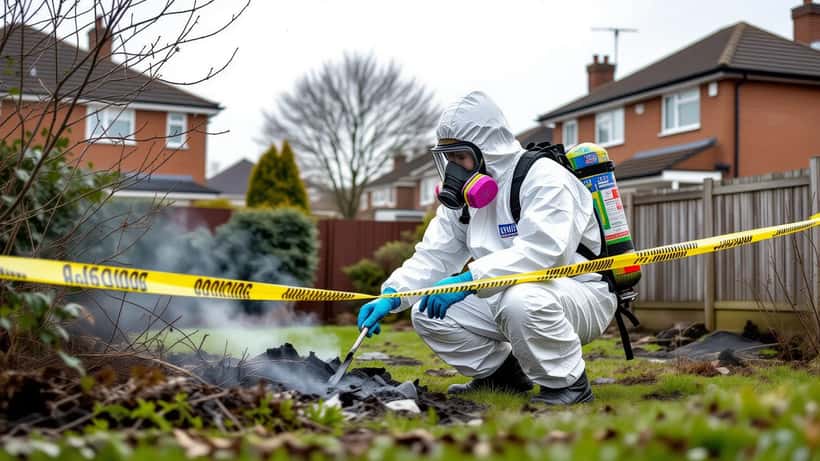
Residents near the Widnes recycling facility on Pickerings Road woke this week to find specialist contractors removing debris — including possible asbestos-containing materials — from their private gardens, raising urgent legal questions about liability and compensation after the major blaze that struck the site on 3 June 2026.
What Happened at the Widnes Recycling Facility
Cheshire Fire and Rescue Service was called to the fire at Pickerings Road, Widnes, at 10:26am on 3 June 2026. Nine fire engines were deployed across multiple sectors, with crews from Widnes, Runcorn, Penketh, Congleton, Crewe, Frodsham, Northwich and Merseyside battling a blaze that tore through large quantities of waste material before spreading to a steel-framed building on site.
A towering smoke plume was visible across Halton for hours, prompting Cheshire Fire and Rescue to advise residents to keep windows and doors closed. A high-reach extending turret was deployed to dampen the fire from above. No injuries were reported, but crews remained on scene for an extended period before bringing the blaze under control.
Nearly three weeks later, the consequences for those living nearby are still unfolding. Halton Borough Council has confirmed it is arranging a specialist contractor to remove debris — and possible asbestos-containing materials — from private gardens in the surrounding area. The council states that risks to public health remain low, but residents are now asking a more pressing question: who is legally responsible, and can they claim?
Why Asbestos Changes the Legal Picture
For most residential fire incidents, property damage claims follow a familiar path: home insurance, then a potential negligence claim against the responsible party. The presence of asbestos-containing materials introduces a more serious layer of legal complexity.
Under the Control of Asbestos Regulations 2012 and the Environmental Protection Act 1990, operators of industrial sites carry significant duties of care when hazardous materials leave their premises. If asbestos was stored, processed or generated at the Pickerings Road facility, residents affected by contamination may have grounds for a direct liability claim against the site operator — independent of any insurance payout.
Residents should not attempt to handle or remove any suspected asbestos-containing materials themselves. The Health and Safety Executive (HSE) provides clear guidance on managing asbestos risks safely, available at hse.gov.uk/asbestos.
5 Legal Questions Residents Should Ask a Solicitor
Whether you own or rent your property, a solicitor specialising in environmental or property law can clarify your position. These five questions are a practical starting point.
1. Can I [Claim Compensation](/gb/news/somerset-flooding-home-insurance-legal-rights-2026) for Property Damage?
In principle, yes. The law of private nuisance allows neighbours to claim against a business that causes measurable damage to their property — whether through smoke, ash, toxic debris or chemical contamination. You must show the damage is real and quantifiable: garden contamination, ruined soft furnishings, structural soot damage or health-related costs. A solicitor will assess whether the specific facts of the Widnes incident meet the legal threshold.
2. Who Is Liable — the Operator or Halton Borough Council?
Liability typically rests with the facility operator, not the local council. Halton Borough Council arranging the clean-up is a precautionary public health measure — it does not constitute an admission of fault on its part. However, if the site operator is uninsured or insolvent, the council may face obligations under the Environmental Protection Act 1990 to remediate contaminated land. A solicitor can identify the correct defendant and investigate the operator's insurance position before any proceedings are issued.
3. What Evidence Must I Preserve Before Contractors Arrive?
This is the most time-sensitive issue. Before any contractor removes debris from your garden or property, document everything: photograph and video all visible ash, debris or suspected asbestos material; note exact locations; record the dates and times. Keep receipts for any protective measures you took — air purifiers, replacement items, cleaning costs. If possible, instruct your own independent surveyor to produce a formal contamination report before the council's contractors clear the site. This becomes critical evidence in any future claim.
4. Do Tenants Have the Same Rights as Homeowners?
Yes. Your tenancy status does not remove your right to claim against the facility operator for property damage or health effects. Your landlord also has a duty under the Landlord and Tenant Act 1985 to maintain your home in a safe, habitable condition. If smoke or asbestos contamination has made part of your property unusable, you may be entitled to a rent reduction or temporary rehousing at the landlord's expense — while also pursuing a separate claim against the operator. A housing or property solicitor can advise on both avenues simultaneously.
5. How Long Do You Have to Make a Claim?
Limitation periods vary by claim type. Property damage claims under private nuisance or the rule in Rylands v Fletcher typically carry a six-year limitation period. Personal injury claims — for health effects from smoke or asbestos exposure — generally run for three years from the date of injury or from when you became aware the condition was linked to the exposure. Because asbestos-related illness can take decades to develop, the law provides that this three-year window runs from the date of awareness, not first exposure. Acting now to preserve evidence keeps all your options open.
What to Do Right Now
If your property was affected by the Widnes recycling fire, the following steps matter most before the clean-up removes key evidence:
- Do not touch any debris, ash or suspected asbestos material — wait for the licensed contractor arranged by Halton Borough Council
- Photograph everything before contractors arrive, including all visible debris and any damage to the property
- Notify your home insurer immediately and ask what your policy covers for third-party industrial fires
- Consult a solicitor who specialises in environmental or property law — many offer a free initial assessment
If several neighbours have been affected by the same contamination, a group action against the facility operator may achieve a stronger outcome than individual claims. Find solicitors with experience in fire damage and environmental liability on Expert Zoom.
Industrial Fires Near Homes: A Pattern Worth Noting
The Widnes fire is not an isolated event. Industry bodies have described fires at UK waste and recycling facilities as occurring at "epidemic" levels, driven in part by improperly disposed lithium-ion batteries from household electricals. For residents living near these sites, the legal framework — private nuisance law, the Environmental Protection Act, the Control of Asbestos Regulations — offers genuine protections. But those protections only work if residents understand them, gather evidence promptly, and consult a qualified expert before the opportunity closes.
This article provides general legal information only and does not constitute legal advice. If your health or property has been affected by the Widnes fire, consult a qualified solicitor before taking any action.
