 Charlotte Hughes
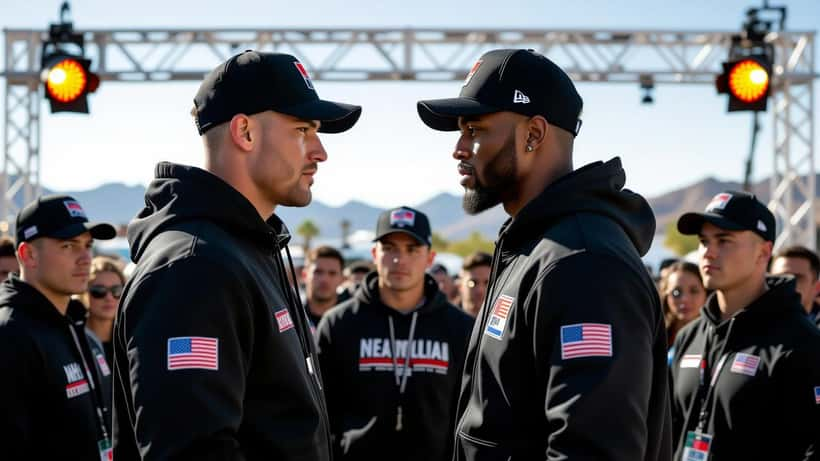
When Ryan Garcia and Conor Benn stood face to face this week ahead of their WBC welterweight world title fight — confirmed for Saturday 12 September 2026 at T-Mobile Arena in Las Vegas — few in the crowd understood quite how close this bout came to never happening. Behind the stare-down lay months of cease-and-desist letters, competing contract claims, and a legal battle involving two separate companies threatening to pull the plug on one of boxing's most anticipated match-ups of the year.
The resolution was quiet and confidential. The legal lessons are anything but.
The Promoter War That Almost Stopped the Fight
Zuffa Boxing — the fight promotion venture co-led by UFC chief executive Dana White, WWE president Nick Khan, and Saudi financier Turki Alalshikh — had been negotiating a showcase welterweight title defence for Garcia since early 2026. Conor Benn, freshly signed to Zuffa on a multi-fight deal, was the target opponent. The venue, the date, and the broadcaster were all agreed in principle. Then Golden Boy Promotions intervened.
Golden Boy, Garcia's former promotional partner, held what it described as a co-promotional option over Garcia's remaining bouts under an existing multi-fight contract — a clause that gave it a mutual veto over any deal Garcia's company, King Ryan Enterprises, sought to sign with a third party. Without Golden Boy's agreement, the argument went, Zuffa Boxing was engaged in tortious interference with an existing contractual relationship. A cease-and-desist letter was issued to Zuffa and its parent company TKO, demanding the negotiations stop.
Within days, streaming platform DAZN fired off its own legal notice. DAZN had what it described as exclusive broadcast rights to Garcia's fights, making the proposed Paramount+ deal a separate breach of contract. Two letters, two sets of lawyers, and one fighter caught between competing claims.
The fight announcement was delayed for weeks. Reports emerged of frantic behind-the-scenes negotiations. Eventually — through a combination of contractual compromise and, most likely, confidential financial settlements — the bout was confirmed. Garcia defends his WBC welterweight title against Britain's Conor Benn on Saturday 12 September, streaming on Paramount+ at no pay-per-view surcharge.
Expert Analysis: What a Cease-and-Desist Letter Actually Does
From a UK legal perspective, the cease-and-desist letters in this dispute are a reminder that these documents are frequently misunderstood — by the public and occasionally by the recipients themselves.
A cease-and-desist letter in English law is not a court order. It carries no judicial authority on its own. What it is, in legal terms, is a formal notice — a 'letter before action' — that the sender believes their rights are being infringed and that proceedings will follow if the conduct continues. Its purpose is often strategic as much as legal: to raise the cost of continuing, to trigger negotiations, and to establish a paper trail that will matter if the case reaches the Commercial Court.
Golden Boy's letter rested on two distinct legal theories. The first was tortious interference with contractual relations: the claim that Zuffa, knowing of Garcia's existing promotional commitments, was deliberately inducing him to breach them. This is an established tort in English law, derived from the 1853 case of Lumley v Gye and developed extensively in the sports and entertainment industries since. The second, less commonly appreciated, was the potential applicability of the Competition Act 1998, which governs exclusive dealing arrangements whose object or effect is to restrict, prevent, or distort competition in the UK market. An exclusive co-promotional clause that effectively prevents a boxer from accepting the best commercial offer available could, depending on the market context, be challengeable on competition law grounds — though this is a high bar to clear and typically requires demonstrating meaningful market power.
DAZN's position was more straightforward: if the exclusivity clause in its broadcast agreement was validly agreed and covers the Garcia vs Benn fight, streaming it on Paramount+ would be a direct breach. Whether that clause could withstand scrutiny — particularly given competition law constraints on exclusive broadcasting in sport — is a separate question.
UK sports lawyers who advise professional athletes in disputes of this kind point to a consistent pattern: cease-and-desist letters in exclusive contract disputes are frequently sent on contestable grounds. The question is not always whether the claim is legally solid, but whether the cost and delay of contesting it is worth bearing. In the Garcia-Benn case, it was not — and a negotiated resolution followed.
For a deeper look at how the British Boxing Board of Control approaches regulatory disputes and promoter complaints, our analysis of the Wilder-Chisora referee controversy explores the formal channels available within the sport's UK governance framework.
The Cage You Sign Yourself Into: A Concrete Scenario
The dynamics at the centre of the Garcia-Benn legal dispute are not unique to professional boxing. They appear — in more modest but equally consequential form — in freelance contracts, talent agreements, and commercial partnerships across the UK every week.
Consider this scenario: a self-employed personal fitness consultant based in Birmingham signs a three-year exclusive management agreement in February 2024 with a sports agency. The contract grants the agency the right to approve all commercial partnerships the consultant enters into, in exchange for a 15% commission on all earnings and a £10,000 upfront development fund.
In June 2026, a national sportswear brand approaches the consultant directly with a sponsorship deal worth £75,000 per year — more than double their current agency-brokered income. The consultant wants to sign. The agency does not approve, citing the exclusivity clause, and issues a cease-and-desist to the sportswear brand alleging tortious interference.
The enforceability of that exclusivity clause — and therefore the legal weight of the cease-and-desist — depends on several factors a specialist solicitor would examine immediately:
Duration and proportionality: English courts have long held that post-contractual restraints in personal services agreements are subject to the restraint of trade doctrine. A three-year exclusivity clause is at the upper limit of what courts will routinely uphold for a self-employed individual, particularly where the agency's actual investment (the £10,000 development fund) is modest relative to the income the clause controls.
Scope: If the clause covers "all commercial activity" rather than a defined category of work or client, it is significantly more vulnerable. Blanket exclusivity clauses in personal services contracts are regularly struck down as unreasonably broad.
Consideration: The £10,000 upfront payment is relevant. Courts assess whether the restrictive obligation was matched by genuine value received. An exclusivity clause where the agency contributed little beyond introductions — and where the consultant generated most of the commercial opportunity themselves — is in weaker standing.
If the clause is enforceable, the agency could apply to the Commercial Court for an injunction preventing the consultant from signing with the sportswear brand. An interim injunction, if granted, could block £75,000 in annual income for the duration of the proceedings. Legal costs for a straightforward commercial injunction application in the UK typically range from £20,000 to £50,000 for each party — before any trial.
If the clause is found to be an unreasonable restraint of trade, it may be void ab initio — meaning it was never binding. The consultant could sign the new deal, and the cease-and-desist would have no legal foundation. But the uncertainty during the period between receiving the letter and obtaining legal clarity is real, and delays in signing commercial deals have their own financial cost.
This is precisely the dynamic that played out for Garcia and Benn: the legal claim may have been imperfect, but the cost and disruption of contesting it in real time — with a fight week deadline — made negotiation the rational path.
What to Do If You Receive a Cease-and-Desist Letter
Whether you are a professional athlete, a freelancer with an exclusivity clause, or a business approached by talent whose existing agreements are disputed, the steps are consistent.
Do not ignore the letter. Silence can be interpreted as acquiescence. A brief acknowledgement that you have received the letter and are taking legal advice is typically appropriate and does not constitute an admission of liability.
Do not publicly dismiss it. Cease-and-desist letters are frequently leaked or referenced in subsequent proceedings. Statements made in response — particularly dismissive ones — can complicate your legal position.
Obtain independent legal advice before responding. The counterparty's solicitors will have drafted the letter to maximise its apparent strength. A specialist in sports, entertainment, or commercial contract law can assess within days whether the underlying claim has genuine merit or is primarily a negotiating tactic.
Assess competition law angles. Under the Competition Act 1998, exclusive agreements that restrict competition may be void. If an exclusivity clause is being used to prevent you from a legitimate commercial opportunity — particularly in a market where the claimant has significant market power — competition law provides a potential route to challenge it, and may even support a damages claim against the party enforcing an anti-competitive restriction.
Understand the injunction threshold. For a claimant to obtain an interim injunction in the UK, they must demonstrate a serious question to be tried, that damages alone would not be an adequate remedy, and that the balance of convenience favours restraining the defendant. This is not automatic. Many cease-and-desist letters are never followed through to injunction proceedings — because the legal claim does not meet the threshold.
For UK professionals navigating the fine print of exclusive contracts — whether in sport, media, or commercial services — expert legal advice at the moment a dispute arises is the difference between a blocked deal and a successful renegotiation. The Garcia-Benn fight made it to Las Vegas because the parties found a way through. For disputes without Dana White's resources and a Saudi-backed chequebook, the outcome depends far more on the quality of the legal advice obtained on day one.
For more on how exclusive sports contracts and image rights are structured for UK athletes, see our analysis of Fury vs Joshua and the contract clauses that matter.
Legal disclaimer: This article provides general legal information for educational purposes only and does not constitute legal advice. If you have received a cease-and-desist letter or are involved in a contractual dispute, consult a qualified solicitor before taking any action.
