 James Harrison
At least 30 people died and more than 70 were injured when a flash fire tore through the Rong Beer Na Ladprao music bar in northern Bangkok shortly before midnight on Sunday 12 July 2026. According to NPR, investigators believe a single spark from a faulty circuit breaker ignited a ceiling lined with highly combustible foam, and most victims died from smoke inhalation within minutes — not from the flames themselves.
For readers in Britain, a nightclub tragedy 6,000 miles away can feel remote. Yet the exact chain of failures that made the Bangkok fire so deadly — a hidden electrical fault, untreated combustible materials, and blocked escape routes — is present in thousands of UK homes right now. Fire safety experts say the disaster is a stark reminder to check the risks sitting quietly behind your own walls.
What happened in Bangkok
The blaze broke out at around 11.40pm as a six-piece band was playing. Four of the band's core members were among the dead, Al Jazeera reported. The band members were reportedly the first to spot a spark from a circuit breaker before flames raced across the low ceiling.
Thai officials said the single-storey building was enclosed, had low ceilings, and appeared to use decorative foam that had not been treated with flame retardant. It took firefighters roughly half an hour to bring the fire under control. Twenty-four of the injured remained in critical condition days later.
The most chilling detail concerns the exits. Investigators told reporters that several of the bar's four exits may have been locked, and the largest cluster of bodies was found near a rear door that had never been opened. A table set up to sell sweets partially blocked one route, and the room was too dark for panicking customers to find their way out.
The three failures that turn a spark into a disaster
Every element of the Bangkok fire maps onto a hazard that a UK home inspection routinely uncovers. Understanding them is the first step to preventing them.
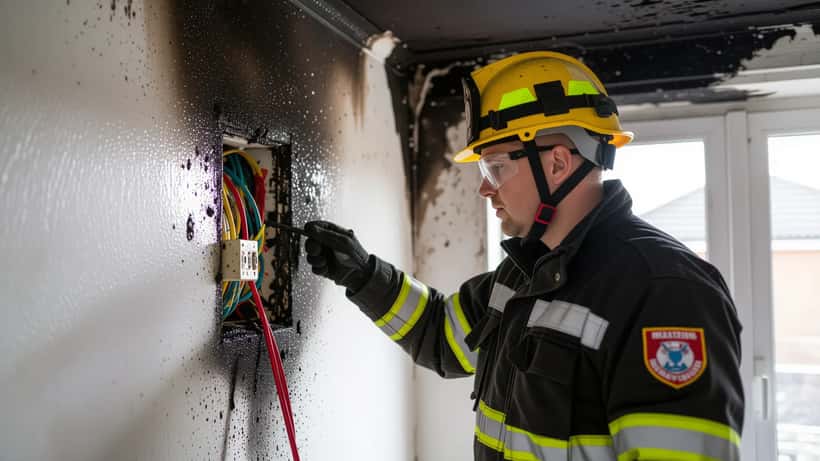
A hidden electrical fault. The fire reportedly began at a circuit breaker. In older British housing stock, ageing consumer units, overloaded sockets, and degraded wiring are among the most common causes of accidental house fires. Electrical faults are behind a significant share of domestic blazes recorded each year by fire and rescue services.
Combustible materials. The Bangkok venue's foam decoration acted like kindling above people's heads. British homes carry their own fuel load: polyurethane foam in older sofas and mattresses, cheap decorative panelling, and cluttered lofts. Furniture made before modern flammability standards can release toxic smoke astonishingly fast.
Trapped exits. People died in Bangkok because they could not get out. In a home, the equivalent is a back door blocked by storage, a window painted shut, keys that are never left in a deadbolt, or a hallway crammed with belongings that becomes impassable in thick smoke.
Why smoke — not fire — is the real killer
The Bangkok victims died from smoke inhalation, and that is the pattern in most fatal fires. Modern furnishings can fill a room with dense, toxic smoke in under three minutes, long before flames reach you. Working smoke alarms buy the seconds that make the difference between escaping and being overcome.
Under GOV.UK guidance, ten-year sealed-battery alarms are recommended, fitted on the ceiling in the middle of a room and on every hallway and landing, and tested at least monthly. Heat alarms — not smoke alarms — belong in kitchens, where cooking would otherwise trigger constant false alerts. You can read the official advice in the government's fire safety in the home guidance.
If you want to understand how quickly smoke affects the body, our explainer on the health risks of smoke inhalation after the Peckham fire sets out the warning signs to watch for.
What an expert can check that you cannot
Some fire risks are visible — a cluttered escape route, a missing alarm — and you can fix them this weekend. Others are hidden inside the fabric of your home, and this is where professional help matters.
A qualified electrician can carry out an Electrical Installation Condition Report (EICR), the formal inspection that identifies overloaded circuits, dangerous wiring, and consumer units at the end of their life — precisely the kind of fault that started the Bangkok fire. Landlords in England are already required to have one every five years; homeowners are not, but experts recommend an inspection if your property has not been checked in a decade.
A home improvement specialist or fire-safety assessor can go further: reviewing your escape routes, advising on fire doors and flame-retardant materials, and flagging older foam furniture that no longer meets safety standards. For anyone renovating, adding a loft conversion, or converting a garage, this advice is not optional — building regulations impose specific fire requirements that are easy to breach unintentionally.
A simple plan you can act on today
Fire experts recommend a short home audit anyone can do:
- Test every smoke alarm and replace any older than ten years.
- Fit a heat alarm in the kitchen and check you have detection on every floor.
- Never block internal or external doors with storage, and keep a key by any deadbolt.
- Agree an escape route with everyone in the household — and a second one in case the first is blocked.
- Book an electrical inspection if your wiring has not been checked in years.
The Bangkok fire was not caused by anything exotic. It was a spark, some foam, and doors that would not open. Those are ordinary hazards, and the reassuring part is that ordinary hazards can be fixed. If you are unsure whether your home's wiring, materials, or layout would hold up in an emergency, connecting with a qualified electrician or fire-safety expert through Expert Zoom is a straightforward way to get a professional assessment before you need one.
This article is general information, not a substitute for a professional fire-safety or electrical inspection. If you smell burning or suspect an electrical fault, switch off at the mains and call a qualified electrician; in an emergency, dial 999.
