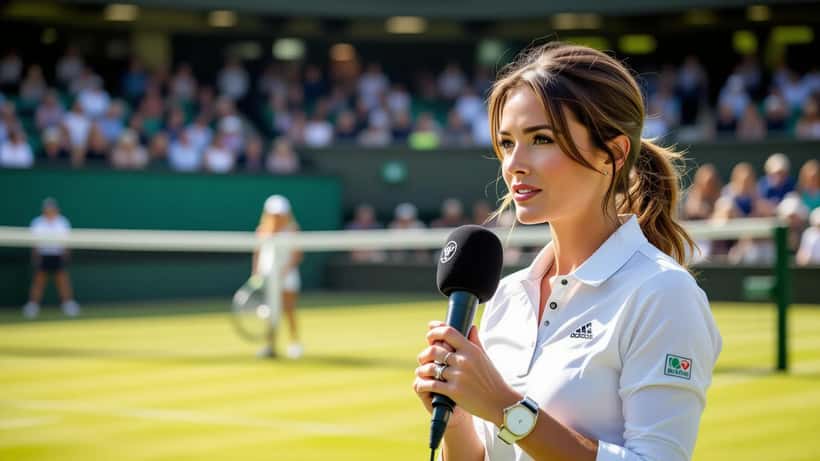
As Wimbledon 2026 approaches, the BBC’s coverage line-up is once again under the microscope—and former British No. 1 Annabel Croft is back at the centre of the conversation. Her return to the commentary booth at SW19 this summer has reignited debate about what makes tennis analysis truly authoritative in an era of data overload and hot takes. For a tournament that prides itself on tradition, Croft’s presence is a reminder that expert insight still beats sheer volume of opinion.
Croft, who reached a career-high ranking of 24 and represented Great Britain in Fed Cup competition, has spent more than two decades translating the technical minutiae of tennis for mainstream audiences. That skill is rarer than it looks. Modern broadcast tennis is awash with statistics—first-serve percentages, break-point conversion rates, rally lengths—but numbers mean little without someone who can explain why a match is unfolding the way it is. Croft’s value lies precisely in that interpretive layer: she reads body language, detects tactical shifts, and contextualises pressure in a way that predictive models still struggle to match.
The 2026 Championships arrive at an inflection point for the sport. With several longtime champions either retired or nearing the end of their careers, audiences are hungry for fresh narratives. British interest is particularly acute this year thanks to the momentum building around Jack Draper’s 2026 Wimbledon run, which has analysts revising their seeding predictions. Croft’s commentary is likely to feature heavily during Draper’s matches, not merely because of her national profile but because her tactical breakdowns help viewers understand the leap from challenger-level power to grand-slam consistency.
Yet expertise in tennis broadcasting is not just about former playing credentials. The legal and administrative undercurrents of the tour are increasingly relevant to fans. Wimbledon 2026 qualifying has already raised questions about player rights, scheduling, and eligibility disputes that can derail a career before the main draw begins. Croft’s interviews and segment hosting frequently touch on these structural issues, giving her a broader remit than pure tactical analysis. In a consultation marketplace, that multidisciplinary perspective is exactly what separates informed guidance from generic commentary.
The tournament is also spotlighting a new generation of British talent. While Draper commands the headlines, lesser-known names are forcing their way into the conversation. Toby Samuel’s tennis career highlights in 2026 illustrate how a measured developmental path—combining doubles specialization with singles breakthroughs—can create unexpected Wimbledon storylines. Croft has consistently championed these nuanced trajectories, resisting the temptation to declare every young player either a future star or a failure. That balanced tone is increasingly valuable as social media rewards polarisation over patience.
On the international side, the men’s draw features contenders whose styles test the limits of conventional analysis. Alex de Minaur’s 2026 Wimbledon run is a case in point: his defensive speed and counter-punching intelligence demand more than praise for athleticism. Effective commentary must explain how he constructs points, neutralises bigger hitters, and manages energy across five sets. Croft’s playing background against a variety of styles in the 1980s and 1990s gives her a vocabulary for these match-ups that resonates with both casual viewers and dedicated fans.
Qualifying week, often treated as a footnote, is where Croft’s eye for detail can shine brightest. Oliver Tarvet’s Wimbledon qualifying campaign in 2026 shows how quickly narratives form around players who arrive with little public profile. Croft has a long track record of identifying the technical signatures—serve patterns, return positioning, footwork on grass—that predict whether a qualifying run is a fluke or a genuine breakthrough. For businesses and professionals in any field, the lesson is familiar: surface signals are noisy; trained judgment separates signal from noise.
Behind the scenes, Croft’s continued prominence also raises a question about expertise itself. In a marketplace—whether for sports analysis, legal advice, health consultation, or technical support—the best experts are not always the loudest voices. They are the ones who can synthesise experience, current evidence, and audience needs into clear recommendations. Wimbledon’s broadcast team clearly values that synthesis, and Croft’s longevity suggests audiences do too. Her career is a working example of how specialist knowledge, communicated with humility, builds trust over time.
For viewers tuning in this summer, the appeal is straightforward. Croft does not just describe what happened; she explains what it means for what happens next. That forward-looking orientation is the hallmark of useful expertise. Whether she is breaking down a tactical adjustment on Centre Court or interviewing a tearful qualifier, her contribution is anchored in the reality of competition rather than the fantasy of narrative.
As the 2026 tournament unfolds, expect Croft’s segments to generate discussion well beyond the tennis bubble. In an age when expertise is often contested, her continued relevance is a quiet argument for the enduring value of people who know their subject deeply and can share it clearly. Wimbledon will be watched for the champions it crowns, but part of its pleasure will come from experts like Croft who help the rest of us understand why they deserved to win.
