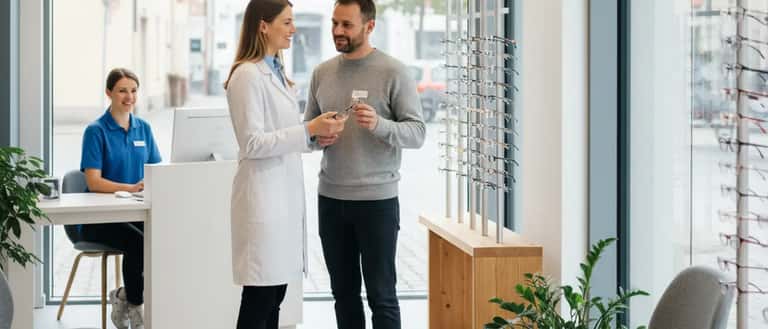
Every adult in the UK should have an eye test at least every two years, yet nearly half of us put it off for longer [College of Optometrists, 2024]. Finding a reliable optometrist near you is the first step toward protecting your vision — and catching health conditions like diabetes and high blood pressure that often show up in the eyes before any other symptoms appear. Whether you need a routine sight test, a specialist contact lens fitting, or urgent care for a sudden change in vision, the right optometrist makes all the difference. Here are seven practical factors that separate a great optometrist from an average one.
1. Check GOC Registration and Professional Qualifications
Every optometrist practising in the UK must be registered with the General Optical Council (GOC), the statutory regulator for the optical professions. You can verify any practitioner's registration status for free on the GOC registrant search. A fully qualified optometrist holds a degree in optometry and has completed a pre-registration year of supervised clinical practice before earning their GOC licence.
Beyond the baseline qualification, some optometrists hold additional specialisms. Independent Prescribing (IP) status allows them to prescribe medication for eye conditions. A fellowship from the College of Optometrists (FCOptom) signals advanced clinical expertise. If you need specialist care — paediatric assessments, contact lens fitting, or low-vision support — ask whether the practice employs an optometrist with the relevant accreditation.
Key point: If a practice cannot confirm GOC registration for its optometrists, look elsewhere.
2. NHS Eye Tests Versus Private Appointments
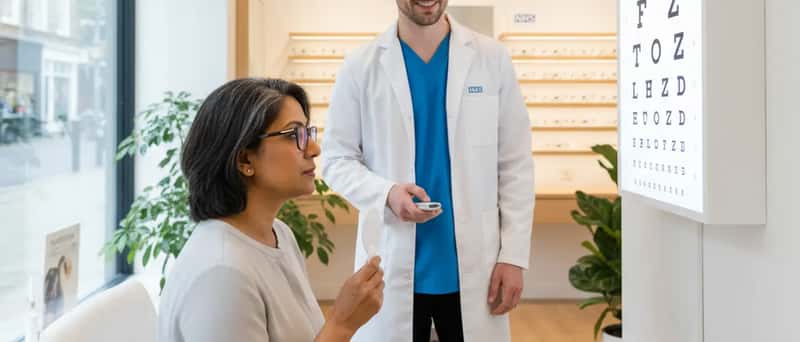
An NHS-funded eye test is available free of charge to certain groups, including children under 16, adults over 60, people receiving Universal Credit, and those diagnosed with or at risk of glaucoma [NHS, 2025]. You can check your eligibility on the NHS sight test page. The test covers a comprehensive examination of eye health and vision. Most high-street optometrists — Specsavers, Boots Opticians, Vision Express — are contracted to provide NHS tests alongside their private services.
A private eye test typically costs between £20 and £50, depending on the practice and location [Association of Optometrists, 2024]. Private appointments may include additional screening technologies such as Optical Coherence Tomography (OCT), which produces detailed cross-section images of the retina. Some independent practices offer extended appointment times of 30–40 minutes compared to the NHS standard of roughly 20–25 minutes.
3. Location, Opening Hours, and Booking Convenience
Proximity matters when choosing an optometrist near you, but convenience goes beyond distance. Check whether the practice offers online booking, evening or weekend slots, and walk-in availability for emergencies. Many UK chains now allow same-day appointments through their websites, while independent practices may require a phone call.
Consider accessibility too. Ground-floor premises or lift access matters for older patients and wheelchair users. If you drive, confirm whether the practice has on-site parking or is near public transport. A practice that is easy to reach makes you far more likely to attend regular check-ups rather than postponing them.
"Patients who choose a conveniently located optometrist are 60 per cent more likely to attend their follow-up appointments on schedule." — Primary Eye Care Services Report, 2023
4. Range of Services and Diagnostic Technology
Not every optometrist offers the same range of services. A standard sight test checks visual acuity and prescribes corrective lenses. A well-equipped practice goes further, offering retinal photography, OCT scanning, visual field testing, and dry eye assessments. These additional tests can detect glaucoma, macular degeneration, and diabetic retinopathy years before symptoms appear.
Specialist Services to Ask About
- Contact lens fitting: Requires a separate appointment and a practitioner with contact lens expertise. Fees range from £30 to £75 for a fitting [AOP, 2024].
- Children's eye exams: Paediatric optometrists use age-appropriate techniques. The NHS covers children's tests and provides a voucher toward glasses.
- Emergency eye care: Some practices participate in the Minor Eye Conditions Service (MECS), offering same-day assessments for sudden symptoms like flashes, floaters, or red eyes — free on the NHS.
If your local practice lacks a specific service, ask for a referral. Optometrists can refer patients directly to hospital eye departments under NHS pathways.
5. Reviews, Reputation, and Word of Mouth
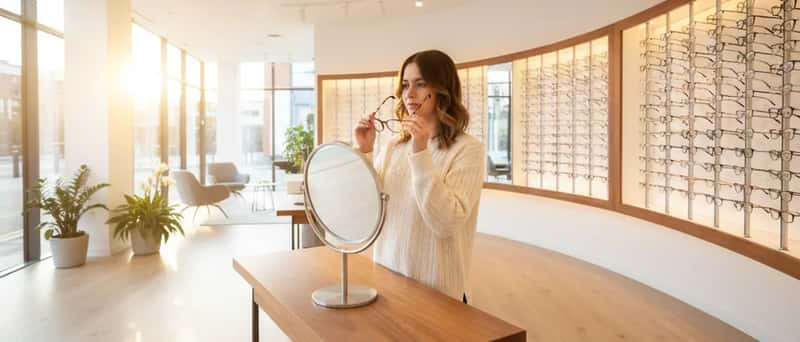
Online reviews provide a useful starting point, but read them critically. Look for consistent themes rather than isolated complaints. A practice with hundreds of reviews averaging 4.5 stars on Google is a stronger signal than one with ten five-star ratings. Pay attention to comments about staff friendliness, waiting times, and how thoroughly the optometrist explained results.
Sarah, a 34-year-old marketing manager in Bristol, switched optometrists after her previous practice rushed through her appointment in under 15 minutes. Her new independent optometrist spent 35 minutes on the examination and identified early signs of ocular hypertension — a precursor to glaucoma that her previous tests had missed. The extra thoroughness changed her treatment path entirely.
Ask friends, family, or your GP for personal recommendations. Local community groups and forums often highlight trusted practices that do not appear at the top of search results.
6. How to Prepare for Your First Appointment
Arriving prepared helps your optometrist provide the most accurate assessment. Follow these steps before your visit:
- Bring your current glasses or contact lenses — even if the prescription is outdated. The optometrist uses them as a baseline.
- List any medications you take — certain drugs, including antihistamines and antidepressants, affect vision and pupil dilation.
- Note any symptoms — headaches, eye strain, difficulty with night driving, or seeing floaters. Mention how long they have lasted.
- Know your family eye history — glaucoma, macular degeneration, and high myopia have genetic components. Your optometrist will adjust screening accordingly.
- Allow enough time — a comprehensive test takes 20–40 minutes. If OCT or retinal photography is included, add another 10 minutes.
A note on contact lens wearers: Remove soft lenses at least 12 hours before your appointment, and rigid gas-permeable lenses at least 24 hours before. This ensures accurate corneal measurements.
7. When to See an Optometrist Urgently
Routine eye tests are scheduled every two years for most adults, but certain symptoms require an immediate appointment. Contact your optometrist or visit an emergency eye care service if you experience sudden loss of vision in one or both eyes, a sudden increase in floaters or flashes of light, a shadow or curtain across your field of vision, severe eye pain, or a red eye with nausea.
These symptoms may indicate retinal detachment, acute glaucoma, or other conditions that require treatment within hours [Royal College of Ophthalmologists, 2024]. The Look After Your Eyes website, run by the College of Optometrists, provides further guidance on recognising urgent symptoms. Many high-street optometrists participate in urgent care schemes such as MECS or the Wales Eye Care Service, providing same-day assessments that can prevent a trip to A&E.
A note on health: The information in this article is provided for general guidance only and does not constitute medical advice. If you experience any of the urgent symptoms described above, seek professional help immediately. For ongoing concerns about your eye health, consult a qualified optometrist or your GP.