
When Sarah moved from Manchester to Bristol last autumn, she assumed registering with a new GP would take a quick phone call. Three weeks, two rejected applications, and one urgent walk-in clinic visit later, she finally secured a place at a practice accepting new patients. Her experience is far from unusual — over 6.36 million patients in England were unable to get a GP appointment when they needed one in 2024 [British Medical Association, 2024]. Finding doctors near you in the UK involves more than a simple postcode search, and the process has changed significantly since the pandemic reshaped primary care.
Why Finding a Doctor Near You Has Become More Difficult
GP availability across the United Kingdom has tightened considerably since 2019. The NHS workforce statistics show that the number of fully qualified, full-time equivalent GPs in England dropped from 27,647 in September 2015 to 27,031 in June 2024 [NHS Digital, 2024], despite a growing population. Rural areas and newly built housing estates face the sharpest shortages — some patients report driving 20 minutes past their nearest practice simply because it is full.
The NHS "Find a GP" tool lists every registered practice by postcode, but availability is another matter. Practices can close their patient lists when demand exceeds capacity, leaving residents in certain postcodes with limited options. Meanwhile, walk-in centres and urgent care clinics handle immediate needs but cannot replace the continuity of a registered GP.
Key point: Registration with a GP practice remains the single most important step for accessing NHS healthcare. Without it, you cannot receive routine prescriptions, specialist referrals, or scheduled health screenings.
How Sarah Found a GP: The Steps That Worked
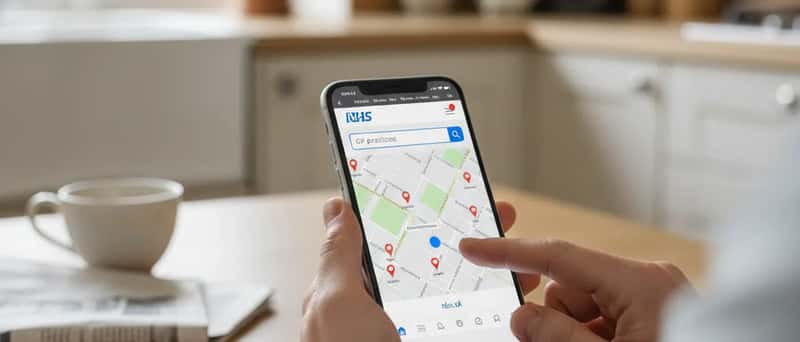
Sarah's initial mistake was common — she tried to register at the closest practice to her new flat without checking whether it accepted new patients. After her second rejection, she followed a structured approach that resolved the problem within five days.
Step 1: Search by Postcode on the NHS Website
The NHS Find a GP service returns every practice within a radius of your postcode. Sarah entered her BS3 postcode and found 14 practices within two miles. The listing shows each practice's address, phone number, and a link to its profile page — but not whether it currently accepts patients.
Step 2: Phone Before Visiting
Rather than walking into each surgery, Sarah phoned the top five practices from the list. Three were accepting new patients in her catchment area; two had closed lists. Each call took under five minutes.
Step 3: Complete the GMS1 Form
Registration requires a GMS1 form, available at the practice or downloadable from the NHS website. The form asks for personal details, previous GP information, and any ongoing medical conditions. Sarah submitted hers on a Monday and received confirmation by Thursday.
Point to remember: You do not need proof of address or immigration status to register with a GP. The NHS states explicitly that these documents are not required, though practices sometimes request them incorrectly [NHS England, 2024].
Common Myths About Registering With a GP
Many patients delay or avoid registering because of misconceptions that circulate widely online.
Myth: You must live within the practice boundary to register. Since January 2015, GP practices in England can accept patients from outside their traditional catchment area under the "out of area registration" scheme [NHS England, 2015]. The practice is not obligated to offer home visits to out-of-area patients, but all other services remain available.
Myth: You need a fixed address. The NHS confirms that people without a fixed address — including those experiencing homelessness — have the right to register with a GP. Practices can use the surgery's own address as the patient's registered address [NHS England, 2024].
Myth: Private GP services are always faster. Private GP appointments typically cost between £50 and £150 per consultation [Private Healthcare UK, 2025]. While booking is usually faster (same-day appointments are common), private GPs cannot issue NHS prescriptions at the subsidised rate, and referrals to NHS specialists may take the same time as those from an NHS GP.
When the NHS Route Stalls: Alternative Ways to See a Doctor

Not every medical need can wait for GP registration to complete. The UK offers several alternative routes to see a doctor quickly.
NHS 111: Calling 111 or visiting 111.nhs.uk connects you with trained advisors who can book same-day GP appointments, direct you to an urgent treatment centre, or arrange a call-back from a clinician. The service operates 24 hours a day, 365 days a year.
Urgent treatment centres (UTCs): These centres handle conditions that need attention within 24 hours but are not life-threatening — sprains, minor infections, cuts requiring stitches. No registration is needed.
Online doctor consultations: Platforms now offer remote GP appointments via video or phone. For non-emergency concerns like prescription renewals, skin conditions, or mental health check-ins, an online doctor consultation can provide clinical advice without leaving home. Many NHS practices also offer their own online triage systems through the NHS App.
Pharmacies: Since 2024, the Pharmacy First scheme allows pharmacists in England to treat seven common conditions — including urinary tract infections, shingles, and earache — without a GP referral [NHS England, 2024]. This reduces pressure on GP surgeries and provides faster access for straightforward conditions.
What to Do if Every Practice Near You Is Full
Sarah's situation — multiple rejections before finding an accepting practice — affects thousands of patients each year. If every GP surgery in your area has closed its list, you still have options.
Contact your local Integrated Care Board (ICB). The ICB (formerly Clinical Commissioning Group) has a legal duty to find you a GP place. Call or email them explaining that no local practice is accepting patients. They must assign you to a practice within a reasonable timeframe.
Request out-of-area registration. A practice slightly further away may have capacity. You sacrifice home visits but gain full access to appointments, prescriptions, and referrals.
Register as a temporary patient. Any GP practice must accept you as a temporary patient for up to three months if you are in the area but not yet registered [NHS Regulations, 2024]. This bridge option ensures continuity of care while you secure permanent registration.
Use Expert Zoom for immediate medical guidance. While no online platform replaces a registered GP for ongoing care, Expert Zoom's health professionals can answer urgent medical questions, help you understand symptoms, and advise whether your situation requires an emergency department visit.
Essential takeaway: No one in the UK should be without access to a GP. If practices refuse you, escalate to your ICB — it is their statutory responsibility to ensure coverage.
Choosing the Right Practice: Beyond Proximity
Distance matters, but it should not be the only criterion when selecting a GP. Sarah eventually chose the third-closest practice because it offered extended evening hours — a practical necessity for her shift-pattern job.
Factors worth checking before you register:
- Opening hours: Some practices offer early morning (7:00 AM) or evening (8:00 PM) appointments. Check the practice profile on the NHS website.
- Online services: Practices connected to the NHS App allow online booking, repeat prescription ordering, and access to medical records. Not all practices have activated every feature.
- Patient satisfaction: The GP Patient Survey publishes annual results for every practice in England. Scores cover ease of getting appointments, staff helpfulness, and overall experience.
- Specialist services: Some practices run in-house clinics for diabetes management, asthma reviews, or mental health support. If you have an ongoing condition, this can reduce hospital visits.
- Languages spoken: For non-English speakers, finding a practice with multilingual staff can significantly improve the consultation experience. Multilingual healthcare platforms and interpretation services can bridge the gap when your nearest practice lacks staff who speak your language.
Disclaimer: The information on this page is provided for general guidance only and does not constitute medical advice. Always consult a qualified healthcare professional for personal medical concerns.