 Emilie Wang
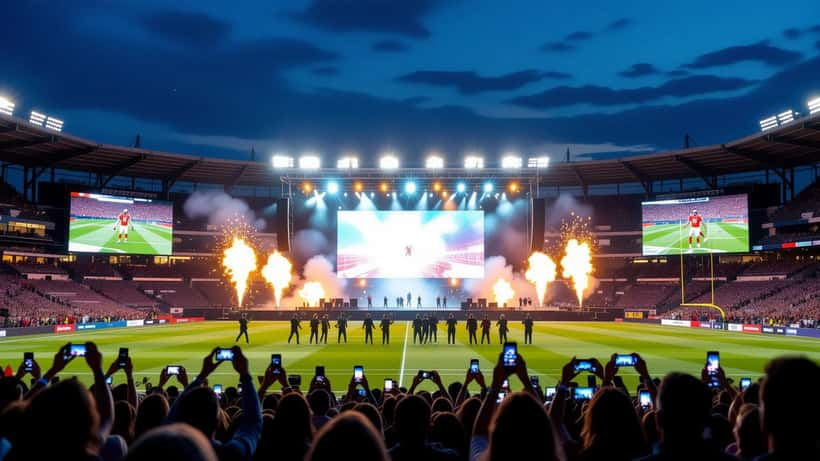
Football's biggest night just borrowed a page from the Super Bowl. On July 19, 2026, MetLife Stadium in New Jersey hosted the first-ever FIFA World Cup Final halftime show, a historic break in the middle of the tournament's closing match. Canada's own Justin Bieber shared the stage with Madonna, Shakira and BTS, with Nigerian star Burna Boy, Venezuelan conductor Gustavo Dudamel and New York's PS22 Chorus rounding out a lineup curated by Coldplay frontman Chris Martin, according to FIFA. Behind the spectacle sat a serious goal: raising money for the FIFA Global Citizen Education Fund, which is targeting USD 100 million to expand access to schooling for children worldwide.
For the roughly one billion people who tuned in, it was 11 minutes of pyrotechnics and pop. For Canadian musicians, managers and creators watching at home, it was also a live demonstration of a business most fans never see — the tangled web of contracts, performers' rights and image licensing that turns a stage into a legal minefield. An entertainment lawyer can explain why a "simple" charity performance is anything but simple.
Why a "free" performance is never really free
FIFA framed the show as a fundraiser, with more than USD 50 million already committed and USD 1 from every 2026 World Cup ticket flowing to the education fund. Even when an artist waives a performance fee, the legal paperwork does not disappear. Someone still has to define who owns the footage, who can use the artist's name and likeness afterward, and how the broadcast can be reused.
A stage appearance of this size generates several distinct rights at once: the musical composition, the sound recording, the live performance itself, and the performer's image. Each can be owned or licensed by a different party. In Canada, performers' rights over their own performances are set out in the federal Copyright Act, which grants artists specific protections when their work is recorded and communicated to the public. You can read the statute directly on the Government of Canada's legislation portal at laws-lois.justice.gc.ca.
The lesson for a Canadian indie band asked to play a festival "for exposure" is straightforward. Exposure is not a contract term. Recording rights, streaming rights and merchandising rights are.
Image rights: the clause that outlives the show
When Justin Bieber's face flashed across screens in more than 200 countries, every one of those appearances raised a question a lawyer would ask first: who controls that image, and for how long?
Image and personality rights let a person control the commercial use of their name, likeness and voice. In Canada, this protection comes largely from provincial privacy laws and the common-law tort of misappropriation of personality, rather than a single national statute. That patchwork is exactly why written agreements matter. A creator who signs a broadcast release without limits may find clips of their performance repurposed in advertising or merchandise long after the final whistle.
A well-drafted image-rights clause typically defines the territory, the duration and the media covered. It separates the one-time broadcast from any future commercial reuse. For a rising Canadian artist, the difference between a good and a bad clause can be the difference between a career asset and a lawsuit.
What the World Cup deal teaches everyday creators
Most musicians will never headline MetLife Stadium. But the same principles scale down to a wedding gig, a brand collaboration on social media or a local charity concert.
- Get the scope in writing. Define what is being performed, where it will be shown and for how long the organizer can use the recording.
- Separate the fee from the rights. Waiving payment is not the same as giving away your recording and image forever.
- Watch the reuse clause. Broadcast today can become an ad campaign tomorrow unless the contract says otherwise.
- Confirm who owns the master. The party that controls the sound recording controls the streaming revenue.
These are the questions a Canadian musician should settle before a performance, not after. The 2026 halftime show involved teams of lawyers precisely because the stakes were enormous. The stakes are proportionally just as high for an emerging artist whose image is their livelihood.
The charity angle carries its own rules
The education-fund framing added another legal layer. When a performance is tied to a registered charity or a fundraising drive, Canadian rules on charitable solicitation, tax receipting and the use of a charity's name come into play. An artist lending their image to a cause needs clarity on how that association can be marketed, and for how long.
This is the same terrain that governs sponsorship and endorsement deals, where an athlete or performer attaches their name to a brand or campaign. Readers following how those arrangements are structured can see a related breakdown in our coverage of Álex Baena's 2026 World Cup sponsorship contract, which unpacks how commercial rights are negotiated around a major tournament.
When to call an expert
Entertainment and intellectual-property law is a specialized field, and generic contract templates rarely fit a performance deal. A Canadian entertainment lawyer can review a performance agreement, flag one-sided image-rights clauses, and make sure that a "free" charity slot does not quietly surrender rights worth far more than the fee.
If you are a musician, content creator, or manager negotiating any public performance in 2026, the World Cup halftime show is a useful reminder: the show lasts minutes, but the contract can last a lifetime. Connecting with a qualified legal expert before you sign is the cheapest insurance you can buy.
This article is general information, not legal advice. Rights over performances and image vary by province and by contract. Consult a licensed lawyer for guidance on your specific situation.
