 Adèle Chartrand
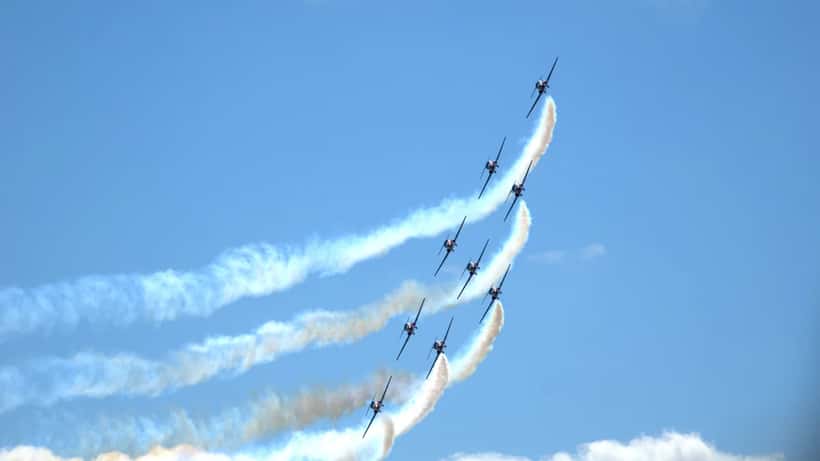
Three days of military jets, aerobatic formations, and a farewell from the Canadian Forces Snowbirds: the 77th Canadian International Air Show runs September 5 to 7, 2026, over Toronto's lakefront, drawing hundreds of thousands of spectators to Exhibition Place and the CNE grounds. What the event brochure does not advertise is the decibel count. During peak flyovers, fighter jets produce noise levels between 120 and 140 dB at close range — more than enough for a single pass to trigger temporary or permanent hearing damage in an unprotected ear.
More than one million Canadian adults already report a hearing-related disability, according to Statistics Canada, and noise-induced hearing loss (NIHL) is among the most common and, critically, most preventable causes. Labour Day weekend at the Toronto air show is precisely the kind of recreational exposure that audiologists warn about: intense, intermittent, and often completely unprotected because spectators simply do not think of a summer airshow as a noise hazard.
Why the 2026 CIAS Is Drawing the Biggest Crowds in Years
The 2026 Canadian International Air Show is a landmark edition before the first engine fires. The Canadian Forces Snowbirds are performing their final appearance in Toronto for the foreseeable future — the aerobatic team is entering a multi-year hiatus and is not expected back at the CNE until the 2030s. That farewell ensures maximum crowd density: more spectators, packed tighter along the lakefront fence, watching longer than a typical year.
The US Air Force F-16 Demonstration Team has pulled out of this year's show amid Canada–US political tensions, but the remaining lineup still includes high-performance jet aircraft and precision aerobatic teams that routinely cruise at speeds exceeding 600 km/h during display passes over the waterfront. At those velocities, the acoustic shockwave reaches spectators standing at the fence almost simultaneously with the visual, giving no time to cover ears before the peak impulse arrives.
The show runs daily from noon to 3:40 p.m. — nearly four hours of sustained elevated noise, not counting warm-up passes, taxiing engines, and amplified PA announcements across the grounds. This is not a quick burst of sound. It is an extended, repeated exposure event.
What 120 Decibels Actually Does to the Inner Ear
Sound is measured on a logarithmic scale. The jump from 85 dB to 120 dB is not a 35-unit difference — it represents a noise intensity roughly 3,500 times greater. According to Canada's occupational health guidelines, the safe daily noise exposure limit is 85 dB for eight hours. At 100 dB, that safe window shrinks to 15 minutes. At 115 dB — the pain threshold — safe exposure is measured in seconds.
Jet flyovers at the CIAS routinely register between 100 and 115 dB at spectator distances along the waterfront. During certain low-altitude passes, readings above 120 dB have been documented. A single loud acoustic impulse at that level — the kind produced by a jet breaking sharply away from a low formation pass — can rupture the delicate hair cells in the cochlea. Unlike most cells in the human body, cochlear hair cells do not regenerate once damaged.
The result can be tinnitus, a persistent ringing that may last days, months, or permanently. In more severe cases, the damage appears as a notch in an audiogram — a specific frequency range, most commonly around 4,000 Hz, where hearing ability is measurably and permanently reduced. That is the clinical signature of noise-induced hearing loss. It shows up on hearing tests long after the triggering event, and patients are often surprised to learn that a single afternoon of recreational noise exposure contributed to it. Noise-induced hearing loss prevention is well documented by Ontario's occupational health specialists at OHCOW.
A Family at the Lakefront Fence: What the Numbers Actually Mean
Consider a family of four arriving at Exhibition Place for the full show on Saturday, September 6, 2026 — two parents in their early 40s, a 16-year-old, and a child aged seven. They stake out a front-row spot along the waterfront fence at approximately 300 metres from the display axis — the most popular location for unobstructed sightlines. None of them are wearing hearing protection, because it looked like overkill on a sunny holiday weekend.
Over the 3 h 40 min show, they are exposed to an estimated 10–14 jet flyovers in the 100–115 dB range, plus sustained ambient crowd and PA noise around 85–90 dB between passes. Under Canadian occupational noise exposure guidance, 105 dB carries a permissible exposure of roughly one hour before cumulative hearing damage risk begins. At 110 dB, that window drops to 30 minutes.
If two flyovers register 110 dB — each lasting approximately 10 seconds — the cumulative dose begins to push toward the risk threshold for unprotected ears, particularly for the youngest family member. Children's ear canals are narrower than adults', amplifying incoming sound by an additional 5–10 dB relative to what a nearby adult experiences. The child at the fence may effectively be receiving 115–120 dB, not 110 dB.
The teenager enters the show with a hearing reserve that is likely already below baseline from years of earbud and concert exposure. A single air show afternoon does not guarantee permanent damage — but in audiological practice, it is precisely this kind of cumulative recreational exposure event that appears as an inflection point when patients look back on when their hearing first changed.
If any member of that family leaves the show with ear ringing that persists beyond 24 hours, that is the clinical signal: a temporary threshold shift occurred. Repeated temporary threshold shifts are the documented precursor to permanent NIHL. This is not a fringe scenario — earlier this summer, concert-goers at Vancouver's PNE reported the same symptom after prolonged exposure in the 90–105 dB range.
Who Faces the Greatest Risk in the Crowd
Audiologists in Canada distinguish between acute acoustic trauma — a single event causing immediate measurable damage — and cumulative noise-induced hearing loss, which builds over years of repeated exposures. The CNE air show sits in a grey zone: intense enough that acute trauma is possible in unprotected ears in the closest viewing sections, and recurring enough (annually for many attendees) that cumulative damage compounds year over year.
Adults over 50 should be aware that age-related hearing loss (presbycusis) and NIHL affect overlapping frequency ranges and intensify each other. Someone entering the CIAS with early-stage age-related decline experiences noise trauma differently than a younger adult: recovery from any temporary threshold shift is slower, and the margin before permanent damage is narrower.
For attendees who work in noisy occupational environments — construction, manufacturing, transportation, military — attending the air show without protection means stacking recreational noise exposure on top of an already stressed auditory system. This matters for a significant share of the Toronto crowd.
Children under 10 face the highest acute risk in a standing-crowd setting. Unlike adults who intuitively flinch or cover their ears during unexpected loud sounds, younger children often do not react quickly enough during a fast low-altitude pass.
What to Do Before Saturday's Snowbirds Pass
The fix is inexpensive and available at any Shoppers Drug Mart or Canadian Tire location before the weekend: foam earplugs rated at NRR 29 or higher reduce effective exposure by approximately 15 dB under real-world conditions — enough to bring a 115 dB jet pass down to a more manageable 100 dB range during peak impulses. For children, properly fitted children's ear defenders (not adult foam plugs, which sit incorrectly in smaller ear canals) provide more reliable and consistent protection through the full show.
Audiologists in Canada use what is sometimes called the "arm's length rule": if you must raise your voice significantly to be understood by someone standing an arm's length away, the ambient noise level is high enough to cause cumulative damage over an extended period. Along the waterfront fence during a Snowbirds formation pass, every person nearby is shouting.
Positioning matters, too. Every doubling of distance from the display axis reduces sound intensity by approximately 6 dB — moving back 150 metres from a 110 dB zone brings peak exposure down toward 104 dB, still significant but meaningfully less traumatic for unprotected ears. Arrive early to assess the site before choosing where to stand.
If ear ringing persists for more than 24 hours after Labour Day weekend, or if sounds appear muffled, distorted, or unusually fatiguing to follow in the days that follow, that is the signal to book an audiological assessment. In Canada, many audiologists and hearing clinics offer free or reduced-cost hearing screenings, and early assessment makes a measurable difference in intervention outcomes. A qualified audiologist can document the degree of any threshold shift, identify the affected frequency ranges, and advise on whether assistive devices or therapeutic options are warranted.
Do not dismiss it as "just part of the experience." The Toronto air show is one of the loudest public events on the Canadian calendar. Three afternoons of exposure without protection can leave a permanent mark — and not the kind worth keeping.
This article is for general informational purposes only and does not constitute medical or audiological advice. If you have concerns about your hearing health, consult a licensed audiologist or healthcare professional.
