 Clara Thompson
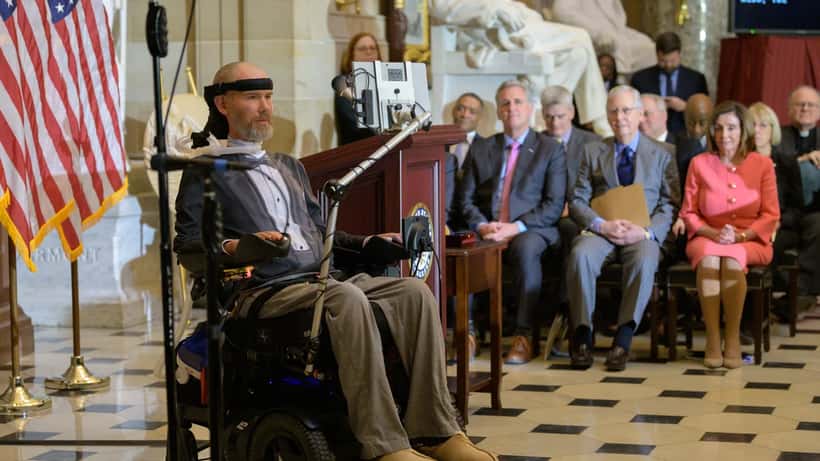
Former New Orleans Saints safety Steve Gleason returned home on May 29, 2026, after spending six days in hospital with dangerously low blood pressure — a moment that drew an outpouring of support from across the NFL and the ALS community worldwide. "Reborn," he posted on social media upon arriving home, framed by oak trees and a full moon. For the approximately 3,000 Canadians currently living with amyotrophic lateral sclerosis (ALS), Gleason's latest health scare is both a reminder of the disease's relentlessness and a prompt to ask a question that could change outcomes: when is it time to see a specialist?
ALS After 15 Years: What Gleason's Hospitalization Reveals
Steve Gleason was diagnosed with ALS in January 2011, at 34 years old. Today, approaching 50, he relies on a ventilator to breathe and a speech-generating device to communicate — technology that has become a central pillar of his advocacy. His May 2026 Ochsner Medical Center admission, triggered by low blood pressure and fever, underscored a reality that every Canadian neurologist familiar with ALS understands well: the disease does not follow a predictable calendar. Even patients who stabilize for years can face acute crises that require immediate, coordinated specialist response.
ALS is a progressive neurodegenerative disease that destroys the motor neurons controlling all voluntary movement — walking, speaking, swallowing, breathing. According to ALS Canada, roughly 1,000 Canadians receive a new ALS diagnosis each year, and the disease is diagnosed in people of all ages, though the average age at onset is between 55 and 65. Average life expectancy from confirmed diagnosis is two to five years, though approximately 10% of patients survive a decade or longer. Gleason, now 15 years into his diagnosis, is living proof that expert care, assistive technology, and relentless determination can redefine what ALS survival looks like.
The critical factor that specialists consistently cite is continuity of expert monitoring. Patients followed in multidisciplinary ALS clinics — coordinating neurology, respiratory therapy, physiotherapy, speech-language pathology, occupational therapy, and palliative care — navigate both slow deterioration and acute crises more safely than those seen only by a general practitioner. Gleason's care team in New Orleans represents precisely this model, and it is the reason a man who was expected to live perhaps three to five years in 2011 is still posting from his porch in 2026.
A Pivotal Year for ALS Treatment in Canada
Gleason's 2026 hospital admission coincides with what many Canadian neurologists are calling a turning point for ALS care in this country. In early 2026, Health Canada approved Qalsody (tofersen) — the first drug designed for a specific genetic subtype of ALS. Patients carrying a pathogenic variant in the SOD1 gene, which accounts for roughly 12 to 20% of inherited ALS cases, now have access to a targeted therapy that clinical trials showed reduces the rate of functional decline by approximately 29% compared to placebo, as measured by the ALS Functional Rating Scale (ALSFRS-R). This is not a cure — but it is, for the first time in Canadian regulatory history, a drug that attacks the underlying genetic mechanism driving one form of the disease.
Separately, NeuroSense Therapeutics has announced plans to file its lead compound PrimeC with Health Canada in December 2026. Phase 2 data showed reductions in two key ALS biomarkers — neurofilament light chain and TDP-43 — in treated patients. If approved, PrimeC would give Canadians with a broader ALS subtype access to a disease-modifying therapy not available even two years ago.
The implication for early diagnosis is profound and immediate. Qalsody eligibility requires confirmed SOD1 genetic testing — testing that only a specialist ALS clinic can order, interpret, and act on within the appropriate treatment window. In Canada, the average time from first symptom to confirmed ALS diagnosis is currently 12 to 18 months, according to data from the national ReferALS program. A patient who enters the public referral queue late may exhaust that window before being tested at all.
When a Delay Costs More Than Time
Consider a 47-year-old accountant in Toronto who notices progressive weakness in his right hand and occasional fasciculations — involuntary twitching — in his left forearm over a six-month period. His family physician, uncertain whether this represents carpal tunnel syndrome, a cervical disc issue, or something more serious, refers him to a general neurologist. The typical waiting time in Ontario: 9 to 14 months, per 2025 access benchmarks published by the Canadian Neurological Society.
By the time electromyography (EMG) confirms upper and lower motor neuron involvement — the diagnostic hallmark of ALS under the revised El Escorial criteria — another 4 to 6 months have passed since that referral was made. Total elapsed time from first symptom to confirmed diagnosis: 16 to 22 months.
Here is the if/then that defines this moment in ALS care in Canada: if that same patient had accessed a private neurologist consultation within the first three months of symptoms — average out-of-pocket cost of $350 to $600 for an initial assessment in Ontario, British Columbia, or Manitoba — the referral pathway to a CALS (Canadian ALS Research Network) multidisciplinary clinic and genetic testing could open 12 to 15 months earlier.
For a SOD1-positive patient, those 12 months are not abstract. They represent potential eligibility for Qalsody, whose 29% relative reduction in functional decline is most meaningful when treatment begins before significant motor neuron loss has already occurred. The calculation is stark: a one-time private consultation of $450, weighed against a $0 public wait, is not a straightforward cost comparison when the downstream variable is access to the only approved disease-modifying therapy for your genetic subtype of ALS. A specialist at a CALS clinic can also enrol the patient in active clinical trial networks — including trials for PrimeC and several other compounds currently in Phase 3 across Canadian research centres — granting potential access to next-generation therapies before market approval.
Warning Signs That Should Not Be Ignored
ALS rarely announces itself dramatically. Gleason's own early symptoms, as he has described them publicly, included unexplained weakness, stumbling, and fatigue — signs easily attributed to overtraining, stress, or the ordinary demands of life in the NFL. Canadian ALS clinic neurologists identify the following as flags that warrant a direct specialist referral, rather than ongoing watchful waiting by a general practitioner:
- Progressive limb weakness worsening over weeks or months in a single limb region, without pain or obvious injury
- Fasciculations (involuntary muscle twitching) appearing in two or more body areas simultaneously
- Dysarthria (gradual slurring of speech) without a clear underlying cause such as stroke or medication
- Dysphagia (increasing difficulty swallowing) combined with any other motor weakness
- Family history of ALS, frontotemporal dementia, or motor neuron disease — particularly in a first-degree relative
The ReferALS tool, launched by ALS Canada in 2025, was designed specifically to help general neurologists identify this symptom cluster and route suspected cases to CALS clinics faster. If three or more of the above are present simultaneously, the current recommendation is a same-cycle urgent neurology referral — not deferred to the patient's next routine check-up.
This article is for general informational purposes only and does not constitute medical advice. If you or someone you care for is experiencing progressive neurological symptoms, consult a licensed physician promptly. ALS diagnosis and treatment require qualified specialist assessment.
What Steve Gleason's Story Means for Canadians in 2026
Steve Gleason posted "Reborn" from his front porch in late May 2026 after six days in a hospital bed. Behind that single word is a care infrastructure built over 15 years: a ventilator, a voice-generating device, a multidisciplinary specialist team, and an advocacy foundation that has shaped ALS policy at every level of North American government. It is not only willpower — it is access to the right expertise, maintained continuously since his diagnosis in 2011.
For Canadians facing early neuromuscular symptoms today, the landscape of ALS care in 2026 is meaningfully different from what it was even three years ago. Qalsody is approved and reimbursable in several provinces. PrimeC is filing with Health Canada before year's end. Clinical trial networks are active across six provinces. The window for maximum benefit from any of these interventions is widest at the beginning of the diagnostic process — not after 18 months on a public neurology waitlist.
An ALS specialist consultation opens the door to genetic testing, CALS clinic enrolment, respiratory baseline assessment, and access to trial networks. Finding that specialist is the first actionable step. ALS Canada maintains a national clinic locator listing every CALS-affiliated multidisciplinary clinic by province — from British Columbia to Nova Scotia — updated for 2026.
format_used: Expert reaction
