 Leah Adams
On September 2, 2026, Environment Canada issued a severe thunderstorm watch spanning the Greater Toronto Area, Hamilton, Niagara, Barrie, and most of southern Ontario — flagging wind gusts up to 130 km/h, golf ball-sized hail, and probable widespread power outages. Meteorologists are calling this one of the strongest storm systems to target the region all year. While homeowners scramble for flashlights and generator fuel, consumer electronics technicians across the province are bracing for a different kind of aftermath: a wave of fried smart TVs, dead laptops, and corrupted hard drives that show up in repair shops the morning after.
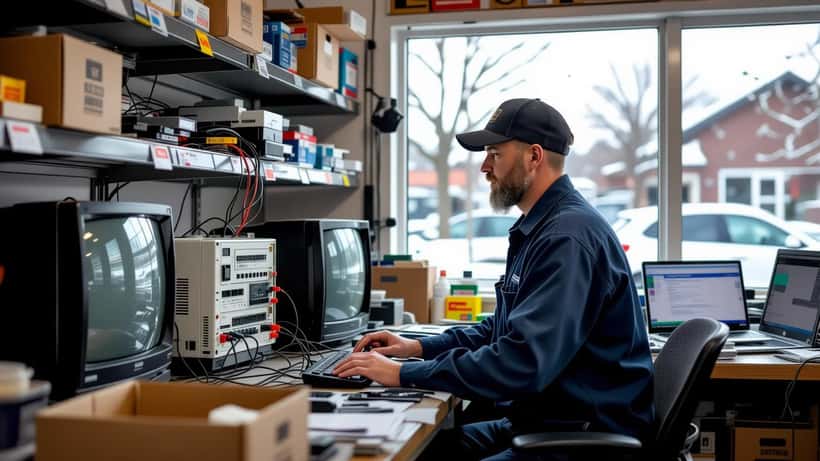
"Power surges from severe storms are the leading cause of unexpected electronics failure we see in our shop," says a Toronto-area consumer electronics technician. "Most people don't realize the damage has happened until they try to turn their device on the next morning and nothing comes on."
When the Sky Darkens Over Ontario: The Storm in Numbers
According to meteorological forecasts issued September 1, 2026, the thunderstorm environment shaping up over southern Ontario for September 2-3 is among the most volatile of this year. The warning area includes Mississauga, Brampton, Toronto, Barrie, Hamilton, Durham Region, London, and Windsor. Environment Canada's severe thunderstorm watch cites wind gusts up to 90 km/h across most of the region, with localized pockets approaching 130 km/h where the most intense storm cells develop — approaching the threshold for damage typically associated with a strong tornado.
Hail stones up to golf ball size (approximately 4.5 cm in diameter) are forecast. Torrential downpours will accompany the system, with localized flooding expected in low-lying streets and underpasses. Most significantly for homeowners and small businesses: power outages are considered virtually certain across the affected area. During the August 2023 derecho that swept Ontario and Quebec, nearly 900,000 customers lost power — some for up to four consecutive days. Storm events of similar magnitude tend to produce the same pattern.
The Real Threat to Your Electronics Is Not the Rain
Water damage gets all the attention when severe storms strike. But for consumer electronics, power surges represent a far greater statistical risk — and one that most Canadians dramatically underestimate.
A surge occurs when voltage spikes significantly above the standard 120V delivered to Canadian homes. Lightning strikes on nearby power lines, transformer overloads during high-demand grid stress, and the sudden reconnection of power after an outage are the three most common surge events during a severe storm. The third cause — return-of-power after an outage — is frequently overlooked.
"When the power flips back on after an outage, you often get a transient spike that is worse than anything that happened during the storm itself," explains an Ontario-licensed electrician with over a decade of post-storm repair experience. "That is the moment that kills televisions, gaming consoles, and HVAC control boards. People celebrate the lights coming back on and then discover their equipment is dead."
A standard surge protector power bar — the type sold at most Canadian hardware stores for $15 to $25 — carries a joule rating of 400 to 600 joules. That sounds adequate until you consider that a direct lightning strike on a nearby power line can generate a transient surge exceeding 20,000 joules. Even indirect events routinely produce spikes of 2,000 to 6,000 joules. The gap between the protection most homes have and the actual energy involved is enormous.
Smart home devices add another layer of vulnerability: many remain continuously powered even when you believe they are off. A smart TV in standby mode, a Wi-Fi router drawing 15W around the clock, a home security hub, and a streaming device with instant-on functionality are all fully exposed throughout the duration of a storm.
For guidance on broader storm preparedness for your home, see Severe Weather in Canada: Expert Home Safety Tips 2026.
Your $4,000 Home Office Is One Power Line Away From Ruin
Consider a typical southern Ontario home office setup in 2026: a mid-range laptop ($1,800), an external 4K monitor ($600), a network-attached storage device used for local backups ($450), a smart TV in the adjacent living room ($900), and a wireless router ($250). Total estimated replacement cost: approximately $4,000 — not counting data recovery.
Suppose the September 2 storm causes a power line strike two blocks away at 7:42 p.m. The resulting transient surge travels through the distribution grid and into your home within milliseconds. Your $22 power bar — rated at 500 joules — absorbs a fraction of the energy before its metal oxide varistors (MOVs) reach their clamping threshold and fail. The monitor goes dark immediately. The NAS device, which was mid-backup cycle, suffers a write error that corrupts the drive's file allocation table. The laptop, fortunately, was running on battery with its charger physically disconnected.
Damage total: one external monitor ($600), one NAS device ($450), data recovery estimate ($800 to $1,500 for a consumer drive with table corruption). Total potential loss: $1,850 to $2,550.
If instead you had invested in a point-of-use surge protector rated at 2,500 joules ($65 to $90 at major Canadian electronics retailers) paired with a whole-home panel-mounted Surge Protective Device (SPD) — which absorbs the bulk of a large transient before it reaches your outlets — the same event plays out differently. The SPD clamps the spike at the electrical panel. The point-of-use protector handles any residual transient reaching the power bar. Your equipment survives intact.
Total investment: approximately $300 to $500 installed by a licensed Ontario electrician. The financial logic is stark: a one-time protection investment of under $500 versus a potential out-of-pocket loss of $1,850 or more, before factoring in time lost to repairs and data reconstruction.
The practical if/then rule: if your home experiences a power outage during a storm and power then returns suddenly, and your devices are connected only through a basic power bar rated below 1,000 joules, you face a meaningful probability of damage to at least one connected device. The risk is highest in the 60 seconds immediately following power restoration.
What a Technician Checks First After a Storm Power Event
If your power goes out during the September 2-3 storm and returns unexpectedly — or if any connected device behaves strangely afterward — a consumer electronics technician recommends this triage sequence before reaching for the power button.
Do not immediately power on any suspect device. Turning on a unit that has sustained surge damage can permanently destroy components that would otherwise have been repairable. Let devices cool and wait at least 30 minutes after power is restored before testing anything that was connected during the storm.
Check for the smell of burnt electronics. A distinctive acrid, sometimes sweet-chemical odor near any device is a reliable indicator of component-level damage. Unplug immediately and do not attempt to restart.
Inspect the surge protector's protection indicator. Most quality surge protectors include a "protected" status LED. If that light is off after a storm event, the MOVs inside have been sacrificed absorbing a surge — the device is no longer providing any protection, even though it still passes power through to your equipment. Treat it as an open power bar and replace it before plugging anything back in.
Back up immediately if your computer survived. If your laptop or desktop starts normally, prioritize backing up your files before anything else. A second surge event, or delayed capacitor failure in the days following the storm, could claim data that survived the first incident.
Notify your home insurer promptly. Most Canadian home insurance policies cover sudden and accidental electrical damage from power surges. The practical window for filing without complications is typically 48 to 72 hours after the event. Photograph every damaged device in place before moving or replacing it.
As for devices that were exposed to high humidity or splashing during the storm itself: a consumer electronics specialist can often recover a moisture-exposed device if it is brought in unpowered within 24 hours. Attempting to turn on a wet device accelerates corrosion and typically converts a recoverable repair into a total loss.
Five Minutes Before the Storm: Your Electronics Protocol
Given the Environment Canada watch issued for southern Ontario on September 2, 2026, a consumer electronics technician's recommended immediate action list is:
Unplug high-value devices now. Physical disconnection from the wall is the only 100% reliable form of surge protection. Unplug your television, desktop computer, gaming console, external hard drives, and any device you cannot afford to replace before the storm makes landfall.
Put your laptop on battery. Disconnect charging cables and adapters and let the device run on its internal battery during the storm. The battery effectively isolates the electronics from the grid.
Verify your surge protectors are still active. Check that the "protected" indicator LED on each surge-protecting power bar is illuminated. If it is not, your equipment is unprotected regardless of what you paid for the strip.
Back up critical data before the storm. Run a cloud backup or copy essential files to an external drive and disconnect it before severe weather arrives. A surge that corrupts a drive mid-backup can make recovery exponentially more difficult.
Book a post-storm diagnostic if you were unsure. If any device was connected and powered throughout the event, a professional diagnostic — typically $50 to $100 in Ontario — can identify latent damage before it causes a sudden failure weeks later, often at the worst possible moment.
Ontario's severe storm season historically runs from late May through mid-September, with early-September events like this week's outbreak becoming increasingly common. A consumer electronics specialist can evaluate your home's current surge protection setup during any service visit and recommend panel-level solutions matched to your device inventory and home's electrical configuration. If your electronics took a hit during this storm — or if you want to ensure they don't during the next one — consult a certified consumer electronics expert who knows Ontario's grid and storm patterns.
