 Aria Nguyen
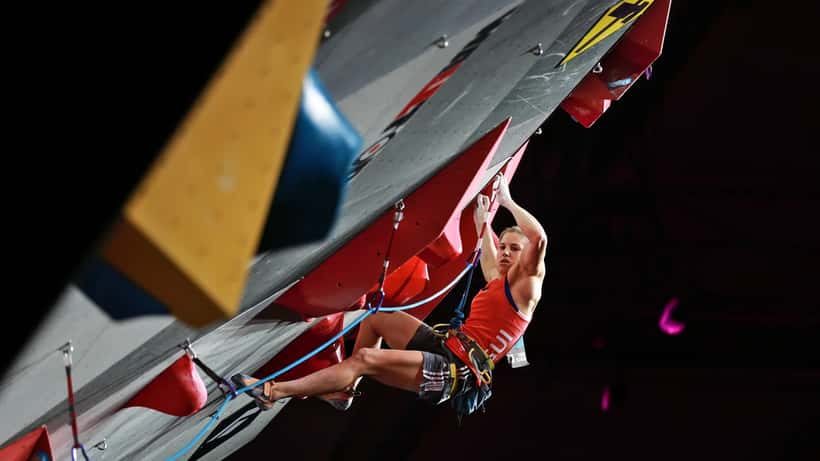
Twenty-four Canadian athletes just returned from Arco, Italy, where they competed at the 2026 World Climbing Youth Championships — the sport's most prestigious event for under-17 and under-19 athletes — held July 18–25. Sienna Chow earned Canada's best result of the championships, advancing to the U19 Women's Boulder semifinal and finishing 12th overall. Nicolas Arteau reached two semifinals, placing 18th in U17 Men's Lead and 19th in U17 Men's Boulder. Bruce Kong posted a 5.93-second qualification run in Speed, Canada's highest placing in that discipline. And beyond the youth circuit, Canadian speed climbing star Ethan Flynn-Pitcher set a blistering national record of 5.232 seconds in Wujiang, China, earlier this summer — his sixth Canadian record and the fastest time ever clocked by a Canadian on the world circuit.
The achievements signal a genuine turning point for Canadian climbing. Indoor facilities have proliferated across the country since the sport's Olympic debut at Tokyo 2021, youth programs report months-long waitlists, and Climbing Escalade Canada's national development pipeline is producing athletes who can compete on a global stage. But as more Canadian families invest time and money into competitive climbing — and as younger and younger athletes train seriously toward national and international goals — a legal question is growing louder in the background: when a youth climber gets hurt at an indoor gym, and a liability waiver was signed at the front desk, does that waiver actually protect the facility?
Canada's Climbing Moment and Its Hidden Legal Dimension
The 2026 World Climbing Youth Championships in Arco drew athletes from across the globe, and Canada's 24-member team — selected through top performances at the 2026 Youth National Championships in Boulder, Lead, and Speed — represented the sport's growing depth in this country. Coaches Aidan Doyle, Elizabeth Maffett, Frédéric Desgranges, Olivier Dorion-Thériault, and Regan Kennedy accompanied the team, reflecting the organizational seriousness that Climbing Escalade Canada is now bringing to youth development.
That seriousness comes with a responsibility that extends beyond coaching and selection: understanding what happens legally when a youth athlete is injured, whether at a training gym in Canada or at a competition facility abroad. The waiver most Canadian families sign at their local climbing gym — often a dense two-page document that parents complete on behalf of their children at registration — is designed to prevent exactly that question from ever reaching a courtroom. But lawyers who work in sports liability say the answer is more complicated than facility operators typically acknowledge.
The Expert Angle: Why Minor Climbers Can Sue Even After a Waiver Is Signed
Walk into any indoor climbing gym in Canada today and you will encounter a liability release before you touch a hold. These agreements acknowledge the inherent risks of the sport — falls, contact with equipment, overuse injuries — and ask participants to waive the right to sue for damages arising from those risks. For adult climbers who sign for themselves, these waivers carry meaningful legal weight, particularly when the risks acknowledged are genuinely inherent to the activity.
For youth athletes, the picture is fundamentally different.
Under common law principles governing most Canadian provinces, a minor generally lacks the legal capacity to enter into a binding contract. This means contracts involving individuals under the age of majority — 18 in most provinces, 19 in British Columbia and Nova Scotia — are voidable at the minor's election. When a parent or guardian signs a waiver on behalf of a child, that signature does not automatically transfer the full benefit of the release to the facility. Canadian courts have reached varying conclusions on whether parental waivers bind a child's future claim, and the law remains genuinely unsettled in several provinces.
This uncertainty sits alongside a separate statutory obligation that no waiver can easily eliminate. Ontario's Occupiers' Liability Act (R.S.O. 1990, c. O.2) requires that occupiers — including commercial climbing facilities — take reasonable care to ensure that every visitor is reasonably safe while on their premises. Equivalent legislation exists in British Columbia, Alberta, and other provinces. Courts have consistently held that this duty cannot be contracted away when the person at risk is a child, particularly when the hazard was known to the operator in advance. Quebec, governed by the Civil Code rather than common law, applies its own distinct rules around contractual capacity and parental authority — creating additional complexity for national organizations running programs across provincial borders.
Concrete Case: What the Numbers Look Like When a Youth Climber Is Injured
Consider a scenario that reflects the kind of incident climbing gyms encounter every season. A 17-year-old competitive lead climber — training toward U19 national selection, similar to athletes who just represented Canada in Arco — trains four days per week at an established indoor facility in Vancouver. At registration 14 months earlier, a parent signed a standard liability release acknowledging the inherent risks of the sport and releasing the gym from all claims "arising out of negligence or otherwise." In August 2026, the teenager clips into a bolt on a training route. A hanger bolt that appeared in the facility's internal inspection log as requiring replacement 9 weeks earlier has not been addressed. The unexpected failure causes a swing fall; the athlete strikes the wall and sustains a fractured left wrist — the lead hand — requiring surgical fixation, a 12-week recovery program, and the loss of the fall competitive season.
Here is what changes legally because the climber is 17 years old at the time of injury:
On timing: British Columbia's Limitation Act, S.B.C. 2012, c. 13, pauses the standard two-year limitation period while a potential plaintiff is a minor. The clock does not begin running until the minor turns 19 (the age of majority in B.C.). This means the injured 17-year-old has until age 21 — potentially four years from the date of injury — to file a negligence claim. The signed waiver does not alter this timeline.
On the waiver's reach: A parent's signature on a liability release does not automatically extinguish the child's independent legal rights. Once the athlete turns 19, they can independently evaluate whether to pursue a claim — and courts reviewing parental waivers have regularly declined to treat them as binding on the child in the same way an adult's own signature would be.
On the negligence argument: The 9-week-old inspection flag on the hanger bolt is central evidence. If the facility's own documentation confirms that staff identified the hazard and failed to act within a reasonable timeframe, the claim is not about inherent climbing risk — it is about a foreseeable, known defect. The Occupiers' Liability Act imposes a duty of reasonable care that applies regardless of what the waiver says.
On the financial stakes: For a competitive youth athlete, the damages picture extends beyond medical costs. Surgical fixation and rehabilitation alone can approach $8,000 to $12,000 out of pocket depending on coverage. Loss of a competitive season at 17 — a critical year for national ranking and selection — can affect the athlete's standing in the development pipeline for two to three years. Courts assessing damages in youth injury cases do look at projected competitive trajectory.
What This Means for Parents and Gym Operators as Climbing Grows
For gyms, coaches, and families navigating this rapidly growing sport, a few practical points follow directly from the legal landscape.
For parents of youth climbers: A waiver signed at registration does not permanently eliminate your child's legal rights. If an injury results from facility negligence — unaddressed equipment defects, inadequate safety matting, improper supervision — your child retains the right to pursue a claim independently once they reach the age of majority. Document any injury at the time it occurs, photograph the conditions involved, and retain copies of any paperwork signed. These records become relevant years later if a claim is pursued.
For climbing gym operators: Your liability waiver is a useful tool for managing risk with adult members — but it offers weaker protection when the injured party is a minor, and no protection against claims arising from known and unaddressed hazards. The best defense in a youth injury case is documented evidence that you fulfilled your duty of care: inspection logs that show flagged equipment was repaired promptly, coach-to-athlete ratios appropriate for the age group, and staff training records for youth-specific program delivery. Insurers covering youth programming should be consulted about coverage limits specific to competitive training environments.
For coaches and competitive programs: Supervision liability is separate from premises liability. A coach who sends a youth climber onto a graded route that exceeds the athlete's demonstrated ability — or who improperly sets up a youth athlete's belay system — faces personal exposure that the gym's waiver does not address. The closer the coaching relationship to a formal training arrangement, the clearer the duty of care becomes.
Similar questions about who bears legal risk in Canadian sport settings came up earlier this year in the context of puck injuries at BCHL games, where venue operators' duty of care and the limits of spectator assumption-of-risk doctrine were closely examined. The principles are parallel: sport facilities cannot rely on signed paperwork as a blanket shield when known hazards go unaddressed or when the injured party is a minor.
What to Do If This Affects You
If your child has been injured at a climbing gym or during a competitive event, and a liability waiver was signed at some point in the process, do not assume that document resolves the matter. The legal picture in Canada is more nuanced — and, for minors, often more favorable to the injured party — than standard-form releases are typically designed to suggest.
A lawyer practising in personal injury or sports liability can assess whether the waiver is enforceable in your province, evaluate whether a duty of care was breached, and advise on the realistic prospects of a claim. Because limitation periods for minors run from the age of majority rather than the date of injury, families have time to make an informed decision — though waiting can complicate evidence gathering as inspections get completed, equipment gets replaced, and witnesses move on.
Canada's climbing community is generating real talent — from Ethan Pitcher's speed records on the world circuit to the youth athletes competing in Arco. Making sure families and facility operators understand the legal framework around youth athletic participation is not a bureaucratic footnote: it is part of what it means to build the sport sustainably.
This article contains general legal information only and does not constitute legal advice. Laws vary by province and territory. Consult a qualified lawyer for advice specific to your situation.
