 Adèle Chartrand
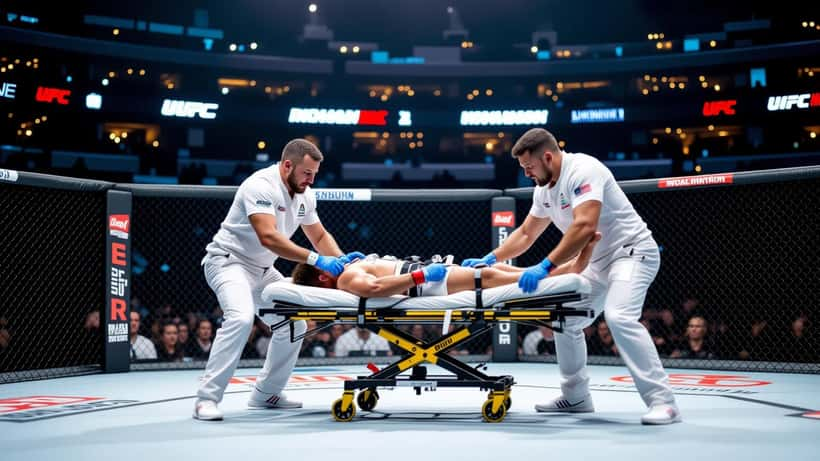
On September 26, 2026, thousands of UFC fans watching the main event at Meta APEX in Las Vegas witnessed one of the most alarming finishes in recent memory. Veteran bantamweight Raoni Barcelos — a 39-year-old Brazilian fighter competing in his first-ever UFC headlining slot after eight years and 15 fights with the promotion — collapsed unconscious after his head struck the cage fence during a scramble with Raul Rosas Jr. in the fifth round. He was stretchered off the canvas and transported by ambulance to a local Las Vegas hospital. Within hours, his team confirmed he was awake and responsive. But the image of Barcelos motionless on the mat sparked an immediate conversation across North America. For Canadian fans — many of whom play contact sports themselves — the incident raises one pressing question: what actually happens to the brain in moments like this, and how do you know when a head injury requires urgent medical care?
What Happened at UFC Vegas 121
Rosas Jr., at just 21 years old, was making his debut as a UFC main-event headliner. Barcelos had won five consecutive fights to earn the opportunity and entered the cage as a battle-tested veteran. Through the first four rounds, the fight was competitive. In the fifth, with both men fatigued, a clinch near the fence led to a takedown scramble. During the exchange, Barcelos' head hit the fence at an awkward angle. Even slow-motion replays could not pinpoint a clean striking blow — commentators struggled to explain what caused the collapse. Barcelos went limp instantly, dropping to the canvas without any conventional impact. Referee Marc Goddard stopped the contest at 1:38 of round five, ruled a KO.
The UFC's cage-side medical team intervened immediately. Barcelos did not regain consciousness on the canvas and was placed on a stretcher as the crowd fell silent at Meta APEX. Later that evening, Brazilian UFC correspondent Evelyn Rodrigues confirmed that Barcelos had regained consciousness at the hospital and was undergoing further neurological evaluation. As of September 27, 2026, no formal diagnosis had been released, but sports medicine professionals across Canada and the United States were already citing the incident as a textbook example of why head injury education matters — not just for professional fighters, but for anyone who plays contact sports.
Why "Phantom" Knockouts Signal Serious Risk
The confusion surrounding Barcelos' collapse — the inability to identify what exactly caused it — is itself medically significant. Neurologists and sports medicine physicians recognize a category of head injury in which the mechanism is not a single dramatic impact but a sudden rotational force, a deceleration, or compression from an awkward angle against a hard surface. These ambiguous knockouts can produce diffuse axonal injury, where nerve fibres throughout the brain are stretched or sheared rather than producing a localized bruise or bleed. The outward result — rapid unconsciousness — can look identical whether the underlying damage is minor or catastrophic.
In Canada, the Public Health Agency of Canada estimates that approximately 200,000 Canadians sustain a concussion each year, with contact sports accounting for a significant share. Hockey, rugby, football, and martial arts are the most common settings. The most dangerous period is not the moment of impact but the 24 to 72 hours that follow. A second blow during this window, even a mild one, can trigger second-impact syndrome: a rare but potentially fatal cerebral swelling that has claimed the lives of young athletes in both Canada and the United States.
According to Health Canada's concussion guidance, specific red-flag symptoms require emergency care rather than a wait-and-see approach: any loss of consciousness, repeated vomiting, post-traumatic amnesia, one-sided weakness or numbness, slurred speech, pupils of unequal size, or a headache that progressively worsens rather than improving with rest. Barcelos exhibited at least one — sustained loss of consciousness — which is why the UFC medical team's immediate stretcher response was clinically necessary, not precautionary.
The Sunday Hockey Player: A Scenario That Hits Close to Home
Consider Marc, a 34-year-old project manager and recreational hockey player in Mississauga, Ontario. On October 5, 2026 — a Sunday evening league game — he takes a hard check into the boards. He bounces up, waves off his teammates, and tells the bench he's fine. He has a headache for about 20 minutes, but it fades and he finishes the period.
Marc drives home, skips dinner, and falls asleep on the couch. He wakes at 3 a.m. with severe pressure behind his eyes, mild confusion, and ringing in his left ear. He takes two ibuprofen — which Health Canada advises against in the first 24 hours after head trauma due to blood-thinning effects — and goes back to sleep.
If Marc has sustained a straightforward concussion, he may recover fully over 10 to 14 days with proper rest and a staged return to activity. But if his injury has produced a slow epidural haematoma — a bleed between the skull and the outer brain membrane — the symptom-free interval of several hours followed by sudden deterioration is a classic presentation. Neurosurgical literature suggests that each hour of delay in intervention for a serious intracranial bleed increases the risk of permanent neurological damage by an estimated 10 to 15 percent. The critical window for surgical treatment is approximately six hours from symptom escalation.
Under Ontario's return-to-sport protocols, aligned with Parachute Canada's national concussion guidelines, Marc must not return to the ice that same night and must complete a structured six-stage return-to-sport progression guided by a registered healthcare provider before he can skate again. Skipping this process matters beyond just his health: in a workplace sports league, an undisclosed concussion that results in a follow-up injury before medical clearance could complicate a short-term disability or workplace insurance claim — an area where a health or legal expert's guidance can protect against unexpected consequences.
Medical Suspensions, Fighter Rights, and What Athletes Should Know
For professional fighters like Barcelos, the post-fight medical process is codified and strict. The Nevada State Athletic Commission mandates automatic medical suspensions for fighters who are rendered unconscious: a minimum 90-day no-contact suspension, with mandatory written neurological clearance before any return to training or competition. Fighters who are hospitalized after a bout face a minimum 180-day suspension. These rules exist because the scientific data on cumulative head trauma in combat sports is unambiguous: repeat concussions within a compressed window dramatically accelerate long-term neurological decline, increasing lifetime risk of chronic traumatic encephalopathy (CTE) and related conditions.
In Canada, provincial athletic commissions — including Ontario's Alcohol and Gaming Commission, which oversees combat sports regulation — follow comparable frameworks. Amateur and semi-professional fighters, as well as gym members who spar regularly, operate in a more ambiguous space. If a coach or gym clears an athlete to return to full-contact training before a medically appropriate hold period, and a second serious injury results, the liability questions can be substantial. Depending on the waiver signed at registration and applicable provincial consumer protection legislation, there may be grounds to seek guidance from a health or legal professional about rights and options.
What to Do After Any Head Injury: A Step-by-Step Response
Whether you are watching Raoni Barcelos compete in a Las Vegas arena or recovering from your own contact sports moment on a Tuesday evening, the post-injury protocol is the same. Knowing these steps before you need them is the difference between a full recovery and a preventable complication.
Stop all activity immediately. Do not walk it off or return to play after "feeling better." If there is any uncertainty about a brief loss of consciousness, treat it as confirmed.
Seek same-day medical assessment. For mild symptoms with no loss of consciousness, a walk-in clinic or urgent care centre is appropriate. For any loss of consciousness, confusion, or worsening headache, go directly to an emergency room or call 911.
Avoid screens for 24 to 48 hours. Digital stimulation — phones, tablets, televisions — has been shown to extend cognitive recovery time following concussion.
Do not take ibuprofen or aspirin in the first 24 hours. Both are blood-thinning agents. Acetaminophen is the preferred option for pain management in the initial post-injury window.
Return to full activity only in stages, guided by a healthcare professional using a validated return-to-activity protocol. Attempting to shortcut this process risks exactly the kind of second-impact event that can turn a manageable concussion into a life-altering injury.
If your situation is complicated — an employer is pushing you back to physical work before you are medically cleared, a sports waiver dispute is blocking access to insurance benefits, or you are unsure how to interpret a doctor's return-to-sport advice — a health or legal professional can review your specific circumstances and help you understand your rights and next steps.
Raoni Barcelos spent eight years building toward a UFC main event. What happened in the fifth round of his biggest night was a reminder that in combat sports, as in everyday life, the moments that change everything arrive without warning — and knowing what to do in the hours that follow can make all the difference.
This article is for informational purposes only and does not constitute medical advice. If you or someone you know has sustained a head injury, please seek immediate professional medical assessment from a qualified healthcare provider.
