 Nathalie Dubois
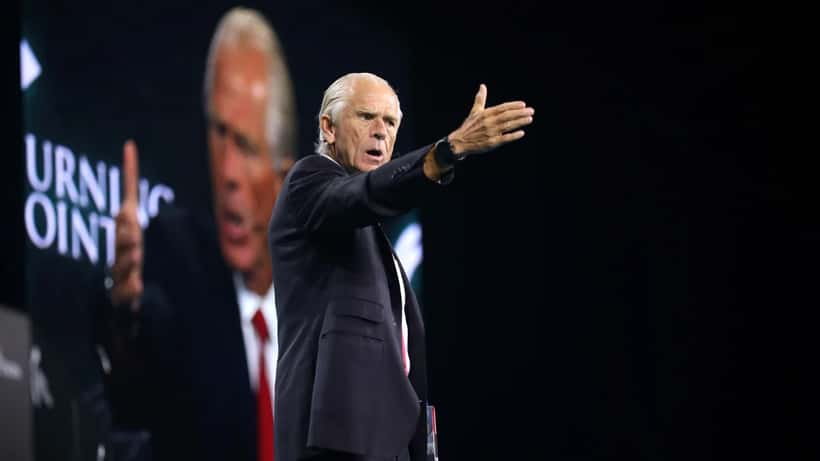
On September 29, 2026, U.S. trade adviser Peter Navarro told Canadian lobbyists operating on Washington's K Street to "get the hell out of our country" — and threatened that Canada would "pay even more dearly" if it interfered in upcoming U.S. midterm elections in border states like Maine and Michigan. The outburst, which drew laughter from Prime Minister Mark Carney, marks a sharp new escalation in the Canada-U.S. trade war that is now directly affecting hundreds of Canadian businesses and their legal exposure on both sides of the border.
The Trade War Reaches a New Flashpoint
The Navarro remarks came hours after a U.S. ban on nearly $1 billion worth of Canadian imports took effect on September 29, targeting alcohol, dairy, and motorcycles — retaliatory measures President Trump signed in response to Canada's own counter-tariffs following the collapse of bilateral trade talks in August 2026.
This is not Navarro's first confrontation with Canada. Earlier in 2026, he accused Canada of "negotiating in bad faith" after Ottawa walked away from a framework agreement. But telling foreign nationals on U.S. soil to leave the country — and linking lobbying activity to electoral interference — crossed a line that legal experts say Canadian businesses cannot afford to ignore.
According to data cited by CBC News, Canadian companies spent an estimated CAD $85 million on U.S. government relations in 2025. That spending is now under a direct political spotlight, raising questions that go far beyond trade policy: what are the legal rights of Canadians lobbying in the United States, what activities constitute "interference," and what exposure do Canadian firms now face if they continue operations in Washington?
The Legal Landscape: What Navarro's Warning Actually Means
Navarro's comments are politically charged, but they are not without legal teeth — and that distinction matters enormously for Canadian organizations active in the U.S. capital.
Under the U.S. Lobbying Disclosure Act (LDA), foreign nationals may legally lobby Congress and federal agencies provided they register with the relevant authorities. However, activities that cross into attempting to influence U.S. elections — or that are perceived as coordinating with foreign governments — fall under the Foreign Agents Registration Act (FARA), a much more demanding and punitive regime.
FARA violations carry criminal penalties of up to five years in prison and substantial fines. The Department of Justice has aggressively pursued FARA enforcement since 2017. Navarro's specific framing — linking lobbying in Maine and Michigan to election interference — suggests the Trump administration may seek to reframe trade advocacy as foreign political activity, which would trigger FARA scrutiny.
For Canadian companies, the practical implication is this: activities that were entirely legal and routine six months ago may now be politically weaponized in ways that require immediate legal review. Retaining a U.S. trade attorney and a FARA compliance specialist is no longer optional risk management — it is urgent business continuity planning.
Back in Canada, the parallel legal risks are equally significant. Ottawa's own counter-tariffs and the collapse of the August trade talks mean that Canadian businesses operating under long-term contracts with American suppliers or clients may be in breach of force majeure clauses, or may have legitimate claims of their own. Whether those claims can be effectively pursued depends heavily on how supply contracts were drafted — and whether they contain the specific language courts now require to invoke tariff-related disruption as an excusing condition.
When It Hits Your Contract: A Concrete Scenario
Consider a mid-sized Canadian distillery that signed a three-year distribution agreement with a U.S. partner in January 2025, before the tariff escalation reached its current intensity. Under that contract, the Canadian company is required to deliver 50,000 cases of premium spirits per quarter at a fixed price per case denominated in U.S. dollars.
As of September 29, 2026, that product category now faces a U.S. import ban that is part of the $1 billion retaliatory measure. The distillery cannot legally ship to the U.S. under the existing agreement. The question is whether the contract's force majeure clause — if it has one — is broad enough to cover a government-imposed trade ban.
Here is the if/then logic that a legal adviser would walk through:
If the contract contains a force majeure clause that specifically names government action, trade embargo, or import prohibition as qualifying events, then the Canadian distillery can likely suspend performance without incurring breach-of-contract liability, preserving its relationship with the U.S. partner and avoiding the approximately CAD $2.4 million in potential damages per quarter (50,000 cases × estimated contract value per case).
If the clause is generic — covering only acts of God, natural disasters, or similar events — then the distillery may not be protected, and could face a lawsuit from the U.S. partner for non-performance, even though the non-performance was forced by a government action entirely outside the Canadian company's control.
If there is no force majeure clause at all, which is more common than most business owners realize in contracts drafted before 2020, then the full breach-of-contract exposure applies, and the only legal pathway is to negotiate an amendment — quickly, before a formal notice of default is issued.
A fourth variable: if the distillery attempted to substitute delivery via a third country to circumvent the ban, it could face additional liability under U.S. customs law. This is precisely the kind of layered risk analysis that requires expert legal guidance, not a business decision made under time pressure.
The same framework applies to Canadian software firms with U.S. government contracts, dairy producers, motorcycle parts suppliers, and any other business in the affected categories — the numbers change, but the legal logic is identical.
What Canadian Businesses Should Do Right Now
The Navarro escalation is not just rhetoric. The September 29 import ban is real, its legal consequences are immediate, and the threat of expanded measures — including potential FARA enforcement against Canadian lobbyists — is being made explicitly by senior White House officials.
Canadian businesses with U.S. exposure should take four concrete steps now.
Review every active U.S. contract for force majeure language and confirm whether current trade bans qualify as triggering events under the specific wording used.
Audit your U.S. advocacy activities — if your company employs a Washington government relations firm, consult legal counsel about whether those activities require FARA registration under the current political climate, even if LDA registration was previously sufficient.
Document all tariff-related losses meticulously, including the September 29 ban, as this evidence will be essential if Canada pursues dispute resolution under the Canada-United States-Mexico Agreement (CUSMA) or if bilateral negotiations resume.
Consult a trade lawyer before modifying contracts or entering new supply arrangements with U.S. counterparties. Improvised workarounds — such as rerouting shipments or restructuring through subsidiaries — may create new legal risk rather than reducing it.
The Canada-U.S. trade relationship has been tested before, but the combination of import bans, explicit threats against lobbyists, and the looming midterm election cycle creates a legal environment that changes week by week. Expert guidance is not a luxury in this environment — it is the difference between protecting your business and discovering too late that a standard contract failed to account for the trade war Canada is now living through.
For Canadian businesses navigating these issues, the Expert Zoom guide on retaliatory tariffs and legal rights in supply contracts provides a useful starting point for understanding the legal framework. Connecting with a qualified trade law specialist or commercial contracts expert can provide access to advisers who understand both the Canadian and U.S. legal dimensions of the current dispute.
The U.S. Department of Justice maintains official FARA guidance and registration resources — Canadian organizations with Washington-based advocacy activities should review this material before their next engagement.
Legal disclaimer: This article provides general information about legal and trade issues affecting Canadian businesses. It does not constitute legal advice. Businesses facing specific contractual or compliance questions should consult a qualified legal professional.
