 Willow Bergeron
A video filmed at Céline Dion's sold-out Paris concert on October 10, 2026 became an unexpected viral moment in Quebec — and the subject is none other than former 98.5 FM morning host Paul Arcand. Seated calmly while fans around him sang and swayed, Arcand's composed reaction lit up social media within hours. More than 500,000 views later, a simple question is spreading across Canadian social feeds: what happens when a video of you — filmed in a public venue by a stranger — suddenly reaches hundreds of thousands of people online?
What happened at the Paris concert
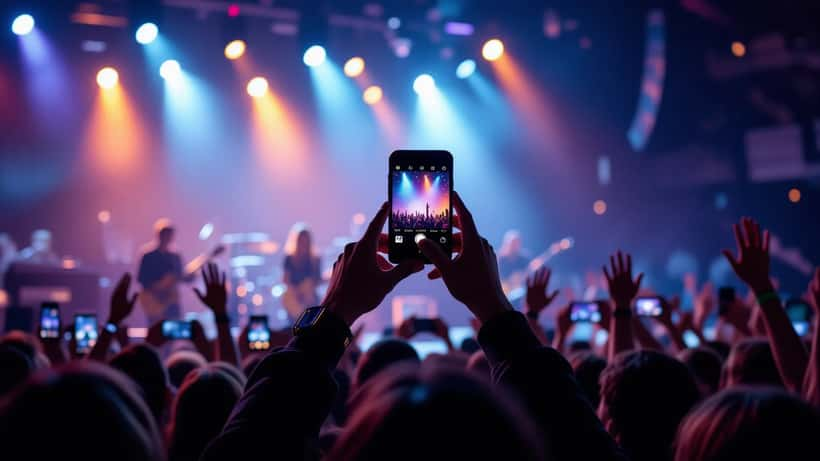
The clip, first shared on the evening of October 11, 2026, shows Arcand seated in a premium section of the venue, visibly enjoying the show in his own understated way while concertgoers around him stood and belted out the lyrics to "My Heart Will Go On." The contrast between his stillness and the surrounding collective excitement went viral almost instantly, generating tens of thousands of comments across TikTok and Instagram.
Arcand, who left his daily morning radio show on 98.5 FM in June 2024 after 34 years behind the microphone, is now developing documentary projects — including a series on men's anger planned for Télé-Québec in winter 2027. The viral moment has made him the subject of a new kind of public attention: not as journalist, but as subject.
The question Canadians are actually asking
The Arcand clip raises a question that matters well beyond celebrity: Can someone film me at a public event — a concert, a sports game, a festival — and post the video online without my permission?
The short answer, in most cases, is yes. But the full legal picture is more nuanced, and there are situations where sharing a video of someone filmed in public can trigger real legal consequences under Canadian law.
Here is how the framework actually works.
What Canadian law says about filming in public spaces
Canada does not have a single federal statute that governs filming people in public places. Three overlapping legal frameworks create real — if uneven — protections depending on your province.
Quebec's distinct framework (Civil Code of Québec, art. 35–36)
Quebec offers the strongest privacy protections in Canada. Article 35 of the Civil Code affirms that every person has a right to the respect of their private life, and this extends in some circumstances to public settings where a person has a reasonable expectation of privacy. Sharing an image of someone in a way that holds them up to ridicule or damages their reputation can constitute an invasion of privacy under Quebec civil law, regardless of where the footage was filmed.
Federal framework: PIPEDA
Canada's Personal Information Protection and Electronic Documents Act (PIPEDA) governs how organizations collect, use, and disclose personal information — including video and images. If a content creator or media outlet shares a video commercially, or builds a following from it, they may be subject to PIPEDA obligations. The Office of the Privacy Commissioner of Canada has clarified that identifiable images constitute personal information under this framework.
Provincial tort law: "intrusion upon seclusion"
Ontario's Court of Appeal recognized the tort of intrusion upon seclusion in Jones v. Tsige (2012), and several provinces have followed. Courts have increasingly been asked to apply similar reasoning to viral video sharing — where the manner of distribution, rather than the location of filming, constitutes the privacy violation.
According to the Office of the Privacy Commissioner of Canada, complaints related to video and image-based privacy violations rose by approximately 34% between 2022 and 2025, as smartphone video sharing at live events has become routine.
What about filming inside a concert hall?
Venues like those hosting Céline Dion's tour typically include terms in their ticket agreements that restrict commercial filming. But this governs the relationship between the audience member and the venue — not between two audience members. If you film a fellow concertgoer and post the video online, you are generally not breaching the venue's terms; the question is whether your sharing constitutes a privacy violation toward that person under applicable law.
Key factors that courts and the Privacy Commissioner weigh when assessing viral video complaints include: whether the person is identifiable; whether the context is capable of causing embarrassment, reputational harm, or distress; whether the video was monetized; and the total reach of the distribution.
Paul Arcand, as a public figure with decades in broadcasting, has significantly reduced privacy expectations in public settings — and his reaction to the clip has been good-humoured. For private individuals, the calculus is very different.
What if the person in the video is you?
Consider this scenario: You attend a sold-out concert at Scotiabank Arena in Toronto on October 25, 2026. A stranger two rows behind films you for approximately 90 seconds. In the clip, you are visibly emotional — singing with tears running down your face. They post it to TikTok with a mocking caption. Within 48 hours, the video reaches 800,000 views. Your employer sees it. Your adult children see it.
If you do nothing, the video likely stays online indefinitely. TikTok's community guidelines permit removal requests only for content that violates specific policies. A merely embarrassing clip — one that does not involve nudity or threats — may not qualify for platform removal. Within 30 days it is typically reposted to secondary accounts, making takedown exponentially harder.
If you consult a lawyer within the first 72 hours, your options include:
- A complaint to the Office of the Privacy Commissioner of Canada under PIPEDA — free to file, but slow, with average resolution taking 9 to 18 months
- In Ontario, a formal cease-and-desist letter under the tort of intrusion upon seclusion — statutory damages for privacy violations under the province's Intimate Images Protection Act range from $1,000 to $20,000, with analogous reasoning being extended by courts to deeply embarrassing non-intimate video
- In Quebec, an injonction provisoire (emergency injunction) under Civil Code art. 35–36, which can result in a court-ordered takedown within days — legal fees for an initial application of this kind typically run $1,500 to $3,500
If the video was shared commercially — for example, a content creator with 250,000 followers built a brand partnership around the clip — you may have a claim to compensation under an unjust enrichment argument. Documented Canadian cases have resulted in awards ranging from $2,500 to $18,000 depending on the reach and duration of commercial use.
The practical difference between acting immediately and waiting three months is, in most provinces, the difference between a viable legal claim and one that is substantially harder to pursue. Evidence — screenshots, posting timestamps, monetization data — becomes harder to preserve the longer you wait.
What to do if a video of you goes viral
Document immediately. Take screenshots of the original post, the view count, any comments, and the poster's profile — with timestamps. This evidence can be critical in any subsequent complaint or legal proceeding.
Use platform reporting tools. Most major platforms have privacy violation reporting workflows. Results vary significantly by platform, but filing a report creates a documented record and sometimes produces faster takedowns than legal action.
Consult a privacy or civil litigation lawyer within 72 hours if the video is causing you distress, embarrassment, or reputational harm. Many lawyers in this area offer free initial consultations.
Contact the Office of the Privacy Commissioner of Canada to file a formal complaint, particularly if a commercial entity is involved in the sharing.
If you are in Quebec, act within days. Emergency injunctive relief under the Civil Code requires urgency to be demonstrated — delays undermine that argument.
The Paul Arcand clip is a lighthearted moment, and the man himself seems entirely at ease with his unexpected second wave of fame. But for private Canadians filmed at concerts, sporting events, or public spaces every week, the legal landscape is genuinely uncertain, and the consequences of viral exposure can be serious. Speaking with a qualified lawyer before your situation moves from uncomfortable to irreversible is the clearest first step.
Disclaimer: This article provides general information about Canadian privacy law and is not legal advice. For guidance specific to your situation, consult a qualified lawyer.
