 Olivia Dubois
Pakistan's T20I series against Sri Lanka launched this evening in Rawalpindi — and for millions of South Asian Canadians glued to their screens, the sight of elite cricketers in action triggers a familiar itch: to dust off their kit bag and get back on the pitch. What many don't realise is that the weekend-warrior cricket boom quietly unfolding in parks and cricket clubs from Brampton to Surrey is also generating a wave of preventable injuries — and the window to act before those injuries happen is right now.
Why October Is a High-Risk Month for Recreational Cricket in Canada
The Pakistan–Sri Lanka T20I series (October 9, 11, and 13, 2026, at Rawalpindi Cricket Stadium) represents the start of a packed cricket calendar that runs through a two-Test series in November. For fans in Canada, that means weeks of live matches, social media highlights, and friendly conversations that end in someone texting the local cricket club WhatsApp group: "Anyone up for a net session this weekend?"
That impulse is healthy and understandable. Canada's South Asian diaspora — which exceeds 1.8 million people according to Statistics Canada's most recent community profile — has propelled recreational cricket from a niche pastime to one of the country's fastest-growing participant sports. Cricket Canada reports more than 45,000 registered players, with estimates of informal participants running three to four times higher.
The problem? A significant share of those informal participants are men in their late thirties to mid-fifties who spend the workweek at a desk and the weekend suddenly bowling off-spin for two hours. Returning to play without medical clearance — or after a long off-season break — is precisely when rotator-cuff tears, lumbar stress fractures, and hamstring strains occur.
The Injuries Elite Players Are Managing — And What That Means for You
Sri Lanka's squad that arrived in Islamabad ahead of this series was not at full strength. Multiple pace bowlers had to be managed carefully through the T20I leg before the more gruelling ODI tri-series and Test matches ahead. That careful load management by professional physios reflects what sports medicine literature has known for years: cricket is a sport where cumulative stress, not a single dramatic collision, causes most serious injuries.
A 2026 clinical review published in the Journal of Applied Sport Science and Medicine catalogued the most frequent cricket injuries among recreational and elite players:
- Rotator-cuff impingement and tears — the leading upper-body injury for fielders and throwing players over age 35
- Hamstring strains — especially in fast bowlers and batters who sprint between wickets after prolonged periods of inactivity
- Lumbar stress fractures — concentrated among bowlers who have not maintained core-conditioning routines during an off-season
- Finger fractures — disproportionately affecting wicketkeepers and close-in fielders
The review noted that recreational players face higher proportional injury risk than professionals in two specific situations: returning to play after breaks longer than eight weeks, and playing multiple matches in rapid succession without structured warm-up protocols.
What Canadian Sports Medicine Actually Covers — and What It Doesn't
For Canadian residents, the healthcare pathway after a cricket injury depends heavily on province. In Ontario, British Columbia, and Alberta — where the vast majority of Canada's South Asian diaspora lives — provincial health insurance plans (OHIP, BC MSP, AHCIP) cover physician visits for acute injuries such as fractures and significant ligament tears. They do not routinely cover:
- Physiotherapy sessions beyond initial triage (unless covered by an employer group plan)
- Sports medicine physician consultations at dedicated clinics, which typically run $150–$300 per session without referral
- Diagnostic imaging (MRI, ultrasound) for soft-tissue injuries, which in Ontario can carry wait times of 6 to 18 weeks through the public system
The gap matters: a rotator-cuff impingement caught early can often be resolved with 8–12 physiotherapy sessions costing $1,200–$1,800 out of pocket. Left unmanaged, the same injury may progress to a partial tear requiring surgical intervention at $8,000–$15,000 (if treated privately) or a 12–24 month public wait list.
According to the Canadian Institute for Health Information (CIHI), musculoskeletal injuries represent one of the most common categories of ambulatory care visits in Canada, accounting for more than $24 billion in direct healthcare costs annually. A disproportionate share of sports-related musculoskeletal admissions involves men aged 35–54 — precisely the recreational cricket demographic.
When to See a Sports Medicine Professional Before You Play
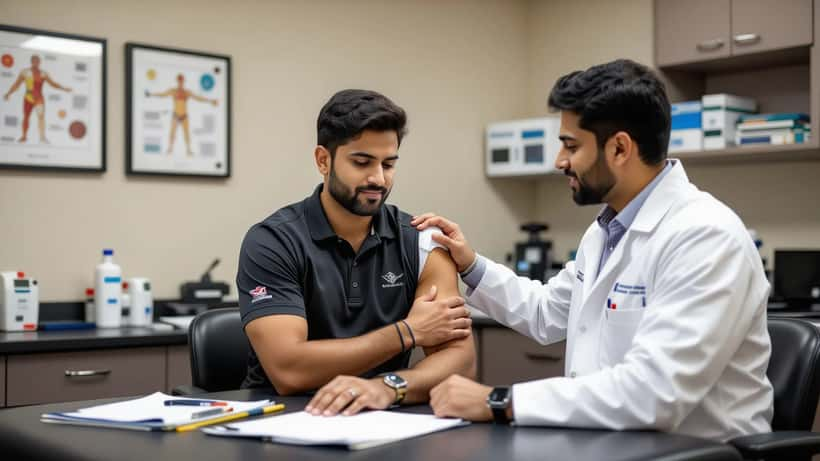
A sports medicine physician or certified physiotherapist can offer a pre-participation physical evaluation (PPE) — a structured assessment that identifies structural weaknesses before they become injuries. For cricket specifically, a PPE typically reviews:
- Shoulder range of motion and rotator-cuff strength — checking for impingement signs that indicate reduced throwing capacity
- Hamstring flexibility and asymmetry — significant bilateral differences correlate with a two-to-three times higher hamstring strain risk
- Lumbar mobility and core stability — especially relevant for bowlers who have not trained during the off-season
- Cardiovascular readiness — a cricket match involves repeated short sprints and static standing; cardiovascular screening is recommended for men over 40 returning to sport after a break
A PPE session at a sports medicine clinic runs approximately $120–$200 in Ontario and BC. It is not covered by provincial health insurance but is eligible for claims under most employer wellness and health spending accounts (HSAs). Many workplaces now include sport and recreation-related medical assessments in their taxable benefits packages, and the out-of-pocket cost may be partially offset through these channels.
The Concrete Case: Sunil's Shoulder, and What It Cost Him
Consider a scenario that plays out every October in the Greater Toronto Area. Sunil, a 44-year-old software engineer in Mississauga, watches the PAK vs SL first T20I on October 9. Inspired, he agrees to play a two-day cricket tournament for his community team on October 18–19 — the same weekend the ODI tri-series begins.
Sunil played club cricket in his twenties but hasn't picked up a ball since spring 2024. He spends roughly nine hours a day at a desk. His right shoulder has been intermittently stiff for six months but never acutely painful.
If Sunil skips a pre-participation assessment and fields for two full days without preparation:
- He has a rotator-cuff impingement that goes undetected
- On day two, an awkward overarm throw tears the supraspinatus tendon partially
- Cost: $2,200 in immediate physiotherapy plus a 9-month OHIP wait for MRI, followed by likely 6–12 additional physiotherapy sessions ($900–$1,800) — total out-of-pocket exposure: $3,100–$4,000, plus 8–12 weeks off work if his job requires keyboard use in a restricted range of motion
If Sunil books a $175 pre-participation evaluation at a sports medicine clinic before October 18:
- The impingement is identified
- He is given a 10-day shoulder-loading protocol and a modified fielding restriction for the tournament
- He plays safely, with monitoring
- Cost: $175 plus $320 in three physiotherapy sessions to address the impingement before it escalates
The if/then is blunt: a $175 investment either prevents a $4,000 outcome, or at minimum gives Sunil informed consent over the risk he's taking.
What You Should Do This Week
If you plan to play cricket before the end of October — whether a tournament, a net session, or a full match — and you have not played competitively in the past eight weeks, consider these steps:
- Book a physiotherapy assessment at a local sports medicine clinic or physiotherapy centre. Most GTA, Metro Vancouver, and Calgary South Asian community health networks can provide referrals. In Ontario, you do not need a physician referral to see a registered physiotherapist.
- Check your employer benefits plan — most group plans include $500–$1,000 in annual physiotherapy coverage, often untouched by October.
- Review your provincial health coverage limits — the CIHI's provincial comparison tool at cihi.ca provides an overview of what musculoskeletal services your province covers.
- Do not rely on anti-inflammatory medication as a substitute for assessment. NSAIDs manage pain but do not address underlying structural vulnerability.
If you do sustain an acute injury during play — sharp pain, inability to bear weight, a "pop" sensation — visit an emergency department or urgent care clinic immediately. For non-acute injuries that limit normal range of motion for more than 72 hours, a primary care physician or physiotherapist referral within one week is the recommended standard of care according to the Canadian Academy of Sport and Exercise Medicine.
The PAK vs SL series will deliver three weeks of elite cricket. Make sure your own cricket season lasts longer than one weekend.
This article provides general health information for educational purposes only. It is not a substitute for professional medical advice. Consult a qualified sports medicine physician or physiotherapist for personal health concerns.
