 Hannah Foster
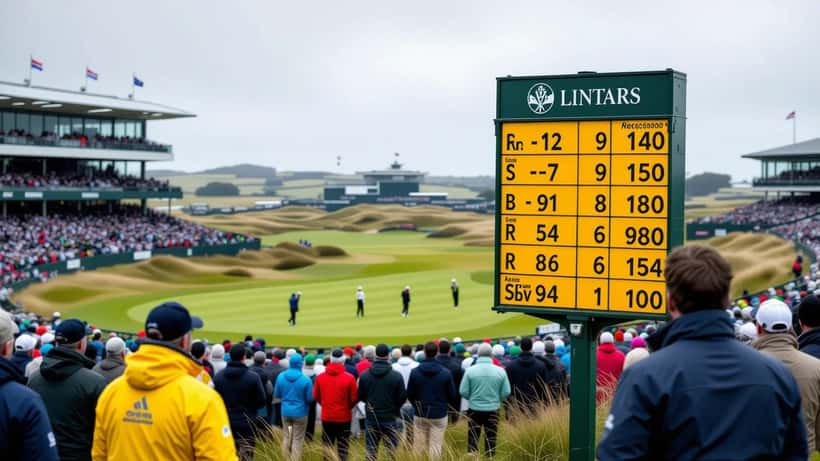
The Open Championship returned to Royal Birkdale this week, and millions of Canadians refreshing the leaderboard on July 19, 2026, saw a column of numbers that looked more like a math quiz than a sports result: -12, -9, E, +3. Those figures are not random. They are a live lesson in relative scoring, one of the most practical arithmetic concepts a student can learn, and this week's championship turns golf's oldest major into a ready-made homework problem for any young learner who loves the game.
The Open, first played in 1860, is the oldest of professional golf's four majors and is run by The R&A, the sport's governing body. Unlike a race timed by the clock, golf is scored in strokes, and the leaderboard reports each player's total relative to par rather than a raw count. Understanding how "-12" is calculated — and why a two-shot lead is safer on Sunday than on Thursday — is exactly the kind of reasoning that shows up in Canadian grade-school and high-school math.
How a golf leaderboard actually works
Every hole on a championship course is assigned a par: the number of strokes an expert player is expected to need. Add the pars for all 18 holes and you get the course par, which at a links course like Royal Birkdale sits around 70 or 71 for a single round. Over four rounds, the tournament par is roughly 280.
A leaderboard does not show a player's total strokes. It shows the difference between the strokes they have actually taken and the par for the holes they have completed. A player who is "-12" has used 12 fewer strokes than par across the holes played so far. "E" means even — exactly at par. "+3" means three strokes worse than par.
This is a straightforward subtraction problem, but it hides two ideas that trip students up. First, the total is cumulative: it grows and shrinks over four days, not one. Second, on the leaderboard, a lower number is better — the opposite of most scoreboards a child has seen in hockey or basketball. Reversing that intuition is a genuine cognitive step, and it is where a tutor can help.
Turn the leaderboard into a homework problem
Parents looking for a way to make math feel urgent can build a lesson straight from this week's coverage. Suppose a player stands at -9 after 14 holes of the final round. The remaining four holes have pars of 4, 3, 5 and 4. If she scores 3, 3, 4 and 4, how does her total change?
Work it hole by hole: a 3 on a par-4 is one under (now -10), a 3 on a par-3 is even (-10 holds), a 4 on a par-5 is one under (-11), and a 4 on a par-4 is even (-11 holds). The player finishes at -11. Students practise addition and subtraction with negative numbers, a topic that formally appears in the Ontario and British Columbia curricula around Grade 7, without ever opening a textbook.
More advanced learners can move from arithmetic to probability. If a golfer leads by two strokes with three holes to play, what is the chance the lead survives? That question introduces the idea of independent events, expected values and simple simulations — the foundation of the statistics unit many Canadian students meet in Grade 11 and 12.
Why relative scoring matters beyond golf
The skill on display this week is not really about golf. Relative scoring — measuring a result against an expected baseline — is everywhere. A budget reports spending relative to a plan. A weather forecast describes temperatures relative to a seasonal average. A report card can be read as marks relative to a class median. A student who can comfortably move between "12 strokes fewer than par" and "-12" is practising the same mental flexibility that later makes algebra, personal finance and data literacy feel natural.
That is why a leaderboard is such a useful teaching tool: it is authentic, it updates in real time, and it rewards the learner with the immediate satisfaction of following a real event. Motivation is often the hardest part of a math lesson, and a live major solves it for free.
When to bring in a private tutor
Not every child clicks with negative numbers, and pushing too hard during a fun weekend can backfire. A qualified private tutor can help in the situations parents tend to recognize: a student who consistently reverses the sign, one who can add strokes but cannot explain why a lower score wins, or an older learner who needs the probability leap for an upcoming statistics exam.
A tutor's value here is diagnostic. Rather than re-teaching the whole unit, an experienced educator identifies the single misconception — often the reversed scoreboard intuition or a shaky grasp of negative integers — and targets it directly. On Expert Zoom, families across Canada can connect with vetted homework-help tutors who specialize in the exact grade level and topic their child is working through, from primary arithmetic to senior-year statistics.
The World Handicap System, administered by golf's governing bodies including The R&A, takes this same relative-scoring logic even further, adjusting a player's results against course difficulty so golfers of different abilities can compete fairly. It is a real-world example of the weighted averages students meet later in school.
A weekend worth learning from
As the final putts drop at Royal Birkdale, the leaderboard will keep telling its arithmetic story. For a curious student, the numbers scrolling across the screen are not just a sports result — they are subtraction, negative integers and probability, dressed up in the drama of a major championship. Parents who seize the moment can turn a Sunday afternoon of golf into a lesson that sticks long after the trophy is lifted, and a good tutor can make sure the concepts hold up when the exam, rather than the tournament, is on the line.
