 Michael Young
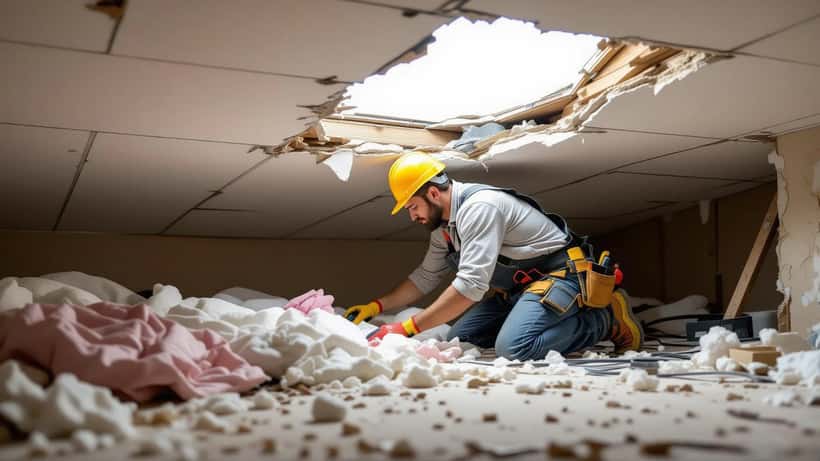
A space rock the size of a heavy carry-on bag punched a hole straight through the roof and master-bedroom ceiling of a home in Hillsborough, New Jersey — and on July 15, 2026, scientists confirmed the fragments contain "extraterrestrial" amino acids, the building blocks of life. The impact, which followed a daytime fireball seen across New York, New Jersey and Connecticut, left the homeowners unhurt but staring at a jagged hole in their bedroom. For most Canadians, a meteorite crashing through the roof is a one-in-a-billion event. A tree limb, a chunk of roof ice, or wind-blown debris going through your ceiling is far more likely — and the emergency response is almost identical.
Here is what a home-improvement or structural repair specialist would tell you to do the moment something breaches your roof.
What actually happened in New Jersey
According to CNN and Sky & Telescope, the object entered the atmosphere on July 16, 2024, traveling at roughly 32,000 miles per hour before breaking apart about 22 miles above the ground. One surviving fragment tore through the ceiling of a master bedroom. The homeowners, who were not injured, put on disposable gloves and carefully collected the black fragments and dust using aluminum foil and glass jars — an instinct that, as it turned out, helped preserve a scientifically priceless sample.
Analysis published in mid-July 2026 identified it as a CM-type carbonaceous chondrite, only the second such meteorite ever witnessed falling to Earth and the first studied in a pristine state, according to phys.org. The story trended again this week as researchers detailed the complex organic compounds inside.
The headline is astronomical. The homeowner's problem, though, was purely structural: a compromised roof and an open ceiling.
First 24 hours: safety before repair
When any object breaches your roof, treat the affected room as unsafe until it is assessed. A puncture can weaken rafters, sever wiring, or destabilize insulation and drywall that may fall without warning.
- Get everyone out of the room and shut the door. Do not stand directly under the damaged ceiling.
- Cut power to the area at the breaker if wiring may be exposed or wet. Water from a compromised roof plus live wiring is a serious hazard.
- Photograph everything before you touch it — the exterior roof, the attic, the ceiling and any debris. These images matter for both repairs and any insurance claim.
- Do not climb onto a damaged roof yourself. Structural integrity is unknown, and a second impact point may not be visible from below.
Falling debris can carry sharp fragments, insulation fibres and, in the New Jersey case, unknown dust — which is exactly why those homeowners reached for gloves. Wear gloves and a mask if you must handle anything.
Temporary weatherproofing that prevents worse damage
The biggest secondary threat after a roof breach is water. A single overnight rainstorm through an open hole can soak insulation, warp framing and trigger mould inside the wall cavity within days.
If the weather is turning, a professional will "dry in" the opening with a reinforced tarp anchored well beyond the damaged area and battened down so wind cannot lift it. This is temporary triage, not a repair. Attempting a permanent patch before the structure is inspected can hide damage that resurfaces months later as a sagging ceiling or a persistent leak.
For a sense of how quickly seasonal roof stress adds up in Canada, our coverage of spring snow-load and melt damage to Canadian homes shows the same principle: what starts as a small breach becomes an expensive structural problem when moisture gets in.
Why a professional structural assessment matters
A hole in drywall looks like a drywall job. It rarely is. The forces involved in an impact — whether a meteorite fragment, a falling branch or a dislodged HVAC unit — travel through the roof deck into the trusses or rafters that hold the whole assembly up.
A qualified contractor or structural engineer will check:
- Rafters and trusses for cracks, splits or shifted connections around the impact zone.
- The roof deck and sheathing for hidden delamination beyond the visible hole.
- Insulation and vapour barrier, which must be replaced if wet to prevent mould and heat loss.
- Electrical and plumbing runs in the ceiling and attic that may have been nicked.
Canada Mortgage and Housing Corporation advises homeowners to inspect roofs regularly and to investigate any sagging or structural signs from inside the attic, not just from the ground — official guidance is available through CMHC's home-ownership resources. After an impact, that inspection should be done by someone qualified before repairs begin.
The insurance and documentation angle
Most Canadian home insurance policies treat "falling objects" as a covered peril, which typically includes debris and, yes, meteorites. But claims hinge on documentation. Before anyone patches anything:
- Keep your dated impact photos and any recovered debris.
- Get a written scope of work from a licensed contractor, not just a verbal quote.
- Ask the contractor to note structural findings explicitly — insurers pay for what is documented, not for what was quietly fixed.
An experienced renovation professional will frame the repair estimate in the language an adjuster needs, which often makes the difference between a partial and a full settlement.
What to take away
The New Jersey meteorite is a reminder that roofs fail from the top down, and usually with no warning. The odds of a space rock hitting your home are effectively zero — but ice dams, storm debris and aging shingles put Canadian roofs under real pressure every year. The response that protected those homeowners applies to all of it: clear the room, kill the power, document the damage, dry it in, and bring in a qualified professional before you reach for the drywall compound.
If something has come through your roof — from the sky or from the tree next door — a home-improvement or structural specialist can assess the hidden damage, weatherproof the opening correctly, and give you the paperwork your insurer will ask for. It is the one repair where guessing costs far more than getting expert eyes on it first.
This article is general information, not structural engineering or insurance advice. Have impact damage assessed by a qualified professional and confirm coverage with your insurer.
