 Michael Young
Ontario's new carbon monoxide alarm law came into full effect in early 2026, and gas appliance inspections across the province have surged 40% — yet most Canadian homeowners still don't know the difference between having a CO alarm and having a safe gas system. With September marking the start of the heating season, that distinction matters more than ever.
Ontario Tightens CO Rules as Heating Season Begins
Under Ontario Regulation 87/25, every home with a gas furnace, water heater, gas fireplace, or attached garage must now have a working carbon monoxide detector on every floor — not just near the bedrooms, as the previous rule required. The change came into force in January 2026 and applies to all new construction and any resale transaction where a property transfer triggers a compliance check.
But inspectors and gas safety professionals are sounding a warning about a critical misunderstanding spreading among homeowners. A CO detector tells you when your gas appliance is already leaking dangerous fumes. It does not prevent the leak from happening in the first place.
"Alarms detect the problem, they don't prevent it," noted the technical advisory released by Gas Man Ottawa this spring, which flagged the 40% inspection surge in Q1 2026 as a positive trend — but called for more homeowners to act before problems develop rather than after an alarm triggers. The distinction between reactive and preventive safety is the heart of what the new provincial law cannot do on its own.
Why September Is the Most Critical Window for Gas Safety
September is the optimal month for furnace and gas appliance inspections across Canada. Technical Safety BC, the provincial regulator for British Columbia, recommends annual servicing of gas appliances before the winter heating season — guidance that aligns with both Health Canada's carbon monoxide prevention framework and Natural Resources Canada's household safety advisories.
The reasoning is mechanical and predictable: a furnace, water heater, or gas fireplace that sat dormant for four to six months accumulates dust, potential flue blockages, and small mechanical degradations that are invisible to an untrained eye. A combustion analysis — one key component of a professional inspection — can detect improperly burning flames that produce carbon monoxide at 30–50 parts per million (ppm) continuously. That level won't trigger an alarm (most Canadian Standards Association-certified CO detectors activate at 70 ppm sustained over four hours), but it's sufficient to cause recurring headaches, chronic fatigue, and dizziness over a full heating season — symptoms frequently misdiagnosed as seasonal illness.
With natural gas prices stabilized at approximately CAD $0.036 per kWh for household consumers as of September 2026, the majority of Canadian homes are expected to continue relying on gas systems as their primary heating source this winter rather than switching to supplementary electric heating. A properly inspected system also burns more efficiently, reducing monthly utility bills by an estimated 5–15% compared to an unmaintained unit.
What a Professional Gas Appliance Inspection Actually Covers
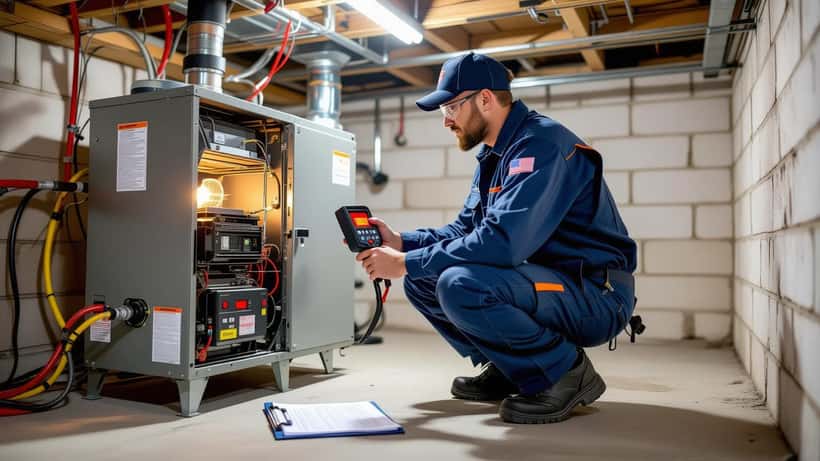
Many homeowners assume a furnace tune-up means a filter change and a brief visual walkthrough. A certified HVAC technician or gas fitter performs a substantially more detailed assessment:
Combustion analysis: Measures the gas-to-oxygen ratio in the burner flame, identifying incomplete combustion that produces CO even when the unit runs and sounds normal.
Heat exchanger inspection: Cracks in the heat exchanger are the most common source of indoor CO leaks in furnaces over 10 years old. The exchanger is the wall separating combustion gases from the air circulated into your living space — a hairline crack can go undetected for an entire heating season without a specialized inspection.
Gas pressure and valve testing: Confirms supply pressure matches manufacturer specifications. Deviations in either direction cause inefficient combustion or unexpected system shutoffs.
Flue and venting inspection: Examines the exhaust pathway for blockages, corrosion, or disconnected joints that allow combustion gases to re-enter the home. Blocked flues are the second most common cause of CO incidents in Canadian residences after heat exchanger failures.
CO alarm compliance verification: Under Ontario Regulation 87/25, a certified inspector can confirm your detectors meet the new multi-floor requirement and flag expired units — most CO sensors have a 7–10 year lifespan and will display no outward sign of failure after expiry.
For aging appliances, BCWide advises annual inspections starting from year five of operation, and inspections every six months from year ten onward.
If Your Furnace Is Over 10 Years Old: A Scenario Worth Knowing
Consider a homeowner in Hamilton, Ontario, with a gas furnace installed in 2014 — now 12 years old. In January 2026, the homeowner installed new CO alarms on every floor to comply with the provincial regulation. In April, they replaced the furnace filter. By their own assessment, the system is fully up to date.
Here is what that homeowner does not yet know: their CO alarm will activate at 70 ppm sustained over four hours. A cracked heat exchanger in a furnace of that age can leak CO at 30–50 ppm continuously — below alarm threshold, but enough to cause measurable health effects over a 20-week heating season.
The if/then calculation is concrete: A certified gas fitter inspection in Southern Ontario typically costs $120–$200. If the inspection reveals a cracked heat exchanger requiring replacement, the repair runs $600–$1,400 — but it is scheduled on the homeowner's timeline in September or October. If the same crack is discovered mid-January during a system failure, the same repair costs the same amount but comes with a 5–10 business day wait in peak season, with no heat in the interim.
If the inspection finds nothing wrong, the homeowner has confirmation that their 12-year-old furnace is safe to run for another heating season — and has documentation that can matter for home insurance purposes, since some Canadian insurers now ask about the maintenance history of gas appliances as part of claims assessment for CO-related incidents.
The pre-season inspection pays for itself in risk reduction alone, regardless of what is or isn't found.
What to Do Before October
The window to book an inspection without competing for appointments closes at the end of September. Certified technicians in major Canadian cities typically experience a 2–3 week backlog beginning in early October as heating systems begin failing.
Book a certified inspection now. Look for technicians licensed by the Technical Standards and Safety Authority (TSSA) in Ontario, Technical Safety BC in British Columbia, or the equivalent provincial regulator. Only licensed gas fitters can legally inspect and certify gas appliances in Canada — unlicensed "handyman" inspections are not compliant with provincial safety codes and do not satisfy homeowner insurance documentation requirements.
Verify CO alarm manufacture dates. Most CO detectors expire after 7 years; some models after 10. An expired alarm is non-compliant under Ontario's 2026 regulation even if it still appears to function. The expiry date is stamped on the back or bottom of the unit.
Clear access around the furnace. Boxes, seasonal storage, and cleaning products placed near a furnace over the summer create fire hazards and can obstruct airflow measurement during inspection. Inspectors require at least 60 cm of clearance around the unit.
Know your gas shutoff valve location. Every adult in your household should be able to locate and operate the main gas shutoff valve. Natural Resources Canada includes this as a basic household emergency preparedness step — relevant year-round, but especially important to refresh before the heating season begins.
Consider a broader home safety consultation. If you are planning any renovation this fall — insulation upgrades, basement finishing, or work near the utility room — a professional home improvement expert can identify whether your planned work intersects with gas lines, venting pathways, or combustion air intakes before you start. Renovation-related gas incidents in Canada frequently involve disrupted venting or blocked combustion air sources that were not recognized as part of the renovation scope. For expert guidance on severe weather preparedness and related home safety checks, see also what Canadian home safety experts recommend ahead of the winter season.
The 40% surge in Ontario gas appliance inspections in Q1 2026 reflects a shift in how Canadian homeowners are thinking about the new CO alarm law — not as a compliance checkbox, but as a prompt to examine the underlying systems. September is the month to act on that instinct, before the booking window closes and the heating season begins in earnest.
