 Eleanor Dubois
On June 30, 2026, a refrigerator-sized robotic spacecraft lifted off from Kwajalein Atoll in the Marshall Islands — its mission: catch a falling telescope before it burns up over Earth. NASA's $30 million contract with Arizona startup Katalyst Space Technologies marks the first attempt in history to robotically rescue an operational scientific satellite from orbital decay. For astronomy lovers, it is a triumph of engineering. For Canada's rapidly expanding space sector, it opens a legal frontier that few have mapped.
Why Swift Is Running Out of Time
NASA's Neil Gehrels Swift Observatory has been scanning the cosmos since November 2004. Designed to detect and quickly pivot toward gamma-ray bursts — the most powerful explosions in the universe — Swift has spent two decades generating irreplaceable data about exploding stars and neutron star mergers.
The problem: intense solar activity in recent years has accelerated the natural decay of Swift's orbit. As of June 2026, the telescope sits at roughly 224 miles (361 km) above Earth — far below its original operating altitude. Without intervention, Swift is projected to drop below 186 miles (300 km) by October 2026. At that point, atmospheric drag makes any rescue impossible, and deorbit would follow within months.
NASA's response was unprecedented: issue a $30 million contract to a private startup and ask it to build a rescue spacecraft from scratch in under two years.
The Robot Racing to Pull It Off
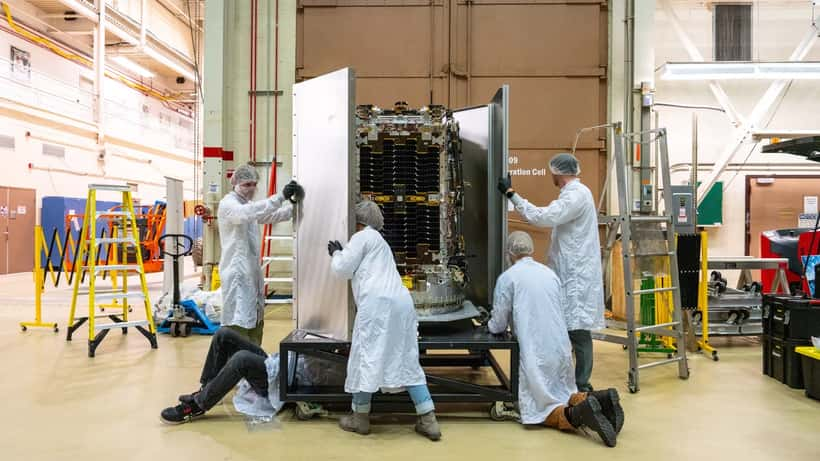
Katalyst's rescue vehicle, called LINK, is packed with serious technology despite its compact size. Equipped with three robotic arms, ion engines, and a suite of autonomous sensors, LINK launched aboard a Pegasus XL rocket — an air-launched vehicle released from a modified aircraft high above the Pacific Ocean. There is no ground-based launch pad; the rocket ignites in mid-air.
Once in orbit, LINK will spend roughly one month chasing down Swift, which travels at approximately 17,000 miles per hour in low Earth orbit. The autonomous docking — latching onto a spacecraft never designed to be captured — is the riskiest phase of the mission. If LINK successfully grasps Swift, it will spend another two to three months firing its ion engines to raise the telescope's altitude to 373 miles (600 km), safely above the decay zone. Swift could then continue science operations for another decade.
What makes this mission historically significant is the "unprepared" nature of the target. Unlike satellites built with future servicing in mind, Swift has no docking ports or capture hardware. Katalyst's robotic arms must grip the telescope's existing structure — a feat with no precedent in spaceflight history.
Canada's Stake in the New Space Economy
Canada is not a passive bystander in this commercial space shift. The Canadian Space Agency (CSA) has contributed to landmark missions including the James Webb Space Telescope's Fine Guidance Sensor, and Canada's robotic systems legacy — from Canadarm to Dextre on the International Space Station — has shaped how the world thinks about in-orbit servicing.
Canadian companies such as MDA Space and Telesat, alongside a growing cohort of startups, are actively building satellites, communications networks, and autonomous orbital systems. The Swift rescue signals a new commercial model: private firms taking on tasks previously reserved for government agencies. As that model expands, Canadian space companies will face contracts, partnerships, and liability questions that require legal expertise far beyond standard corporate law.
Who Owns a Rescued Satellite? What Space Law Says
Here is where the legal complexity begins. Unlike maritime law — where a ship salvor can claim a share of rescued cargo — space law operates under a fundamentally different framework.
The 1967 Outer Space Treaty states in Article VIII that a nation retains jurisdiction and control over objects it launches into space, regardless of where those objects are located. NASA owns Swift. Full stop. Katalyst is a contractor performing a service under a commercial agreement with a federal agency — not a salvor asserting a claim.
But as more private actors enter orbit, the legal questions multiply. What happens when a commercial company boosts a satellite owned by a foreign nation without explicit authorization? What liability does a servicing firm carry if its robotic arms damage the target spacecraft? What if the mission fails and the telescope deorbits sooner than projected?
According to the UN Office for Outer Space Affairs, the Outer Space Treaty has been ratified by 114 countries, including Canada. But its provisions were written in an era of government-only spaceflight. Much of what commercial startups are now doing exists in legal grey areas where contracts — not treaties — govern outcomes.
When to Seek Legal Expertise in the Space Sector
For Canadian entrepreneurs, investors, or established firms considering moves into commercial space, legal counsel is not optional. Key moments to seek expert advice include:
- Before signing contracts with American or international space agencies
- When negotiating intellectual property rights over autonomous systems or mission data
- If your satellite or launch vehicle causes damage — the Liability Convention of 1972 holds launching states financially responsible, which may include Canada if your company launches from Canadian territory or under Canadian registry
- When structuring commercial relationships involving data from government-owned observatories
- Before partnering with foreign startups on in-orbit servicing ventures
The Swift rescue is a reminder that space is no longer the exclusive domain of national agencies. As private capital and robotics transform what is possible in orbit, legal frameworks are struggling to keep pace. For Canadian companies, operating without expert guidance carries real financial and reputational risk.
Disclaimer: This article is for informational purposes only and does not constitute legal advice. Consult a qualified legal professional for guidance specific to your situation.
