 Ryan MacDonald
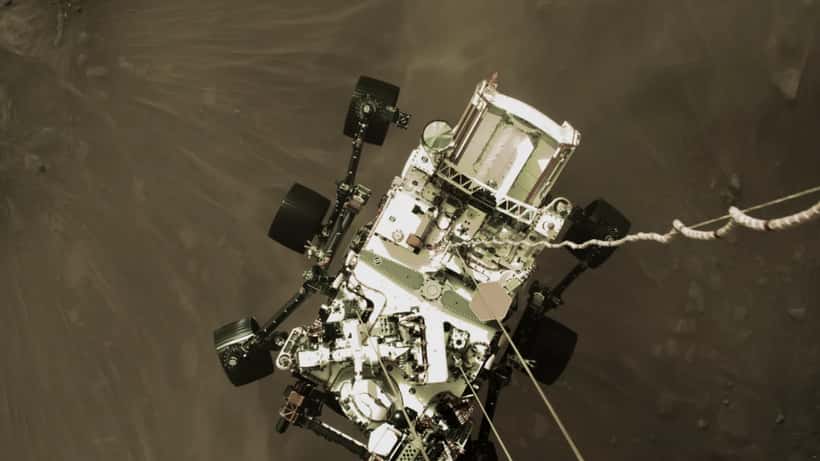
When Perseverance crossed the 42.195-kilometre mark on Mars in July 2026 — completing the equivalent of a full marathon across the Red Planet — it did so largely on its own. No human rover planner mapped its route that day. An artificial intelligence system, built on generative AI technology, had planned the drive, identified hazards, and navigated the terrain with minimal intervention from Earth. For Canadian IT professionals watching the space industry, the milestone is more than a feel-good story: it is a live demonstration of where autonomous AI systems are heading, and a signal that the skills, governance, and legal frameworks around AI-driven automation are becoming urgent professional territory.
What Actually Happened on Mars in 2026
NASA's Perseverance rover reached two major milestones this year. In July 2026, the rover completed the equivalent of a full marathon — 42.195 kilometres of driving across Jezero Crater, achieved over five years and four months and marking Sol 1,890 of its mission, according to NASA's Jet Propulsion Laboratory (JPL).
Earlier in the mission year, Perseverance also completed the first drives on another world that were planned by artificial intelligence. Executed on December 8 and 10, 2025, and reported publicly in early 2026, the demonstration used generative AI — specifically a system built on Anthropic's Claude AI — to create navigation waypoints for the rover. The AI identified hazards including sand traps, boulder fields, and rocky outcrops, then generated a safe path without human involvement in that planning step. On December 8, Perseverance drove 210 metres; two days later, it drove 246 metres. A digital twin verified more than 500,000 telemetry variables before NASA transmitted the commands across 200 million kilometres of space.
Meanwhile, NASA's Curiosity rover — now nearly 14 years into its mission — continues operating despite significant wheel wear visible in images captured on July 23, 2026 (Sol 4,963). Curiosity's longevity itself represents an engineering and operational achievement, sustained by iterative remote maintenance decisions made from Earth.
The Expert Angle: Why IT Professionals in Canada Should Care
The Mars missions are no longer purely a scientific story. They have become a proving ground for autonomous AI systems operating in extreme, high-stakes environments — and the lessons from orbit are arriving on Earth faster than most organizations realize.
"What NASA demonstrated with the AI-planned drives is a capability that has direct analogues in industrial automation, autonomous logistics, and infrastructure monitoring," says the kind of analysis increasingly sought from Canadian IT consultants. The core technology — generative AI that perceives an environment, localizes within it, and plans an optimal path — is architecturally similar to what underlies autonomous vehicles, warehouse robots, and predictive maintenance systems now being piloted across Canadian industries.
According to the Government of Canada's Digital Ambition framework, federal agencies are actively investing in AI-driven automation for public services, infrastructure management, and data analysis. The private sector is moving faster: logistics companies in Alberta, manufacturing firms in Ontario, and agricultural technology providers in Saskatchewan are all evaluating or deploying autonomous systems that raise the same governance questions NASA had to answer before trusting an AI to drive a rover on another planet.
Those questions include: Who is liable when an autonomous system makes a wrong decision? How do you validate an AI's outputs before acting on them (NASA's answer: 500,000 telemetry checks via a digital twin)? And how do you maintain human oversight without eliminating the efficiency gains that make automation worthwhile?
A Concrete Scenario: The Canadian Warehouse Operator
Consider a mid-sized Canadian logistics company — call them a third-party fulfilment provider operating a 50,000-square-foot distribution centre in the Greater Toronto Area. In early 2026, they implement an autonomous mobile robot (AMR) fleet to handle internal pick-and-pack operations. The AMRs use an AI path-planning system that promises to cut labour costs by 30% and reduce picking errors by 40%.
Three months in, a software update to the path-planning AI causes two AMRs to navigate toward the same narrow aisle simultaneously. The collision damages $18,000 worth of inventory and injures a warehouse associate, who is off work for six weeks.
If the company had engaged an IT consultant before deployment, the risk landscape would look very different:
- A proper AI governance audit would have identified the lack of collision arbitration logic in the updated model — the kind of validation NASA built into its 500,000-variable digital twin check.
- A change-management protocol would have required staged rollout of the update, tested in a simulation environment before live deployment.
- Clear liability documentation would have established whether the AMR vendor, the AI software provider, or the warehouse operator bears responsibility for the outcome — a question that Canadian courts have not yet fully resolved, but that contractual frameworks can address proactively.
The consultant's fee for a pre-deployment AI governance review in a scenario like this: approximately $8,000–$15,000. The cost of the incident described above: $18,000 in inventory, six weeks of lost productivity, a workers' compensation claim, and potential litigation. The arithmetic is straightforward — but only if someone raises the governance question before the first AMR ships.
What This Means for Canadian Businesses Adopting Autonomous AI
Three practical implications stand out for any Canadian organization evaluating AI-driven automation in 2026.
Validation architecture matters more than the AI itself. NASA's most important innovation wasn't the generative AI — it was the digital twin that verified 500,000 variables before acting. Canadian businesses deploying AI automation need equivalent validation layers: sandboxed testing environments, staged rollouts, and continuous anomaly monitoring. Skipping this step is the single most common cause of AI system failures in enterprise deployments.
The skills gap is real and widening. According to the Information and Communications Technology Council (ICTC), Canada faces a shortfall of more than 250,000 skilled technology workers by 2025, a gap that autonomous AI adoption makes more acute, not less. Organizations cannot simply purchase an AI system and assume their existing IT team can govern, maintain, and troubleshoot it. Many are discovering this only after incidents occur.
Regulatory clarity is still catching up. Canada's Bill C-27 (the Artificial Intelligence and Data Act, or AIDA) establishes a framework for "high-impact AI systems" — a category that autonomous path-planning systems in industrial settings could well fall under, depending on the risk assessment. IT professionals advising Canadian businesses need to understand both the current regulatory state and how pending legislation may change compliance requirements over the next 12 to 24 months.
What Should You Do Now?
If your organization is evaluating, deploying, or scaling autonomous AI systems — whether that's robotic process automation, AI-driven logistics, predictive maintenance, or any other form of machine decision-making — the time to engage an IT specialist with AI governance expertise is before the system goes live, not after the first incident.
A qualified IT consultant can help you design validation frameworks, assess vendor AI claims against your specific operational environment, structure liability language in technology contracts, and build the internal capacity to oversee AI systems sustainably. The Mars rovers are not running on hope and good intentions — they run on rigorous engineering, continuous monitoring, and human expertise guiding every step of the deployment. Canadian businesses deserve the same standard.
ExpertZoom connects you with vetted Canadian IT professionals who specialize in AI governance, autonomous systems, and technology strategy. Whether you're a small business exploring automation for the first time or a larger organization scaling an existing AI deployment, finding the right specialist can mean the difference between a transformation that works and one that costs far more than anticipated.
